
- Catalogs
- DOTT GALLINA
- General Catalogue Building

General Catalogue Building

General Catalogue Building
Dott. Gallina S.r.l., founded in 1960, initially specialized in automotive profiles and later expanded into thermoplastic materials for construction and industry. The company operates globally with production sites in Italy, Greece, Poland, the US, and India, employing around 170 people. Gallina is renowned for its polycarbonate products used in roofing and glazing, valued for their transparency and superior mechanical and thermal properties.
Gallina employs advanced extrusion processes to manufacture multi-wall and solid polycarbonate sheets. These sheets are co-extruded for UV protection, enhancing durability and delaying material aging. The production process is energy-efficient and environmentally friendly.
The company complies with ISO 9001, ISO 14001, and ISO TS 16949 standards, ensuring high-quality production and environmental management.
Polycarbonate is lightweight, impact-resistant, and offers excellent thermal insulation. It is used in construction for its transparency and cost-reduction benefits. The material is recyclable and provides good chemical resistance, though specific tests are recommended for aggressive chemicals.
Multiwall sheets offer varying light transmission, solar factors, and shading coefficients, depending on the pigments used. They provide effective thermal insulation and are suitable for translucent roofing and walls.
Gallina's modular systems include interlocking, connector, and overlapping systems, each designed for specific applications. These systems offer natural illumination, product reliability, and customizable light management through double-color extrusion technology.
The product range includes multiwall sheets, solid sheets, and modular systems, each with specific technical properties tailored to different construction needs. The products are designed to meet safety standards and provide energy savings.
Progetto Caleido focuses on innovative facade and covering solutions using modular panels with transparent or translucent colors. The use of double color technology allows for diverse applications on walls and coverings.
The Progetto Caleido line includes various modular systems, such as arcoPlus® panels and Policarb® multiwall sheets, which can be colored to manage light transmission and reduce internal heating.
Products are designed to absorb solar heat through IR absorbers, reducing internal heating and energy costs. They come with a 10-year warranty against degradation in light and solar transmission, yellowing, and hail damage.
IR line products block solar heat while allowing light, reducing internal heat transmission and cooling costs by up to 25%. The document provides a formula for calculating fuel savings based on thermal transmittance differences.
Guidelines include avoiding direct sunlight exposure during storage, using polycarbonate-compatible silicone for sealing, and allowing for thermal expansion during installation.
Includes interlocking, connector, overlapping, and opening systems, each designed for specific applications like roofing, translucent glazing, and vertical windows. Systems ensure weatherproof finishes and include necessary accessories for installation.
arcoPlus®324 and arcoPlus®625 are modular systems with coextruded polycarbonate panels, offering UV protection, light transmission, and heat insulation. They are not suitable for roofing applications.
Installation involves using aluminium profiles and vented aluminium breather tape for sealing. The document provides load resistance data and installation guidelines for various applications.
The panels are available in various thicknesses (40mm, 8-12mm) and structures (4, 7, and 9 walls). They offer thermal insulation ranging from 1.0 to 3.3 W/m2K and acoustic insulation up to 22 dB. The panels are UV protected and have a temperature range of -40°C to +120°C.
The panels feature a tongue and groove connection for easy installation without metal reinforcement frames, reducing thermal bridges. For installations over 2.2m, a section-breaker profile is required. The panels can be installed with or without eaves, and specific calculations for panel length adjustments are provided.
The document includes graphs showing maximum loads on two and more supports, emphasizing the importance of following the Technical Handbook Recommendations for installation to ensure load resistance.
A range of aluminum profiles and accessories are available, including base profiles, upper and side profiles, and brackets. These components are essential for ensuring proper ventilation, sealing, and structural integrity.
The systems are suitable for vertical windows, roofing, and translucent curtain walls. Key advantages include easy installation, light transmission, UV and hail resistance, and heat insulation.
The document describes different modular systems like arcoPlus®547, arcoPlus®549, Velario®613, and Velario®20-5, each with specific applications and technical features.
The document describes modular polycarbonate panel systems used for roofing and curtain walls. These panels are available in thicknesses of 8-12mm and are UV protected on both sides. They are anchored to existing structures using specific brackets and can be joined using polycarbonate or aluminum cover plates for a watertight seal.
Installation involves anchoring the panels to the supporting structure with aluminum brackets. The panels can be used for flat or curved roofing, with specific requirements for snow and wind load resistance. Self-drilling screws or tap bolts are used for fastening, depending on the structure material.
The panels are designed to meet load resistance standards and are easy to install. They offer thermal insulation of 1.7 W/m2K, acoustic insulation of 20 dB, and are resistant to UV rays and hail. The panels are self-supporting and suitable for temperatures ranging from -40°C to +120°C.
The systems are suitable for translucent roofing applications, vertical glazing, and curtain walls. They can be used in both residential and commercial settings.
The systems offer easy and low-cost installation, high light transmission, and excellent resistance to environmental factors. They are also available with IR and AR treatments for enhanced performance.
Graphs in the document indicate maximum load capacities for different support distances, ensuring compliance with technical handbook recommendations.
A complete range of accessories is available to facilitate installation, including various connector profiles and sealing tapes to ensure a watertight seal.
The document provides technical specifications and installation guidelines for various roofing systems using polycarbonate panels. It includes details on load resistance, installation procedures, and accessory components for different roofing applications.
The document outlines the specifications for different polycarbonate panel systems, including thickness, profile height, structure, modular width, thermal and acoustic insulation, linear thermal expansion, temperature range, UV protection, fire reaction class, and accidental shock resistance. The panels are designed for high load resistance, light transmission, and thermal insulation.
Installation procedures for continuous and curved roofing systems are detailed, emphasizing the importance of proper anchorage using aluminum caps, Vipla washers, and self-drilling screws. The document also describes the process of creating skylights and continuous roofing through lateral overlapping of panels.
The document recommends a minimum slope of 5% for certain applications and 7% for continuous roofing to ensure optimal performance. It also highlights the importance of using heat-sealed ends to prevent soiling inside the air cells of the panels.
A range of accessories is provided to support the installation of the roofing systems, including tongue and groove gaskets, sealant tapes, bracing brackets, and protected steel profiles. These accessories ensure compatibility with various panel types and enhance the structural integrity of the roofing systems.
The document includes tables and graphs illustrating the load resistance of different panel systems based on the distance between supports. It specifies maximum loads for both single and multiple panel systems, ensuring that installations meet the required safety standards.
The systems are suitable for translucent curtain walls, roofing, and skylights. They are designed to withstand UV rays, hail, and dynamic wind loads, making them ideal for various architectural applications.
The document provides technical specifications and application guidelines for Gallina's polycarbonate roofing systems, focusing on skylight gutter ridge applications and continuous roofing solutions. It includes details on anchorage, load resistance, modular overlapping systems, and accessories.
Roofing is anchored by drilling and inserting screws with Vipla washers and caps. The document specifies different sizes for these components (21mm, 28mm, 40mm).
The skylight system is designed for lateral overlapping with corrugated roofing sheets, with a recommended minimum slope of 5% for skylights and 7% for continuous roofing. Load resistance is detailed with maximum loads on supports, with specific distances between supports and corresponding load capacities.
The document describes the construction of large transparent roofing areas using continuous lateral overlapping of panels. It emphasizes the importance of following technical handbook recommendations for installation.
Various accessories are listed, including aluminum caps with gaskets, screws with Vipla washers, and PE-LD GrecaClick ridge bird comb kits. These components are essential for ensuring proper installation and performance of the roofing systems.
The polycarbonate panels offer high load resistance, UV protection, light transmission, and thermal insulation. They are easy to install and provide resistance to UV rays and hail.
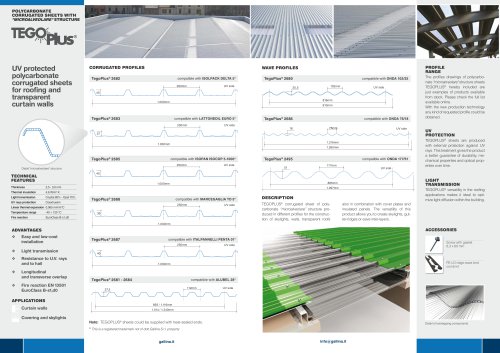
The document outlines the modular system for corrugated UV-protected multiwall polycarbonate, suitable for both curved and flat roofing applications. It includes specifications for thickness, profile height, and thermal and acoustic insulation properties.
The document specifies production standards for various panel types, including multiwall sheets with different wall structures and thicknesses. It highlights the importance of UV protection and thermal insulation.
The systems are suitable for industrial continuous roofing, skylights, vertical walls, and openable windows. Advantages include high load resistance, ease of installation, and energy-saving properties.
Gallina's roofing systems offer versatile solutions for various architectural applications, providing durability, insulation, and aesthetic appeal. Proper installation and adherence to technical guidelines are crucial for optimal performance.
Policarb® sheets are designed with a solar factor that measures the ratio of energy transmitted inside compared to total solar radiation. They have a linear thermal expansion of 0.065mm/m°C and can withstand temperatures ranging from -40°C to +120°C. The sheets are coextruded with UV protection on both sides and meet the EuroClass B-s1,d0 fire rating.
High-resistance pigments are added to polycarbonate to achieve various light transmission values. Sheets must be fastened with specific washers to ensure watertightness and accommodate thermal expansion. Adhesive steel tapes are available for closing the cells, with different heights depending on sheet thickness.
Policarb® sheets are available in various thicknesses and configurations, each with specific load resistance values. The choice of sheet thickness is based on snow/wind loads and sheet dimensions.
Solid polycarbonate sheets offer transparency, extreme impact strength, and good fire rating. They are lightweight, weighing 50% less than glass, and provide excellent thermal and acoustic insulation. These sheets are versatile for construction and industrial applications.
Policomp® and Scudo® sheets can be used for roofing, vertical windows, and advertising signs. They are easy to process and can be cold-formed mechanically. Installation requires consideration of thermal expansion, with guidelines provided for cutting and fitting.
Policomp® sheets have high impact strength, with a Charpy unnotched impact strength of no break and a notched impact strength of approximately 11 KJ/m2. They have a thermal conductivity of 0.2 W/m°C and a Vicat softening temperature of 148°C.
The sheets have a dielectric strength of 35 kV/mm and a volume resistivity of 0.15%.
When drilling holes in polycarbonate sheets, ensure the hole is at least 1.5 times the diameter away from the edge. Avoid using cutting oil and opt for threading only if necessary, as sheets may break post-drilling.
Use adhesives that are neutral and compatible with polycarbonate for gluing solid sheets.
Clean Poli-comp® and Scudo® sheets with warm water and a soft cloth.
Remove protective film before thermoforming. Pre-heat material to 120°C to remove moisture, using an air circulating oven. Perform thermoforming immediately after drying as sheets reabsorb moisture below 100°C. Hot curving should be done between 155°C and 165°C.
Policomp® and Scudo® sheets can be cut using circular saws, belt saws, or milling machines with specific rake angles, inclination angles, cutting speeds, and feed speeds. Detailed parameters for drilling include rake angle, angle of tip, blade angle, inclination angle, cutting speed, and tip speed.
Polycarbonate solid sheets without UV protection are easy to install, provide light transmission, heat insulation, and are self-supporting. They are suitable for room partitions, false ceilings, and machinery protection guards.
- Orders: Valid only if they refer to the current price-list and are signed by the buyer. Orders are binding and can only be canceled with written consent.
- Delivery: Dates are indicative and not binding. Delays do not warrant refunds or cancellations.
- Packaging: Materials are supplied in white polyethylene packaging.
- Transportation: Goods are transported at the buyer's risk. Complaints must be reported immediately.
- Warranty: Valid from the invoice date as per company certificates.
- Tolerance: Size variations of ± 2 mm/m are allowed.
- Payment: New orders are accepted only if previous materials are paid for. Delayed payments incur interest.
- Disputes: Settled exclusively in the Court of Turin.
Catalog excerpts

CATALOGUE * MODULAR SYSTEMS PLASTIC ■ MULTIWALL SHEETS BUILDING PRODUCT
Open the catalog to page 1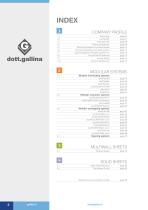
COMPANY PROFILE Technology Certification Polycarbonate Chemical resistance Technical properties of multiwall sheets Technical properties of modular systems Light management "Progetto Caleido" line Product with IR treatment Energy saving Use and maintenance page 34 page 38 page 42 page 46 Modular overlapping systems arcoPlus1000 arcoPlus1000 curvo arcoPlusSUPER1000 arcoPlusSUPER1000 curvo arcoPlusGrecaClick arcoPlusMiniGreca arcoPlusMiniGreca curvo arcoPlusOnda arcoPlusOnda curvo page 18 page 22 page 24 page 28 page 32 page 33 Modular connector systems arcoPlus684-6104-6124 arcoPlus684-6104-6124...
Open the catalog to page 2
COMPANY PROFILE Dott. Gallina S.r.l. was founded in 1960 by Pier Aulo Gallina, originally to manufacture profiles for the automotive industry. With developments in technology and the expansion of the market for thermoplastic materials, Dott. Gallina S.r.l. extended its range of products to include sectors such as construction and industry and is now a leading name on the international market. The company currently has a workforce of some 170 people and production plants in Italy, Greece, Poland, the US and India. Dott. Gallina S.r.l. manufactures plastic profiles for bodywork and upholstery for...
Open the catalog to page 4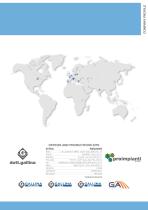
COMPANY PROFILE OFFICES AND PRODUCTIONS SITE SITES ITALY SPAIN GREECE POLAND US INDIA FRANCE GERMANY BELGIUM REGIONS LA LOGGIA (TURIN) - DOTT.GALLINA S.R.L. (*) MADRID - AISLUX S.A. KILKIS - GA PLASTICS S.A. TYCHY - DOTT.GALLINA POLAND (*) JANESVILLE (WISCONSIN) GALLINA USA LLC (*) NEW DELHI - GALLINA INDIA (*) PARIS EBERSTADT BRUGES *PRODUCTION SITE
Open the catalog to page 5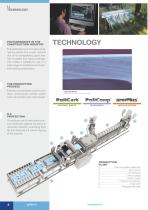
POLYCARBONATE IN THE CONSTRUCTION INDUSTRY Polycarbonate is an innovative engineering plastic that is also versatile due to its transparency, good thermal insulation and impact strength. This makes it suitable for use in a wide range of residential and industrial building applications. THE PRODUCTION PROCESS Extrusion is a process used to produce continuously formed plastic multi-wall profiles and solid sheets. COEXTRUSION Coextrusion observed with a microscope MULTIWALL SHEETS SOLID SHEETS MODULAR SYSTEMS U.V. PROTECTION All products are co-extruded to ensure protection against exposure to ultraviolet...
Open the catalog to page 6
Products are certified by authorita- tive laboratories and international For further information please visit MIAMI DADE KUHSmOFFPRllFSTELLE FRANKEN The company operates a quality SISTEMA QUALITA' CERTMCATO
Open the catalog to page 7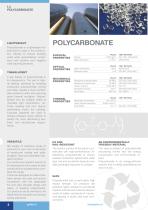
LIGHTWEIGHT Polycarbonate is a lightweight material that is used in the construction industry to reduce building costs while guaranteeing compliance with positive and negative wind load requirements. POLYCARBONATE PHYSICAL PROPERTIES OPTICAL PROPERTIES TRANSLUCENT A key feature of polycarbonate is its transparency. The use of natural lighting, achieved by installing translucent polycarbonate roofing and walls, creates a more comfortable ambience while also ensuring good thermal insulation. Polycarbonate can be suitably tinted to modulate light transmission, optimise shading and thus reduce overheating...
Open the catalog to page 8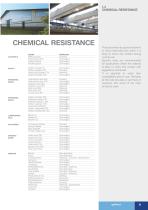
CHEMICAL RESISTANCE AGENT Methyl alcohol Ethyl alcohol 50% n-Butyl alcohol Ethylene glycol Cracking Unchanged Unchanged Unchanged Sodium hydrate 1% Sodium hydrate 10% Ammonium hydrate 10% Calcium hydrate 10% Unchanged Clouding Browning Unchanged INORGANIC ACIDS Hydrochloric acid 35% Hydrochloric acid 10% Sulphuric acid 70% Sulphuric acid 30% Nitric acid 40% Nitric acid 10% Cromic acid 10% Cracking Unchanged Unchanged Yellowing Yellowing Yellowing Unchanged INORGANIC SALTS Sodium chloride 10% Potassium nitrate 10% Potassium Bicrom. 10% Sodium sulphate 10% Ammonium chloride Sodium carbonate 10%...
Open the catalog to page 9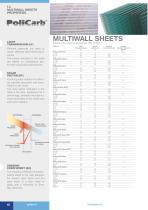
1.5 MULTIWALL SHEETS PROPERTIES MULTIWALL SHEETS Optical and Thermal properties (EN 16153) PROFILE Different pigments are used to obtain different light transmission values. The values indicated in the table are based on calculations performed at specialist laboratories. SOLAR FACTOR (SF) Incoming solar radiation is reflected, partially absorbed, and transmitted to the inside. The solar factor indicated in the table is the ratio, expressed as a percentage, between the total energy transmitted to the inside and total solar radiation. Direct solar Transmission Solar Radiation Solar Reflection Emission...
Open the catalog to page 10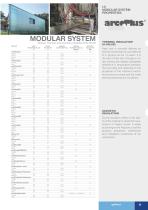
1.6 MODULAR SYSTEM PROPERTIES MODULAR SYSTEM Optical, Thermal and acoustic properties (EN 16153) % arcoPlus324 Crystal Green Bronze Opal arcoPlus625 Crystal Opal arcoPlus344x Crystal Green Bronze Opal arcoPlus347-547 Crystal Green Bronze Opal arcoPlus549 Crystal Opal arcoPlus684 Crystal Blue Bronze Opal arcoPlus6104 Crystal Blue Bronze Opal arcoPlus6124 Crystal Blue Bronze Opal arcoPlus6166 Crystal Green Bronze Opal arcoPlus626 Crystal Green Bronze Opal Velario 613 Crystal Opal Velario 20-5 Crystal Opal arcoPlus1000 Crystal Opal arcoPlusSUPER1000 Crystal Opal arcoPlusGrecaClick Crystal Opal arcoPlusMiniGreca...
Open the catalog to page 11
The line Progetto Caleido is dedicated to the realisation of facades and coverings with innovative aesthetic and architectural solutions PRODUCT LINE LIGHT MANAGEMENT The arcoPlus® panels and the Policarb® multiwall sheets can be colored to modulate the light transmission, optimize the shadow effect and allowing thereby for a lower heating of the internal environment. Transpartent or translucent colors with the possibility to modulate light and color according to the needs of the customer. All products available in the Progetto Caleido line are characterized by the indicated symbol. THE PRODUCTION...
Open the catalog to page 12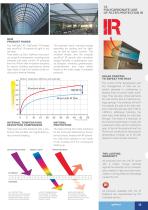
1.8 POLYCARBONATE LINE OF FILTER PROTECTION IR NEW PRODUCT RANGE The PoliCarb® IR, PoliComp® IR sheets and arcoPlus® IR panels let light in but not heat. They make up Dott. Gallina’s new product range for transparent coverings and windows with solar control. All products from the IR line offer innovative solutions for typical building applications where high levels of light are wanted while reducing the internal heating. 35° The potential result: reduced energy spending for cooling and for lighting as well as higher comfort. The multiwall sheets, and the modular arcoPlus® IR panels offer incredible...
Open the catalog to page 13All DOTT GALLINA catalogs and technical brochures
 Arcopure
6 Pages
 Architecture dressed in Light
50 Pages
 arcoPlus 549
2 Pages
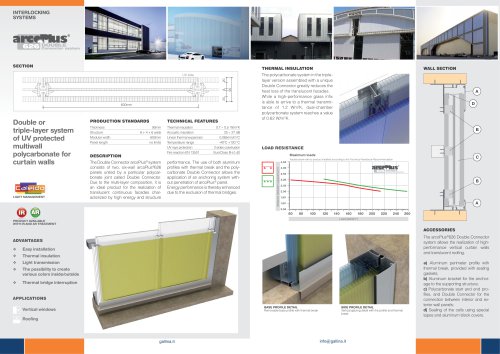 Double Connector System
2 Pages
 Ventilated Facade System
2 Pages
 Architectural
17 Pages
 catalogo_en
88 Pages
 Flyer arcoWall
2 Pages
 TEGOPLUS®
2 Pages

- Building polycarbonate sheet
- Honeycomb polycarbonate panel
- Translucent polycarbonate panel
- Insulated polycarbonate panel
- Polycarbonate panel with UV protection
- Polycarbonate roof panel
- Transparent polycarbonate panel
- Modular polycarbonate panel
- Flat polycarbonate panel
- Corrugated polycarbonate panel
- Polycarbonate interior fitting panel
- Polycarbonate facade cladding panel
- Polycarbonate curtain wall panel
- Polycarbonate partition wall panel
- Interlocking polycarbonate panel
- Facade polycarbonate panel
- Curved polycarbonate panel
- Window polycarbonate panel
- Impact-resistant polycarbonate panel