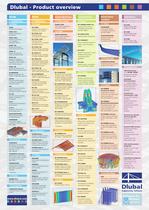
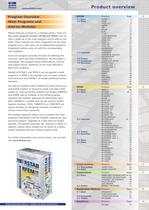
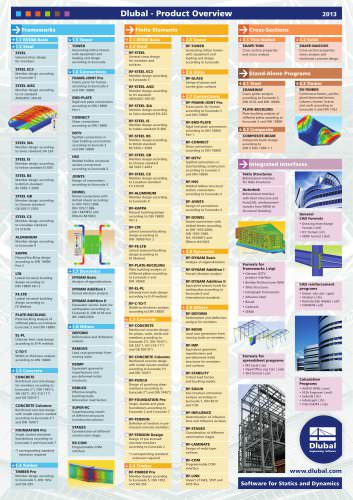
Overview: The document provides a comprehensive overview of Dlubal Software's structural analysis programs, RSTAB and RFEM, and their associated modules. These programs are designed for structural design, analysis, and engineering, offering solutions for various materials such as steel, concrete, timber, and composite structures.
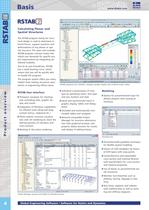
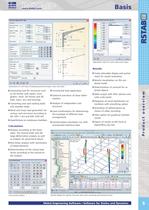
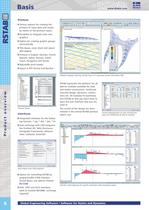
Main Programs:- RSTAB: Focuses on the analysis of planar and spatial structures, determining internal forces, support reactions, and deformations. It includes modules for steel, concrete, timber, and composite design.
- RFEM: Similar to RSTAB but with additional capabilities for modeling surface elements and more complex structures.
Modules:- Steel Design: Includes modules for designing according to various international standards (e.g., Eurocode 3, AISC, SIA, IS, BS, GB) and specialized analyses like lateral torsional buckling and plate buckling.
- Concrete Design: Offers modules for reinforced concrete design, including columns, foundations, and punching shear analysis.
- Timber Design: Provides modules for designing timber structures according to EN 1995-1-1 and DIN 1052.
- Composite Design: Includes modules for composite beam design according to EC4.
- Dynamics: Modules for dynamic analysis, including natural frequencies, modal analysis, and earthquake load simulations.
- Other Modules: Include deformation analysis, load case generation, stability analysis, and soil-structure interaction.
Interfaces: The software supports integration with various CAD and calculation programs, allowing for bidirectional data exchange with tools like Tekla Structures, Autodesk Revit, and others.
Cross-Sections and Connections: Modules for analyzing thin-walled and solid cross-sections, as well as designing steel and timber connections.
Stand-alone Modules: Include specialized tools for crane girder design, plate buckling, and timber structures.
User Interface and Features: The software offers a user-friendly interface with features like 3D rendering, customizable views, and comprehensive libraries for materials and cross-sections. It supports multiple languages and provides detailed printout options for reports.
Conclusion: Dlubal Software's modular approach allows for tailored solutions to meet specific project requirements, with the flexibility to upgrade and integrate additional modules as needed.
Specifications: The software supports integrated interfaces for formats such as *.stp, *.dxf, *.dat, and *.ifc, and facilitates data exchange with CAD programs like ProSteel 3D, Tekla Structures, and AutoCAD. It includes options for controlling RSTAB via a programmable COM interface and offers IGES, STEP, and ACIS interfaces through an add-on module.
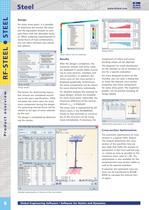
Procedures: The document outlines procedures for stress analysis, including the import of materials and cross-sections from RSTAB/RFEM, design of thin-walled cross-sections, and determination of maximum stresses. It also describes the process for graphical display of stress points and stress ratios, optimization of cross-sections, and data export to MS Excel.
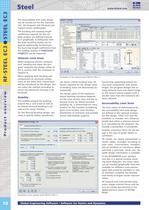
Standards and Norms: The software performs stress analyses according to standards like DIN 18800 and Eurocode 3. It includes modules for ultimate and serviceability limit state design, stability analysis, and deformation analysis according to Eurocode 3, with country-specific arrangements integrated.
Recommendations: The document recommends using the software's features for optimizing cross-sections and performing detailed analyses, such as fatigue design. It suggests utilizing graphical tools for selecting members and load cases and emphasizes the importance of adjusting parameters for accurate design results.
Key Features: Key features include automatic optimization of cross-sections, graphical distribution of stress ratios, and detailed representation of stresses. The software also offers modules for flexural buckling design and lateral torsional buckling design according to DIN 18800, with options for considering rotational restraints and shear panels.
Conclusion: Dlubal Engineering Software provides robust tools for structural analysis and design, with extensive support for various standards and integration with CAD programs. Its modules offer flexibility and precision in designing steel structures, making it a valuable resource for engineers.
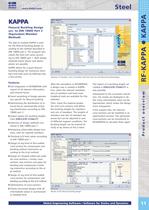
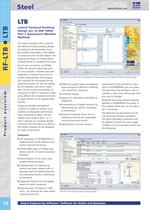
Lateral Torsional Buckling (LTB): This section discusses the design process for lateral torsional buckling using the LTB module. It includes the selection of members, load groups, and support types. The module allows for detailed specification of support types and considers shear panels and rotational restraints. The moment coefficient ζ is crucial for determining the critical buckling moment Mcr.
FE-LTB Module: The FE-LTB module is used for analyzing planar sub-structures detached from spatial models. It performs stress design with warping torsion and stability analysis for buckling. The module provides tools for determining shear panels and rotational restraints and allows for graphical selection of load application points.
Ultimate Limit State Design (EL-PL): The EL-PL module uses elastic-plastic analysis to utilize the plastic resources of cross-sections. It checks the width-to-thickness ratios and provides cross-section optimization. The module integrates with RSTAB/RFEM for importing relevant information and internal forces.
Width-To-Thickness Analysis (C-TO-T): This module analyzes the effectiveness of cross-section parts under compressive stress according to DIN 18800. It provides options to consider shear stresses and optimize cross-sections, avoiding complex buckling analyses for welded cross-sections.
Plate Buckling Analysis (PLATE-BUCKLING): The PLATE-BUCKLING module is used for analyzing rectangular plates reinforced by stiffeners. It imports internal forces from RSTAB/RFEM and considers the entire panel for buckling analysis. The module provides a photo-realistic representation of panels and buckling modes.
Ultimate and Serviceability Limit State Design (STEEL AISC): This module is based on the ANSI/AISC 306-05 standard and performs ultimate limit state design, stability, and deformation analysis for members. It supports both Allowable Stress Design (ASD) and Load Resistance Factor Design (LRFD).
Design Standards: The modules support various international standards, including AISC, SIA 263:2003, IS 800:2007, BS 5950-1:2000, BS EN 1993-1-1, GB 50017-2003, and EN 1999-1-1:2007.
Design Capabilities: They offer design solutions for tension, compression, bending, shear, and combined internal forces. Stability analyses for buckling, torsional buckling, and lateral-torsional buckling are also included.
Cross-Section Optimization: The software allows for cross-section classification and optimization, supporting a wide range of cross-sections such as I-, C-, T-sections, angles, hollow sections, and more.
Serviceability and Ultimate Limit State Design: The modules perform serviceability limit state design by checking deformations and ultimate limit state design according to the specified standards.
Material Libraries: Libraries for U.S. materials and other standard-specific materials are included to facilitate design processes.
Results Documentation: Detailed results documentation is provided, including references to design equations and standards used. Results can be filtered and arranged by member, cross-section, load cases, and more.
Integration and Units: Seamless integration with RSTAB/RFEM is ensured, with support for both metric and imperial units.
Specific Modules:
- STEEL AISC: Focuses on the design of steel members according to the American Institute of Steel Construction standards.
- STEEL SIA: Designed for Swiss standards, it includes features for stability analysis and cross-section optimization.
- STEEL IS: Based on Indian standards, it includes a material library and cross-section library for rolled sections.
- STEEL BS: Supports British standards and Eurocode, offering automatic cross-section classification and detailed results documentation.
- STEEL GB: Adheres to Chinese standards, providing automatic determination of critical buckling loads and stability factors.
- ALUMINIUM: Designed according to EN 1999-1-1:2007, it includes features for aluminum member design and cross-section optimization.
- CRANEWAY: Focuses on crane girder design according to DIN standards, including stress and fatigue design for crane runways.
Conclusion: Dlubal Engineering Software offers a robust suite of tools for the design and analysis of steel and aluminum structures, supporting a wide range of international standards and providing detailed documentation and optimization features.
Crane Specifications and Procedures: The document outlines the process of selecting and specifying crane parameters, including the number of cranes, crane axes, exposure category, lifting class, and wheel loads. Imperfections are considered using the first eigenmode, and calculations are based on second-order analysis for torsional buckling, including stability analysis against lateral-torsional buckling. Fatigue design is evaluated using the Rainflow method, comparing stress peaks with DIN 4132 standards.
Reinforced Concrete Design: The CONCRETE module in RSTAB/RFEM is used for reinforced concrete design, supporting standards like EN 1992-1-1 and DIN 1045. It integrates with RSTAB/RFEM for determining reinforcement, considering factors like shear, torsion, and biaxial compression stresses. The design process includes defining standards, load cases, and material properties, with options for non-linear design and crack width limitation. Results are presented in tables and 3D renderings.
Column Design and Fire Resistance: The module supports flexural buckling and fire resistance design for compression elements according to standards like EN 1992-1-1. It includes features for creep consideration, buckling length determination, and fire resistance design. The design process involves entering columns, load cases, and reinforcement specifications, with results displayed in tables and 3D renderings.
Foundation Design: The FOUNDATION module designs single, bucket, and plate foundations according to DIN 1045 standards. It considers various loads, including surface loads and water levels, and ensures safety against lifting, ground failure, and bending failure. The module provides reinforcement proposals and allows for customization of reinforcement layouts, with results documented in tables and graphics.
Timber Design: The TIMBER Pro module supports timber design according to EN 1995 and DIN 1052 standards, including fire resistance design. It integrates with RSTAB/RFEM, offering features like material libraries, stability analysis, and cross-section optimization. The design process involves selecting members, load cases, and design methods, with results visualized in RSTAB/RFEM models.
1. Timber Design with TIMBER Pro:- The software analyzes tension, compression, bending, and shear forces in timber structures, considering both ultimate and serviceability limit states.
- It allows for optimization of cross-sections and integrates with RSTAB/RFEM for recalculations.
- Stress ratios are visually represented, aiding in identifying critical areas.
- Designs are documented with detailed specifications and graphical representations.
2. Composite Beam Design:- COMPOSITE-BEAM module designs continuous composite beams according to EC 4 standards.
- It supports various construction types and cross-sections, including cast-in-place and pre-cast concrete.
- The module calculates internal forces and designs for bending, shear, and torsional resistance.
- Results are presented in tables and can be integrated into printout reports.
3. Dynamic Analysis with DYNAM:- DYNAM Basic determines natural frequencies and eigenmodes of structures, considering geometric stiffness and additional masses.
- It provides visualization and animation of eigenmodes, supporting detailed dynamic analysis.
- DYNAM Add. I and II extend capabilities to forced vibration analysis and earthquake load calculations, respectively.
- These modules allow for the definition of excitation cases, response spectra, and equivalent lateral forces according to various standards.
4. Deformation and Deflection Analysis:- The DEFORM module analyzes deformations of individual and continuous members in structures.
- It allows for graphical selection of members and specification of limit deformations.
- Results can be integrated into global printout reports for comprehensive documentation.
Conclusion: The document outlines the capabilities of Dlubal's software modules in providing comprehensive solutions for structural analysis and design, emphasizing flexibility, integration, and detailed documentation.
DEFORM Module: This module is used for deformation analysis of members and sets of members. Users can select relevant load cases, define members manually or graphically, and assign allowable deformation limits. Results are displayed in structured tables, and failed analyses are marked. DEFORM integrates easily into global reports and is user-friendly.
RSMOVE and RF-MOVE Modules: These modules generate load cases from moving loads, such as cranes or cars on bridges. They can create up to 9,999 load cases and allow for the addition of loads to existing cases. The modules support various load types and directions, and results can be saved for future use.
RSIMP Module: RSIMP generates equivalent geometric imperfections and pre-deformed initial structures according to various standards. It evaluates deformations, buckling modes, and eigenmodes to orient imperfections. The module supports quick analysis and application of lateral loads and can handle pre-deformed structures.
RSBUCK Module: This module performs eigenvalue analysis to determine buckling shapes, lengths, and loads. It imports structural data and boundary conditions automatically and provides results in structured tables and graphics. RSBUCK is user-friendly and integrates with other modules for further analysis.
RSCOMBI and RF-COMBI Modules: These modules create load groups and combinations for various load cases, adhering to standards like EN 1990 and DIN 1055-100. They automate the combination process, reducing manual errors and time consumption. Users can classify load cases and save user-defined factors.
SUPER-LC Module: SUPER-LC handles superimposing results from different structures or construction phases. It allows for the integration of various structural phases and superimposes loads according to combination criteria. The module supports standards like Eurocode and DIN 18800.
TOWER Modules: These modules assist in generating tower models with equipment and loading. They support the creation of complex lattice tower structures and provide tools for defining geometry, bracings, and other structural elements. The modules offer interactive graphics and easy data export to RSTAB/RFEM.
TOWER Equipment: Towers serve as support structures for antennas and other equipment like platforms and ladders. The add-on module allows for the creation of transmitter towers with necessary equipment efficiently. Key features include:
- Generation of platforms using a comprehensive library with parametrization options.
- Libraries for tubular extensions and antenna brackets in 2D and 3D.
- Antenna groups evaluation according to mobile network operators.
- Selection of various antennas from databases.
- Parameterized input of inner ducts, cable lines, and ladders with interactive graphics.
Equipment elements are defined in input tables, and data can be transferred to RSTAB or RFEM.
TOWER Loading: This module creates design-relevant actions for RSTAB or RFEM, considering the tower's structural data and equipment. It covers requirements according to DIN standards for various loads and allows for individual load situations. Features include:
- Automatic consideration of the tower's self-weight.
- Specification of wind load distribution.
- Determination of wind and ice loads.
- Generation of traffic load cases.
Loads can be exported to RSTAB or RFEM.
RS-/RF-COM Interface: RS-COM and RF-COM are programmable interfaces for RSTAB or RFEM, allowing customization through common programming languages. Features include:
- Read and write access to structural and load case data.
- External control of calculations.
- Access to results and control elements.
- Import and export of data from spreadsheets.
Requires licenses for RSTAB and RS-COM or RFEM and RF-COM.
RFEM Overview: RFEM is a finite element method (FEM) program for analyzing deformations, internal and support forces in structures. It is user-friendly and efficient, supporting multi-core processors and 64-bit technology. Applications include reinforced concrete and steel design. Features include:
- Graphical interface with navigator and table integration.
- Modeling capabilities for various structural elements.
- Calculation options with non-linear effects consideration.
- Results output in tables and graphics with customizable filters.
RFEM supports data exchange with various programs and offers a 2D version for planar structures.
RF-STEEL Module: The RF-STEEL module in RFEM is used for stress designs of members and surfaces. It integrates with RFEM to import structural information and internal forces. Features include:
- Design and analysis of structural parts.
- Determination of various stresses and stress ratios.
- Serviceability limit state design.
- Graphical and numerical results output.
Results can be integrated into printout reports for documentation.
RF-CONCRETE Module: The RF-CONCRETE module is divided into two parts: RF-CONCRETE Surfaces for surface and shell elements, and RF-CONCRETE Members for member elements. It supports various standards such as DIN 1045 and EN 1992-1-1, and offers features like independent reinforcement on both surface sides, analytical serviceability limit state design, and deflection and crack width analysis.
RF-PUNCH Module: This module is used for designing punching shear resistance for surfaces supported by columns or nodal supports. It automatically determines the governing punching load and supports standards like EN 1992-1-1 and DIN 1045-1. It provides a clear arrangement of punching shear designs and reinforcement requirements.
RF-TENDON and RF-TENDON Design Modules: These modules are used for designing prestressed concrete members according to EN 1992-1-1 and EN 1992-2. RF-TENDON allows for the definition of tendons and calculation of prestressing forces, while RF-TENDON Design performs the design process, including ultimate and serviceability limit state design.
RF-DYNAM Module: This module facilitates the analysis of eigenfrequencies and forced vibrations. It includes features for automatic mass consideration, eigenmode visualization, and dynamic behavior determination. RF-DYNAM Add I and Add II extend capabilities to forced vibration analysis and equivalent lateral loads for earthquakes, respectively, supporting standards like Eurocode 8 and DIN 4149.
Conclusion: The document outlines the capabilities and features of various RFEM and RSTAB add-on modules, emphasizing their integration with standards and ease of use for structural analysis and design.
Equivalent Lateral Forces: This section discusses the calculation of equivalent lateral forces according to Eurocode 8 and DIN 4149, with options for design spectrum and elastic response spectrum. It also mentions the American standard IBC 2000 procedures and the export of generated forces to RFEM.
Geometric Imperfections (RF-IMP): RF-IMP generates imperfections as equivalent lateral loads or pre-deformed initial structures. It supports non-linear calculations and stability analyses, with features for generating imperfections based on load cases, buckling shapes, and eigenvibrations.
Stability Analysis (RF-STABILITY): This module determines critical load factors and buckling modes for frameworks and shell structures. It provides features for simultaneous determination of buckling shapes, consideration of axial forces, and visualization of buckling modes.
Soil-Structure Interaction (RF-SOILIN): RF-SOILIN considers soil conditions in structural analysis, allowing for realistic interaction between structure and soil. It calculates foundation coefficients based on standards like EC 7 and DIN 4019, and supports settlement calculations.
Glass Design (RF-GLASS): RF-GLASS facilitates deflection analysis and stress design for laminated or insulated glass. It supports various glazing types and provides features for defining pane structures, considering climatic loads, and displaying results for each glass layer.
Staged Construction Analysis (RF-STAGES): RF-STAGES calculates framework structures considering construction sequences. It allows for the definition of structural conditions, modification of member properties, and analysis of permanent and temporary loads.
Laminate Surface Design (RF-LAMINATE): RF-LAMINATE performs deflection analyses and stress designs for laminate surfaces, using the sandwich theory. It supports various material models and provides detailed output of stresses and design ratios.
Cross-Section Properties (SHAPE-THIN): SHAPE-THIN is a tool for determining cross-section properties and stresses of thin-walled sections. It integrates with RSTAB and RFEM, allowing for the import of cross-section properties and internal forces.
SHAPE-THIN: This module is used for determining cross-section properties and stresses. It supports various cross-section shapes and provides detailed calculations for section properties such as area, moments of inertia, torsional constants, and more. It also includes plastic section properties and stress analysis capabilities. The module allows for the import of DXF templates and integrates with RSTAB and RFEM for further design processes.
SHAPE-MASSIVE: This standalone program calculates properties of massive cross-sections and performs stress analysis and reinforced concrete design according to standards like DIN 1045 and EN 1992-1-1. It supports the import of internal forces from RSTAB or RFEM and offers a comprehensive material library for modeling composite cross-sections.
FRAME-JOINT Pro: This module is designed for the dimensioning and design of frame joints according to EN 1993-1-8 and DIN 18800. It supports various joint types and provides automatic suggestions for bolt layouts and required stiffenings. The module integrates with RSTAB/RFEM for geometry and load data import and offers detailed graphical output for connection visualization.
END-PLATE: This add-on module calculates bending-resistant end plate connections according to DIN 18800. It provides design and dimensioning modes for bolts, end plates, and welds, supporting both symmetrical and asymmetrical I-sections. The module is integrated with RSTAB and RFEM, allowing for automatic adjustments to connections based on structural modifications.
CONNECT: This module is used for dimensioning typical shear connections in steel construction according to DIN 18800. It supports various connection types, including web cleats and end plates, and is fully integrated with RSTAB or RFEM.
Key Features: The software offers extensive libraries for cross-section and material properties, supports data exchange with MS Excel, and provides detailed printout reports. It also includes features for stress analysis, plastic design, and effective cross-section calculation according to relevant standards.
Steel Connections:- Web Cleat Connection: Designed according to DIN 18800 part 1, this connection involves a beam's hinged shear connection to a column or girder using web cleats. Features include design of welds and cleats for stress, selection of fillet welds, and adjustable cleat dimensions.
- End Plate Connection: Utilizes an end plate to transfer shear force, with options for bolt and weld design. It follows DIN 18800 standards.
- Seating Cleat Connection: Transfers shear force via a seating cleat, secured by an end plate connection. It includes design of bolts and connection welds.
Typified Connections: The DSTV module designs moment-resisting and pinned I-beam connections according to EC 3 and DIN 18800. It includes features like automatic dimensioning of bolt sizes, indication of failure reasons, and output of structural details.
Hollow Structural Section (HSS) Connections: The HSS module designs joints of steel hollow sections according to Eurocode 3. It supports various connection types and allows for manual or automatic geometry recognition.
Timber Connections:- Dowel Connections: The DOWEL module designs dowel connections with slotted sheets for timber constructions, checking both ultimate limit state and geometric feasibility.
- RX-TIMBER Modules: These stand-alone programs design timber beams, columns, frames, and braces according to DIN 1052 and EN 1995-1-1. They include features for load determination, vibration design, and fire protection.
Interfaces: The RX-LINK module allows for the import of IGES, STEP, and ACIS files, facilitating the exchange of model geometry data.
Interfaces and Integration: The document outlines various interfaces available for different formats, including IFC, German DSTV, MS Excel, DXF, SDNF, and ASCII. It highlights integration capabilities with CAD programs like Tekla Structures, ProSteel 3D, Advance Steel, and others. Special interfaces in RFEM are also mentioned, such as those for Glaser ISB-CAD and Nemetschek Allplan, along with a direct connection to Revit Structure.
Project Overview - Biomass Power Plant: A modern biomass power plant in Schwendi, Germany, designed by Matteo Thun, features a sophisticated framework of reinforced concrete, steel, and timber. The structure was modeled using RSTAB, involving approximately 1000 nodes and 2000 members. The project faced time constraints, starting in January 2007 and completing in July 2008.
Project Overview - Hotel in Marina of Kressbronn-Gohren: The marina hotel, located on Lake Constance, was designed using a spatial FEA model in RFEM. The structure accounts for wind and seismic loads, with a total weight of approximately 2100 tons. The model includes 626 nodes and 123 members, with a calculation time of about 30 seconds for all load cases.
Project Overview - New Filter Plant in Medupi, South Africa: The Medupi power station, one of the largest coal-fired stations, features a baghouse system designed using RFEM. The structure includes 5021 nodes and 8909 members, accommodating South African construction rules and specifications.
Project Overview - Waterside Theatre in Aylesbury: The Waterside Theatre, designed by RHWL Architects, features a unique timber facade modeled in RSTAB. The structure includes over 1700 members, with wind loads applied due to its free-form design.
Project Overview - Industrial Filter Device: The design of a filter/dryer device required stress and deformation analysis in RFEM. The model includes 1424 surfaces and 425 members, with loads applied for pressure, temperature, and agitator stress cycles.
About Dlubal Engineering Software: Dlubal Engineering Software provides tools for statics and dynamics, emphasizing intuitive usability, efficient analysis, and excellent customer service. Their programs, RSTAB and RFEM, are essential for structural analysis and design.
Company Overview: Dlubal Engineering Software, established in 1987, specializes in developing software for structural analysis. The company has offices in Tiefenbach, Germany, and Prague, Czech Republic, and employs a team of engineers focused on creating practical software solutions. Dlubal's main program, RSTAB, was one of the first spatial framework programs and has become synonymous with quality structural
analysis software.
Product Acceptance and User Base: Dlubal's software is trusted by approximately 7000 users worldwide, including engineering offices, planning agencies, and academic institutions. The software is known for its high quality, flexibility, and ease of use, making it suitable for both small and large organizations. It is particularly valued in educational settings for its intuitive interface.
Objectives and Development: The company aims to maintain its leading position by adapting to changing building standards and technical possibilities. Key objectives include implementing international standards, extending program families, and open-sourcing software to integrate with customer workflows. Dlubal actively participates in trade fairs and seminars to achieve these goals.
Customer Support and Services: Dlubal offers service contracts for priority support and discounted upgrades. Technical support is available via email or fax, with priority given to service contract holders. The company encourages customer feedback to improve its products.
System Recommendations: Recommended system specifications include a 2 GHz processor, 2 GB RAM, a graphics card with OpenGL acceleration, and a DVD drive for installation. The software is compatible with MS Windows/XP/Vista/7.
Additional Information: Interested users can download a free demo version from the Dlubal website. The company provides extensive resources, including videos and user manuals, to help users get started with the software. Dlubal also offers personalized software packages tailored to individual needs.