
- Catalogs
- DL Chemicals
- PARAFOAM INSULATION NBS

PARAFOAM INSULATION NBS

PARAFOAM INSULATION NBS
This technical data sheet provides detailed information about PARAFOAM INSULATION NBS, a one-component PU gunfoam with low diisocyanate content, designed for high thermal and acoustic insulation. It is suitable for various applications and offers excellent adhesion to common building materials.
Characteristics
- Low diisocyanate content (<0.1%)
- High thermal and acoustic insulation
- Water-resistant and UV-resistant
- Adheres to wood, concrete, brick, plaster, metal, and more
- Free of CFCs and HCFCs
Applications
- Insulation of buildings, vehicles, and vessels
- Repair insulation works
- Insulating hard-to-reach places
- Preventing condensation and reducing thermal bridges
Technical Characteristics
- Type: Polyurethane-prepolymer
- Curing time: 24 hours
- Application temperature: +10°C to +30°C
- Temperature resistance: -50°C to +90°C
- Expansion during curing: 100%
- Thermal conductivity: 0.033 W/mk
- Acoustic damping index: 62 dB
- Fire class: B3
Method of Use
- Ensure good ventilation during application
- Warm chilled cans in lukewarm water
- Pre-moisten surfaces before application
- Apply foam from a distance of 40 cm
- Maximum foam layer thickness: 2 cm
- Wait 60 minutes between layers
Cleaning
- Remove fresh foam spills immediately
- Use PU Foam & Gun Cleaner for fresh foam
- Use Parafoam Remover for cured foam
Safety and Points of Attention
- Consult safety information on packaging
- Does not adhere to PE, PP, PTFE, silicone, oil, grease
- Avoid prolonged UV exposure
- Store canisters upright
Technical Approvals
- UKCA & CE conform BS EN 14315-1
- French VOC emission class A+
Catalog excerpts
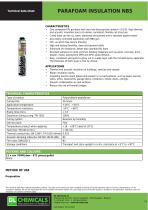
Technical data sheet PARAFOAM INSULATION NBS CHARACTERISTICS • One-component PU gunfoam with very low diisocyanate content (<0.1%). High thermal and acoustic insulation due to its dense, consistent, flexible cell structure. • Cured foam can be cut, sawn, plastered and painted and is resistant against water • Accurately controlled application with NBS gun • CFC- en HCFC-free (ozone friendly) • High and lasting flexibility, does not become brittle • Enhanced UV resistance, better than standard PU foam • Excellent adhesion to most common building materials such as wood, concrete, brick, plaster, metal, polystyrene (EPS and XPS), polyurethane... • Easy, consistent and quick to spray out in a wide layer with the included spray applicator. The thickness of foam layer is free to choose. APPLICATIONS • Thermal and acoustic insulation of buildings, vehicles and vessels. • Repair insulation works. • Insulating hard-to-reach places and uneven or curved surfaces, such as pipes, barrels, tanks, attics, basements, garage doors, containers, lintels, doors, ceilings. • Prevent condensation on cold surfaces. • Reduce the risk of thermal bridges. This technical data sheet replaces all previous editions. The data on this sheet have been compiled according to the last laboratory report. Technical characteristics can be changed or adapted. We are not responsible for any incomplete information. Before use, one needs to ensure that the product is suitable for his application. Therefore, tests are necessary. Our general conditions apply DL CHEMICALS I Manufacturer of Sealants
Open the catalog to page 1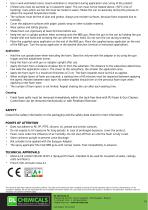
Use in well-ventilated rooms. Good ventilation is important during application and curing of the product. Chilled cans must be warmed up in lukewarm water. The can must not be heated above +50°C (risk of bursting). Cans which are too hot must be cooled in water. Shake the can occasionally during this process to obtain the required temperature faster. The surfaces must be free of dust and grease. Always pre-moisten surfaces, because foam expands due to humidity. Cover the adjacent surfaces with paper, plastic wrap or other suitable material. Wear gloves and safety glasses. Shake foam can vigorously...
Open the catalog to page 2All DL Chemicals catalogs and technical brochures
 PARAFOAM PANELGLUE 1K
3 Pages
 PARABOND PANEL & DECORATION
2 Pages
 PARAROOF COLD GLUE
2 Pages
 PARACOL UNIVERSAL FLOORING
2 Pages
 PARACOL PU D4 NORMAL
2 Pages
 PARACOL WOOD D3
2 Pages
 PARACOL MONTAGEKIT NEOPRENE
2 Pages
 PARACOL MIROSEAL MS
2 Pages
 DETAFLEX 4000
2 Pages
 PARABOND 400 STANDARD
3 Pages
 PARASILICO MONUMENT
3 Pages
 PARAROOF BITUMEN
2 Pages
 DETAFLEX 1500
2 Pages
 PARABOND LOW MODULUS
3 Pages
 PARABOND GLAZING
3 Pages
 PARABOND CONSTRUCTION
3 Pages
 PARASILICO E95 T
3 Pages
 PARASILICO AM85-1
3 Pages
 PARASILICO ALCOXY 15
3 Pages
 PARABOND PARQUET 240
3 Pages
 PARAFUGE FACADE G
2 Pages
 PARAROOF SUPER
2 Pages
 PRODUCT CATALOGUE
140 Pages
 Color cards
5 Pages
- Industrial plaster
- Building coating
- Indoor coating
- Synthetic insulation
- Thermal-acoustic insulation
- Indoor primer
- Protective coating
- Sealant
- Outdoor primer
- Concrete mortar
- Cement mortar
- Concrete primer
- Finishing coating
- Exterior insulation
- Glue
- Acrylic resin-based primer
- Water-repellent coating
- Powder mortar
- Elastic sealant