


- Company
- Products
- Catalogs
- News & Trends
- Exhibitions
EPD | Strand Woven Bamboo

EPD | Strand Woven Bamboo
Zhejiang Daocheng Bamboo Industry Co., Ltd has published an Environmental Product Declaration (EPD) for their dasso strand woven bamboo products, in accordance with ISO 14025 and EN 15804 standards. The EPD is valid from April 1, 2020, to April 1, 2025, and covers a global geographical scope.
Scope and Goal
The EPD follows a 'cradle-to-gate with options' approach, including transport to the building site and end-of-life stages. The declared unit is 1 kg of dasso strand woven bamboo boards, which are used in various applications such as flooring, wall cladding, and furniture. The goal is to assess the potential environmental impact over a lifespan of 35 years.
Product and Application
dasso strand woven bamboo is made from high-density bamboo fiber, offering durability and a wooden texture. It is suitable for interior decoration and is used in commercial and residential projects worldwide.
LCA Description
The Life Cycle Assessment (LCA) covers the product stage (A1-A3), construction stage (A4), and end-of-life stage (C1-C4), with resource recovery (D) included. Installation and usage stages are excluded.
LCA Results
The EPD provides potential environmental impacts for 1 kg of dasso strand woven bamboo, including global warming potential, ozone depletion, acidification, eutrophication, and more. Notably, the product meets Class E1 formaldehyde emission standards.
Environmental Impact Parameters
Key parameters include:
- Global Warming Potential (GWP): 8.60E-01 kg CO2 eq.
- Ozone Depletion Potential (ODP): 1.70E-08 kg CFC 11 eq.
- Acidification Potential (AP): 5.80E-03 kg SO2 eq.
- Eutrophication Potential (EP): 9.20E-04 kg PO43- eq.
- Primary Energy Resources (Renewable and Non-renewable): Various values provided for energy use and raw materials.
For further details, contact [email protected] or visit www.environdec.com.
Catalog excerpts

Environmental Product Declaration Information Disclosure Summary dasso strand woven bamboo Zhejiang Daocheng Bamboo Industry Co., Ltd Xinhe, Linpu, Xiaoshan, Hangzhou, Zhejiang, China 311251 T: 86-571-57163765 W: dassoGroup.com E: [email protected] The International EPD® System Programme operator Third-Party Verifier Bill Kung, Ecovane Environmental Zhejiang Daocheng Bamboo Industry Co., Ltd Product Name dasso strand woven bamboo Publication date Valid until
Open the catalog to page 1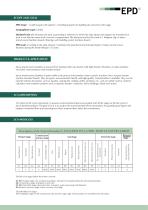
SCOPE AND GOAL EPD Scope: “cradle-to-gate with options”, including transport to building site and end of Life stage. Geographical scope: Global Declared Unit: the declared unit aims at providing a reference to which the data inputs and outputs are normalized in such a way that the same level of service is represented. The declared unit for this study is 1 kilogram (kg) of dasso strand woven bamboo boards (flooring, wall cladding, panel, furniture board). EPD Goal: according to the data analysis, it indicates the potential environmental impact of dasso strand woven bamboo during the whole lifespan...
Open the catalog to page 2
LCA RESULT dasso strand woven bamboo - Potential Environmental Impacts: The results presented below are for the listed environmental categories for 1 kg of dasso strand woven bamboo board and are aggregated for A1-A4, C1-C4 and D stages. The results are presented for dasso strand woven bamboo flooring, wall cladding and panel. Costruction process stage Product stage Depletion potential of the stratospheric ozone kg CFC 11 eq. layer (ODP) Global warming potential (GWP) Eutrophication potential (EP) Formation potential of tropospheric ozone (POCP) Abiotic depletion potential – Elements Abiotic...
Open the catalog to page 3All Dasso catalogs and technical brochures
 Dasso XTR
2 Pages
 Lumber
2 Pages
 Bamboo Acoustic Boards
2 Pages
 Fused bamboo leaflet
2 Pages
 Flyer | Interior Product
2 Pages
 Flyer | dassoCTECH PLUS
2 Pages
 Flyer | dassoXTR-ULTRA GRIP
2 Pages
 Brochure | Company Brochure
60 Pages
 Flyer | Bamboo Panel
2 Pages
 Brochure | Project Reference
88 Pages
 EPD | dassoXTR&dassoCTECH
3 Pages
 EPD | dassoEcosolid Bamboo
3 Pages
 Brochure | dassoXTR&CTECH
36 Pages
 Flyer | Green·Bamboo·Dasso
6 Pages


- Industrial wood floor
- Public bench
- Glued parquet flooring
- Contemporary public bench
- Engineered parquet flooring
- Commercial public bench
- Indoor flooring
- Tertiary flooring
- Wooden public bench
- Public bench with backrest
- Strip parquet floor
- Acoustic panel
- Panel rainscreen cladding
- Sustainable public bench
- Domestic use flooring
- Industrial pergola
- Commercial flooring
- Commercial acoustic panel