

TESTS
1 / 1 PageView full catalog
TESTS
Product catalog summary
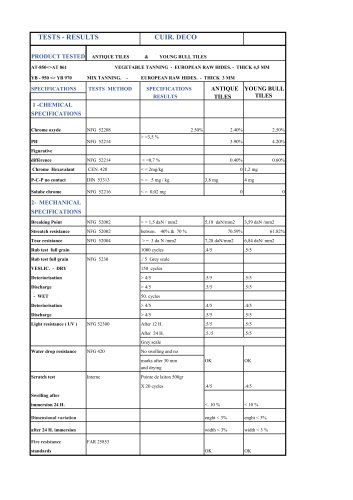
Product Overview: The document presents test results for two types of leather tiles: Antique Tiles and Young Bull Tiles. Both products are made from European raw hides, with Antique Tiles using vegetable tanning and a thickness of 4.5 mm, while Young Bull Tiles use mixed tanning and have a thickness of 3 mm.
Chemical Specifications:
- Chrome Oxide: Both tiles meet the specification of 2.50%.
- pH Level: Antique Tiles have a pH of 3.90%, and Young Bull Tiles have 4.20%, both above the minimum requirement of 3.5%.
- Figurative Difference: Both tiles are within the specification of less than or equal to 0.7%.
- Chrome Hexavalent: Antique Tiles have 0 mg/kg, and Young Bull Tiles have 1.2 mg/kg, both within the limit of 2 mg/kg.
- P-C-P: Both tiles are below the maximum of 5 mg/kg.
- Soluble Chrome: Both tiles have 0 mg, meeting the specification of less than or equal to 0.02 mg.
Mechanical Specifications:
- Breaking Point: Antique Tiles exceed the minimum requirement with 5.18 daN/mm2, and Young Bull Tiles have 3.59 daN/mm2.
- Stretch Resistance: Antique Tiles have 70.59%, and Young Bull Tiles have 61.82%, both within the specified range of 40% to 70%.
- Tear Resistance: Both tiles exceed the minimum requirement of 3 daN/mm2.
- Rub Test: Both tiles perform well in dry and wet conditions, with scores of 4/5 or 5/5.
- Light Resistance (UV): Both tiles maintain a score of 5/5 after 12 and 24 hours.
- Water Drop Resistance: Both tiles show no swelling or marks after 30 minutes.
- Scratch Test: Both tiles score 4/5.
- Swelling After Immersion: Both tiles show less than 10% swelling.
- Dimensional Variation: Both tiles have less than 3% variation in length and width after 24-hour immersion.
- Fire Resistance: Both tiles meet the FAR 25853 standards.
See more
Related Searches
- Industrial flooring
- Indoor flooring
- Industrial wallcovering
- Interior wall-covering
- Domestic use wall-covering
- Commercial wall-covering
- Tile flooring
- Domestic use flooring
- Gray flooring
- Commercial flooring
- Modern wall-covering
- Brown flooring
- Beige flooring
- Living room wall-covering
- Living room flooring
- Acoustic floor covering
- Black flooring
- Decorative flooring
- Gray wall-covering
- Blue flooring
*Prices are pre-tax. They exclude delivery charges and customs duties and do not include additional charges for installation or activation options. Prices are indicative only and may vary by country, with changes to the cost of raw materials and exchange rates.
About ArchiExpo
ArchiExpo is a marketplace that offers B2B players a complete experience, from product sourcing to purchase. ArchiExpo is an entity of VirtualExpo Group.
Are you a buyer?
Are you a supplier?