
- Catalogs
- Coverguard
- Seasons - 2021 version

Seasons - 2021 version

Seasons - 2021 version
This document serves as a comprehensive guide on the Coverguard® range of textile products, detailing specifications, materials, coatings, care instructions, and standards for protective clothing.
The document describes various fabrics, including natural fibers like cotton and synthetic fibers such as polyester and polyamide. Key fabric types include Oxford, Taffeta, Ripstop, and Twill, each with specific properties for different applications.
Coatings such as PVC and PU enhance fabric properties like water repellency and abrasion resistance. Membranes are distinguished by their waterproof and breathable qualities.
Softshells are categorized by layers, balancing breathability and waterproofing. The 3-layer system is emphasized for maintaining comfort and protection against weather conditions.
Guidelines include following washing instructions, avoiding bleach and fabric softeners, and preferring air drying to extend product life.
Standards like EN ISO 13688, NF EN 14058, and NF EN 342 are referenced, ensuring ergonomics, comfort, and durability for protective clothing.
Detailed specifications of softshell jackets are provided, highlighting benefits, fabric composition, waterproofness, breathability, and available sizes. Features include high collars, central zips with chin guards, and multiple pockets.
- Waterproofness: Ranges from 2,000 mm to 8,000 mm.
- Breathability: Varies from 600g/m2/24h to 3,000g/m2/24h.
- Fabric Composition: Typically 94% Polyester and 6% Elastane with a TPU membrane and microfleece lining.
- High collars and central zips with chin guards.
- Raglan sleeves and elasticated cuffs.
- Multiple pockets, some with waterproof zips.
- Adjustable elements like hoods and hemlines.
- High waterproofness and breathability.
- Insulating and windproof properties.
- Reflective and visibility features.
- Lightweight and flexible designs.
Jackets are available in individual packs or in sets of ten.
Various jackets like HOTARU, TAKA, PYTHON, POLAIRE, ANGARA, MIKAN, and KIJI are detailed, each with unique benefits, fabrics, and features.
Graphene is noted for its lightweight, strength, conductivity, and non-polluting properties, used for thermal and electrical conductivity in textiles.
Membranes offer protection against wind, rain, and cold, with features like Micromink lining for warmth and Oxford elbow pads for durability.
Measurements for waterproofness, windproof capabilities, and breathability are provided, along with fabric and construction details.
Specifications and features of outerwear products like bodywarmers, bombers, and parkas are detailed, focusing on fabric composition, features, benefits, and sizes.
- Hood Design: Options include fixed, removable, and storm hoods.
- Collar and Cuffs: High collars with fleece lining, semi-elasticated cuffs with velcro tabs.
- Zippers and Flaps: Central zips with protective flaps.
- Pockets: Multiple configurations with zips or velcro closures.
- Outer Fabric: Polyester pongee or Oxford, often PVC or polyurethane coated.
- Lining: Fleece and taffeta for warmth and comfort.
- Thermal Resistance: High-density quilting and fleece linings.
- Waterproofing: Ratings from 2,000 mm to 5,000 mm.
- Windproofing: Designed to block wind.
- Visibility: Reflective details for safety.
Parkas are available in individual packs or in bulk.
Some models comply with standards like EN 14058 and EN 343.
Specifications and standards for clothing items designed for thermal protection, windproofing, and waterproofing are outlined, with details on materials, features, sizes, and packaging.
Specifications and features of rainwear and accessories are provided, including PVC sets, parkas, coats, and headwear items designed for protection against rain and wind.
- PVC Set: Elasticated waistband, hand pass slits, adjustable lower legs, welded seams.
- PVC Parka: Waterproof and windproof, fixed hood, central zip under flap.
- PVC Coat: Similar to parka with additional step slit.
- Accessories: Warm caps, balaclavas, coverheads, sailor caps with features like foldable ears and Thinsulate™ insulation.
Rainwear made from 60% cotton and 40% polyester, double PVC coated. Accessories use materials like nylon, polyester fleece, and acrylic knitwear.
Products available in various sizes, with packaging options from individual packs to bulk packs.
Customers are encouraged to visit the Coverguard Safety website for more details, with an index of product codes and page references included.
Catalog excerpts
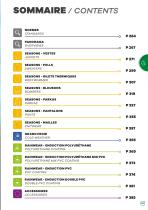
SOMMAIRE / CONTENTS NORMES STANDARDS PANORAMA OVERVIEWS SEASONS - VESTES JACKETS SEASONS - PULLS SWEATERS SEASONS - GILETS THERMIQUES BODYWARMER SEASONS - BLOUSONS BOMBERS SEASONS - PARKAS PARKAS SEASONS - PANTALONS PANTS SEASONS - MAILLES KNITWEAR GRAND FROID COLD WEATHER RAINWEAR - ENDUCTION POLYURÉTHANE POLYURETHANE COATING RAINWEAR - ENDUCTION POLYURÉTHANE MIX PVC POLYURETHANE MIX PVC COATING RAINWEAR - ENDUCTION PVC PVC COATING RAINWEAR - ENDUCTION DOUBLE PVC DOUBLE PVC COATING ACCESSOIRES ACCESSORIES
Open the catalog to page 3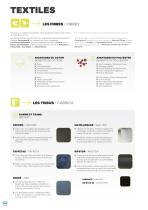
TEXTILES LES FIBRES / FIBRES Pour qu’une matière soit textile, il faut qu’elle permette notamment la réalisation de fils. For a material to be textile, it must allow the realization of yarns. Les fibres textiles entrant dans la composition des vêtements de la gamme Coverguard® se classent en deux catégories : Les Fibres Naturelles d’origine végétale comme le Coton et les Fibres Synthétiques créées chimiquement comme le Polyester, le Polyamide, l’Acrylique ou l’Elasthanne. The textile fibres used in the composition of the clothes of the Coverguard® range fall into two categories: Natural Fibres...
Open the catalog to page 4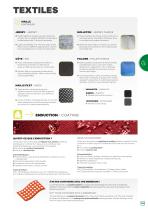
TEXTILES MAILLE KNITWEAR JERSEY / JERSEY MOLLETON / JERSEY FLEECE ■■ aille légère et souple. Les deux faces de M ce tissu ont un aspect différent. Utilisé dans la fabrication des T-shirts et des polos. ■■ issu moelleux et chaud. Il est construit sur T une base jersey et gratté à l’intérieur pour lui conférer son aspect duveteux. ■■ ight and flexible knit. The two sides of this L fabric have a different appearance. Used in the manufacture of T-shirts and polo shirt. ■■ oft and warm fabric. It’s built on a jersey S backing and brushed on the inside to give it its fluffy feel. POLAIRE / POLAR FLEECE...
Open the catalog to page 5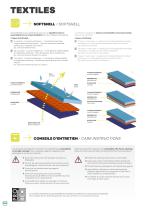
TEXTILES SOFTSHELL / SOFTSHELL Une Softshell a pour objectif de trouver un équilibre entre la respirabilité et une imperméabilité face aux faibles intempéries. A softshell is designed to balance breathability and waterproofing against the elements. 3 1 couches : 1 couche extérieure + 1 membrane laminée imperméable et respirante + 1 couche intérieure laminée polaire pour l’apport de chaleur Ex : Environnement frais 2 2 ,5 couches : 1 couche extérieure + 1 membrane imperméable et respirante laminée + 1 film protecteur de la membrane Ex : Environnement chaud/ mi-saison 2 3 couches : 1 couche extérieure...
Open the catalog to page 6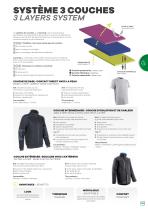
PLUIE ET VENT RAIN AND WIND Le système de couches ou « layering » est une technique qui désigne la superposition de plusieurs couches de vêtements. Chaque couche doit permettre d’évacuer la transpiration vers la couche suivante ou vers l’extérieur. 1 3 : S’habiller c’est aussi simple que de compter : 1 pour rester au sec 2 pour conserver la chaleur 3 pour se protéger des éléments extérieurs Layering is a technique that refers several layers of clothing. Each layer must allow perspiration to be evacuated to the next layer or to the outside. 1 RESPIRABILITÉ BREATHABILITY 2 3 : Dressing is as simple...
Open the catalog to page 7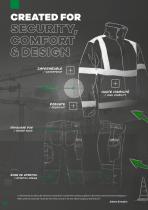
ImpermEable / waterproof RIPSTOP / RIPSTOP Haute visibilitE / high visibility Robuste / resistant rehausse dos / Raised back Zone de stretch / stretch areas « L'homme et sa sécurité doivent constituer la première préoccupation de toute aventure technologique » "Man and his security must be the first concern of any technological adventure" 262
Open the catalog to page 8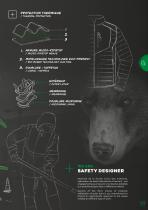
Protection thermique / thermal protection Armure micro-RIPSTOP / micro-ripstop weave MATELASSAGE technologie eco-friendly / bio-based technology quilting DOUBLURE : taffetas / lining : taffeta Exterieur / outer layer membrane / membrane DOUBLURe Micromink / micromink lining SAFETY DESIGNER Maîtrise de la forme, choix des matières, réalisation de tests (laboratoire et terrain) : nos engagements pour assurer une réponse adaptée aux problématiques liées à différents métiers. Control of the form, choice of material, realization of tests: here is our commitment to ensure an appropriate response to...
Open the catalog to page 9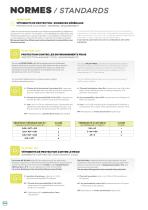
VÊTEMENTS DE PROTECTION : EXIGENCES GÉNÉRALES PROTECTIVE CLOTHING : GENERAL REQUIREMENT Cette norme permet de répondre aux exigences essentielles du règlement : L’ergonomie / Le confort / L’innocuité / La compatibilité des vêtements avec d’autres équipements ou portés ensemble / La durabilité, le vieillissement / Le marquage et la notice d’information / Indication de la taille du porteur. Elle ne peut pas être utilisée seule mais uniquement en association avec d’autres normes. This standard fulfils the essential requirements of the regulation : Ergonomics / Comfort / Innocuity / Compatibility...
Open the catalog to page 10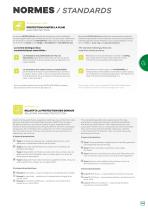
PROTECTION CONTRE LA PLUIE RAIN PROTECTION La norme NF EN 343+A1 spécifie les exigences et les méthodes d’essais applicables aux matériaux et aux coutures des vêtements de protection contre les intempéries, telles que les précipitations sous forme de pluie ou de neige, le brouillard et l’humidité du sol. La norme distingue deux caractéristiques essentielles : Standard NF EN 343+A1 specifies the requirements and test methods applicable to the materials and seams of protective clothing against severe weather, such as precipitation in the form of rain or snow, fog and ground moisture. The standard...
Open the catalog to page 11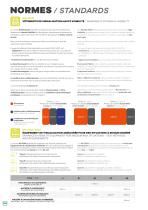
NORMES / STANDARDS ISO 20471 VÊTEMENTS DE SIGNALISATION HAUTE VISIBILITÉ / WARNING CLOTHING HI-VISIBILITY La norme EN ISO 20471 spécifie les exigences que doivent respecter les vêtements à Haute Visibilité afin de signaler visuellement la présence de l’utilisateur, notamment dans des conditions dangereuses, de jour comme de nuit. The EN ISO 20471 standard specifies the requirements that High Visibility garments must comply with in order to visually signal the presence of the user, particularly in conditions of dangerous, day and night. Beaucoup de professionnels peuvent être concernés par le...
Open the catalog to page 12All Coverguard catalogs and technical brochures
 NEW PRODUCTS
61 Pages
 FALL PROTECTION ANTICHUTE
98 Pages
 General catalogue
908 Pages
 NEW PRODUCTS
77 Pages
 Hand protection - 2021 version
110 Pages
 Foot protection - 2021 version
128 Pages