
- Catalogs
- Coverguard
- FALL PROTECTION ANTICHUTE

FALL PROTECTION ANTICHUTE

FALL PROTECTION ANTICHUTE
This document provides comprehensive information on fall protection equipment, focusing on safety and practicality. It includes specifications for various products such as harnesses, lanyards, anchors, and connectors, designed to ensure safety in different work environments.
- Specifications: Details on comfort padding, automatic buckles, and simplified pre-use checks are provided to enhance user safety and convenience.
- Product Categories: The document categorizes products into lanyards, rope grabs, anchors, connectors, full body harnesses, special environments, fall protection kits, accessories, self-retracting lifelines, and confined space equipment.
- Work at Height Hierarchy of Controls: Emphasizes the importance of eliminating fall hazards, using collective protective equipment, and minimizing fall consequences with personal protective equipment.
- European Standards: Lists relevant standards such as EN 361 for full body harnesses and EN 362 for connectors, ensuring compliance with safety regulations.
- Maintenance and Inspection: Guidelines for cleaning, storage, and inspection of equipment to maintain optimal performance and safety. It stresses the importance of professional maintenance and repair services.
- Avoid working at height whenever possible by modifying work processes.
- Use collective protective equipment over personal protective equipment for fall prevention.
- Ensure regular maintenance and inspection of fall protection equipment.
The document underscores the critical importance of safety in fall protection, providing detailed guidelines and product information to support safe work practices in various environments.
- Storage: Equipment should be stored in a cool, dry, and clean environment, away from direct sunlight. Use protective bags provided with the equipment.
- Cleaning: Remove excess grease, dirt, and grime using mild soap, water, and a rag. Dry the equipment with a rag and hang it out of direct sunlight.
- Pre-Use Check: Inspect all fall protection equipment for wear, damage, and deterioration before each use. If in doubt, consult a competent person or discard the equipment.
- Repair and Servicing: Mechanical devices can be serviced and repaired by factory-authorized centers. Do not modify or repair equipment in-house.
- Regulation: Personal Protective Equipment (PPE) against falls must be inspected every twelve months as per EN365 standard.
- Products to Inspect: Includes full body harnesses, lanyards, rope grabs, retractable fall arresters, connectors, karabiners, anchors, tripods, and winches.
- Competent Person: Inspections should be conducted by someone knowledgeable about current requirements and manufacturer instructions.
- Documentation: Inspection results must be recorded in a PPE register. Defective equipment should be removed from service and destroyed.
- Frequency: Inspections should occur at least once every twelve months, starting from the date of first use.
- Regulation: PPE category 3 is regulated by Regulation (EU) 2016/425.
- Training Offerings: Coverguard provides technical guidance, documentation, personalized support, and various training programs including fall protection awareness and product training.
- Work Restraint: Prevents falls by restricting user movement. Not designed to arrest falls.
- Work Positioning: Supports work at height with hands-free operations. Requires a backup system.
- Fall Arrest: Stops falls and minimizes injury. Requires a rescue plan.
- Work in Suspension: Used for accessing hard-to-reach areas. Not a work position unless necessary.
- Confined Space Work: Secures access to confined spaces with a system typically consisting of a tripod, self-retracting lifeline, and rescue winch.
- Preparation: Empty pockets and inspect the harness.
- Fitting: Properly adjust shoulder, chest, and leg straps. Ensure the harness is snug but allows free movement.
- Attachment Points: Use only authorized points for connecting fall arrest equipment.
- Swing Falls: Occur when the anchorage point is not directly above the user, leading to a pendulum effect that can cause serious injury upon impact with nearby structures.
- Fall Factor: Defined as the ratio of free fall distance to the length of the lanyard. Different scenarios are described based on the position of the anchor relative to the user.
- Suspension Trauma: A medical emergency that occurs when a worker is suspended in a harness for too long, leading to orthostatic shock. Symptoms include dizziness, nausea, and increased pulse rate. Immediate rescue is critical.
- Dropped Object Hazards: Emphasizes the importance of securing tools to prevent them from falling, as industrial helmets offer limited protection against falling objects.
- Fall Protection Equipment: Detailed descriptions of various equipment types, including absorbing lanyards, self-retracting lifelines, and full-body harnesses, with specific applications for different work environments.
This document provides detailed specifications and features of various safety harnesses and lanyards designed for fall arrest, positioning, and suspension systems. Each product is described with its unique benefits, usage, standards, and packaging details.
- Weight: 1.18 kg
- Features: Fall indicators, adjustable straps, protected label with inspection log
- Usage: Fall arrest or restraint system
- Standards: EN361:2002
- Breaking Strength: > 15kN
- Weight: 1.7 kg
- Features: Easy to adjust, comfortable padding, fall indicators
- Usage: Fall arrest or restraint system
- Standards: EN361:2002
- Breaking Strength: > 15kN
- Weight: 1.48 kg
- Features: Lightweight, different colored straps, lanyard keepers
- Usage: Fall arrest and/or positioning system
- Standards: EN361:2002, EN358:2018
- Breaking Strength: > 15kN
- Weight: 1.87 kg
- Features: Fall indicators, adjustable straps, protected label
- Usage: Fall arrest and/or positioning system
- Standards: EN361:2002, EN358:2018
- Breaking Strength: > 15kN
- Weight: 2.3 kg
- Features: Easy to adjust, comfortable padding, protected label
- Usage: Fall arrest and/or positioning system
- Standards: EN361:2002, EN358:2018
- Breaking Strength: > 15kN
- Weight: 1.6 kg
- Features: Ergonomic back support, breathable straps
- Usage: Suspension, fall arrest, and positioning system
- Standards: EN361:2002, EN358:2018, EN813:2008
- Breaking Strength: > 15kN
- Weight: 2.25 kg
- Features: Easy to adjust, comfortable padding, fall indicators
- Usage: Suspension, fall arrest, and positioning system
- Standards: EN361:2002, EN358:2018, EN813:2008
- Breaking Strength: > 15kN
- Various models with lengths ranging from 1m to 4m
- Features: Shock absorbing, protected loops, steel connectors
- Standards: EN355:2002
- Force Reduction: < 6 kN
- Material: Polyester webbing (30 mm width) and Polyamide braided rope (Ø 11 mm).
- Connectors: Steel screw karabiners, automatic karabiners, and scaffold hooks.
- Sizes: Various lengths ranging from 1 m to 2 m.
- Force Reduction: Less than 6 kN.
- Breaking Strength: Greater than 15 kN.
- Weight: Varies by model and length, ranging from 720 g to 1.92 kg.
- Protected loops for enhanced durability.
- Elastic webbing to reduce length when not in tension, minimizing trip hazards.
- Stitches protected by a transparent sleeve for increased durability.
- Tested for use near sharp edges according to VG 11.074 standards.
- Designed for fall arrest systems, providing shock absorption to limit forces during a fall.
- Double leg lanyards offer 100% tie-off, allowing safe movement between anchors.
- Restraint lanyards limit user movement to prevent reaching fall-risk areas.
- Lightweight aluminum connectors reduce overall weight.
- Automatic karabiners ensure quick and secure connections.
- Validated for use near sharp edges, enhancing safety in construction and industrial environments.
- Complies with EN355:2002 and EN354:2010 standards.
- Packaged individually, with options for 10 or 20 units per carton.
1. The document details various safety equipment, including steel screw karabiners and connectors with a 50 mm opening.
2. The equipment is made from polyamide braided rope with a diameter of 11 mm and 14 mm, and includes steel connectors.
3. Breaking strength is specified as greater than 15 kN or 22 kN, depending on the product.
4. Weight varies from 160 g to 3.4 kg based on the product type and size.
1. Restraint lanyards are designed to limit user movement to prevent falls.
2. Positioning lanyards allow users to work hands-free and are part of a work positioning system.
3. Self-retracting lifelines (SRL) are used for vertical and horizontal applications, providing freedom of movement and reduced clearance distance.
1. Products comply with standards such as EN354:2010, EN358:1999, and EN360:2002.
2. Some products are tested on sharp edges according to VG 11.060.
1. Many products feature protective sleeves for durability and easy adjustment mechanisms.
2. SRLs can be used in any direction and are suitable for use near sharp edges.
3. Some products are lightweight and include fall indicators for pre-use checks.
1. Products are individually packed, with quantities per box varying from 4 to 25 depending on the product.
1. Products include features like loops with thimbles, steel tensioners, and automatic karabiners.
2. Materials used include polyamide and polyester webbing, with some products featuring aluminium components.
3. Sizes range from 1 m to 6 m, with specific models designed for different applications.
1. The document outlines the specifications for self-retracting lifelines (SRLs) and mobile rope grabs, designed for use in potentially explosive environments (ATEX).
2. Standards include EN360:2002 and ATEX DIRECTIVE 2014/34/EU for SRLs, and EN353-2:2002 for rope grabs.
3. Connectors and karabiners comply with EN362:2004 standards.
1. SRLs feature a strong polymer housing, galvanized steel cable, and steel swivel snaphook with impact indicators.
2. Rope grabs are made of steel with absorbers and polyamide braided ropes.
3. Connectors and karabiners are available in steel and aluminum, with various locking mechanisms and breaking strengths.
1. SRLs are designed for overhead use, allowing freedom of movement and reduced clearance distance.
2. Rope grabs are suitable for vertical, horizontal, and inclined surfaces, with options for automatic and manual locking.
3. Temporary anchors allow for the creation of anchor points around structures for fall arrest or restraint systems.
1. SRLs are individually packed, with quantities per box varying by model.
2. Rope grabs and connectors are also individually packed, with specific quantities per carton.
1. SRLs have a force reduction of less than 6 kN and a breaking strength of over 12 kN.
2. Rope grabs have a breaking strength of over 15 kN.
3. Connectors have a breaking strength of over 23 kN, with specific gate openings and weights detailed for each model.
1. The document includes details on the materials used, such as steel, aluminum, and polyester webbing.
2. Specific models and sizes are listed, with corresponding weights and dimensions.
3. The document emphasizes the importance of visual checks and suitability for ATEX environments.
1. Tarpaulins: Available in two types:
- 120g/m2 Polyethylene, green color, with metal eyelets every meter. Dimensions: 8 x 12 m, 2 per box.
- 68g/m3 Polyethylene, royal blue color, with metal eyelets every meter. Several sizes available.
- Suitable for farming, silviculture, fishing, regional/public authorities, maintenance, infrastructure, building industry, construction finishing work, and services/distribution sectors.
- Harnesses & Belts: Various models including ADHARA, ALBALI, ALCOR, ALIOTH, and more, with page references for detailed information.
- Connectors: Models like ANEO, APUT, MAOYAQ, and others.
- Lanyards: Includes ARALIA, ARDISIA, ARECA, and more.
- Anchors: Products such as BALTORO, BATURA, PASSU, and others.
- Self Retracting Lifelines: Models like BOREAS, CALIMA, EUROS, and more.
- Accessories: Includes ALTAI PRO, MAX300, SAFETY STAR, and others.
Coverguard Safety is a designer and supplier of personal protective equipment from head to toe, located at 555 rue de la Dombes, 01700 MIRIBEL, France. Contact: +33 (0)4 72 26 23 23, [email protected].
Catalog excerpts

FALL PROTECTION
Open the catalog to page 1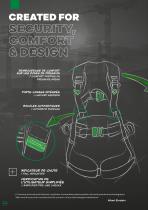
Rembourrage de confort sur les zones de pression / Comfort padding on pressure areas porte-longes integrEs / Lanyard keepers boucles automatiques / Automatic buckles indicateur de chute / fall indicators verification de l'utilisateur simplifiee / simplified pre-use checks « L'homme et sa sécurité doivent constituer la première préoccupation de toute aventure technologique » "Man and his security must be the first concern of any technological adventure" Albert Einstei
Open the catalog to page 2
PRATIciTE / securite / rapidite / Practicality safety Sangle en polyester / polyester webbing Rembourrage en mousse / Comfort padding in foam Mesh respirant polyester / BREATHABLE POLYESTER MESH SAFETY DESIGNER Maîtrise de la forme, choix des matières, réalisation de tests (laboratoire et terrain) : nos engagements pour assurer une réponse adaptée aux problématiques liées à différents métiers. Control of the form, choice of material, realization of tests: here is our commitment to ensure an appropriate response to the issues related to different type of wo
Open the catalog to page 3
SOMMAIRE / CONTENT PANORAMA OVERVIEW ENVIRONNEMENTS SPÉCIAUX SPECIAL ENVIRONMENTS HARNAIS ANTICHUTE & CEINTURES FULL BODY HARNESSES & BELTS LONGES LANYARDS ANTICHUTES À RAPPEL AUTOMATIQUE SELF RETRACTING LIFELINES ANTICHUTES MOBILES SUR CORDE ROPE GRABS CONNECTEURS CONNECTORS ANCRAGES ANCHORS ESPACES CONFINÉS CONFINED SPACE KITS ANTICHUTE FALL PROTECTION KITS
Open the catalog to page 4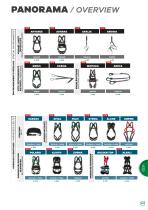
RISQUE ÉLECTRIQUE ELECTRICAL HAZARD SOUDAGE / HAUTE TEMPÉRATURE WELDING AND HOT WORKS ATEX / ENVIRONNEMENTS EXPLOSIFS / POTENTIALLY EXPLOSIVE ENVIRONMENTS HARNAIS DE SUSPENSION SUSPENSION HARNESSES CEINTURES BELTS HARNAIS ANTICHUTE FULL BODY HARNESSES HARNAIS AVEC CEINTURE DE MAINTIEN BELTED HARNESSES HARNAIS & CEINTURES / HARNESSES & BELTS ENVIRONNEMENTS SPÉCIAUX / SPECIAL ENVIRONMENTS
Open the catalog to page 5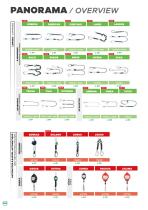
PANORAMA / OVERVIEW CORYLUS À ABSORBEUR ABSORBING LANYARDS LONGES / LANYARDS DE RETENUE RESTRAINT LANYARDS PERSONNEL PERSONAL CÂBLE CABLE SANGLE WEBBING ANTICHUTES À RAPPEL AUTOMATIQUE SELF RETRACTING LIFELINES
Open the catalog to page 6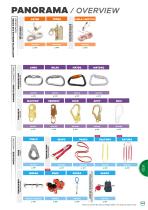
DÉTACHABLE DETACHABLE VIOLA / NEOTTIA MOUSQUETONS À ABSORBEUR KARABINERS CONNECTEURS / CONNECTORS ANTICHUTES MOBILES SUR CORDE ROPE GRABS PANORAMA / OVERVIEW LIGNE DE VIE HORIZONTALE TEMPORARY HORIZONTAL LIFELINE FIXES À ABSORBEUR FIXED TEMPORAIRES TEMPORARY TEMPORAIRES TEMPORARY ANCRAGES / ANCHORS CROCHETS HOOKS *Dans la limite des stocks disponibles / As long as stocks last
Open the catalog to page 7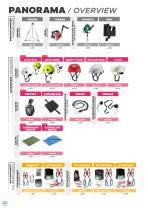
ANTICHUTE AVEC TREUIL SRL WITH WINCH SUPPORT SUPPORTS ESPACES CONFINÉS CONFINED SPACE PANORAMA / OVERVIEW SAFETY STAR SKYLOR PLUS NEMBUS ACCESSOIRES HARNAIS HARNESS ACCESSORIES ANTICHUTES POUR OUTILS TOOL TETHERS BÂCHES TARPAULINS CASQUES HELMETS CASQUES À ABSORBEUR HELMETS ALTAI WIND ACCESSOIRES / ACCESSORIES KITS ANTICHUTE FALL ARREST KIT KITS DE RETENUE À ABSORBEUR RESTRAINT KIT KITS ANTICHUTE FALL PROTECTION KITS
Open the catalog to page 8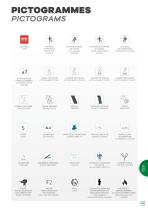
SYSTÈME DE RETENUE RESTRAINT SYSTEM SYSTÈME D'ARRÊT DE CHUTE FALL ARREST SYSTEM SYSTÈME DE MAINTIEN AU TRAVAIL WORK POSITIONING SYSTEM SYSTÈME DE SUSPENSION SUSPENSION SYSTEM SYSTÈME POUR ESPACE CONFINÉS CONFINED SPACE SYSTEM 1 POINT D'ATTACHE 1 ATTACHMENT POINT 2 POINTS D'ATTACHE 2 ATTACHMENT POINTS 4 POINTS D'ATTACHE 4 ATTACHMENT POINTS 5 POINTS D'ATTACHE 5 ATTACHMENT POINTS CORDE TORONNÉE TWISTED ROPE CORDE TRESSÉE BRAIDED ROPE SANGLE WEBBING SANGLE ÉLASTIQUE ELASTIC WEBBING CÂBLE WIRE ROPE CAPACITÉ 2 UTILISATEURS 2 USER CAPACITY VÉROUILLAGE À VIS SCREW LOCKING VÉROUILLAGE AUTOMATIQUE AUTOMATIC...
Open the catalog to page 9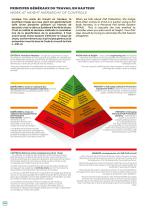
PRINCIPES GÉNÉRAUX DU TRAVAIL EN HAUTEUR WORK AT HEIGHT HIERARCHY OF CONTROLS Lorsque l'on parle de travail en hauteur, la première image qui nous vient est généralement celle d’une personne utilisant un harnais de sécurité, c’est-à-dire un Système d’Arrêt de chute. C’est en réalité la dernière méthode à considérer lors de la planification de la prévention. Il faut avant toute chose essayer d’éliminer le risque de chute, conformément aux 9 principes généraux de prévention inscrits dans le Code du travail (article L. 4121-2). ÉVITER le Travail en Hauteur – il s’agit de supprimer le risque de chute...
Open the catalog to page 10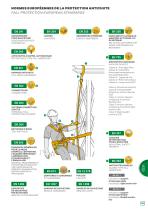
NORMES EUROPÉENNES DE LA PROTECTION ANTICHUTE FALL PROTECTION EUROPEAN STANDARDS DESCENDEURS POUR SAUVETAGE DESCENDER DEVICES FOR RESCUE ABSORBEURS D’ÉNERGIE ENERGY ABSORBERS LONGES LANYARDS EN 358 CEINTURES ET LONGES DE MAINTIEN AU TRAVAIL OU DE RETENUE BELTS AND LANYARDS FOR WORK POSITIONING OR RESTRAINT EN 360 ANTICHUTES À RAPPEL AUTOMATIQUE RETRACTABLE TYPE FALL ARRESTERS HARNAIS ANTICHUTE FULL BODY HARNESSES Class A: Structural anchors Class B: Transportable temporary anchor devices (CE) Class C: Anchor devices employing horizontal flexible lines Class D: Anchor devices employing horizontal...
Open the catalog to page 11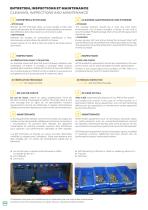
ENTRETIEN, INSPECTIONS ET MAINTENANCE CLEANING, INSPECTIONS AND MAINTENANCE ENTRETIEN & STOCKAGE • STOCKAGE Stocker les EPI antichute dans un local ventilé, à l’abri des rayons ultraviolets, de l’humidité et d’atmosphères corrosives, de préférence dans des casiers ou armoires à outils. • NETTOYAGE Nettoyer les sangles et composants métalliques à l’eau savonneuse, ne pas utiliser de solvant chimique. Laisser sécher à l’air libre à l’abri du soleil et de toute source de chaleur. INSPECTIONS A) VÉRIFICATION AVANT UTILISATION Un contrôle visuel doit être fait avant chaque utilisation par l’utilisateur...
Open the catalog to page 12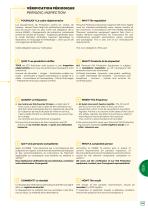
VÉRIFICATION PÉRIODIQUE PERIODIC INSPECTION POURQUOI ? Le cadre réglementaire Les Equipements de Protection contre les chutes de hauteur doivent faire l’objet de vérifications périodiques tous les douze mois au plus. C’est une obligation de la norme EN365 « Équipements de protection individuelle contre les chutes de hauteur - Exigences générales pour le mode d'emploi, l'entretien, l'examen périodique, la réparation, le marquage et l'emballage » ; ainsi qu’une de nos exigences de fabricant. Personal Protective Equipment against falls from height must be checked periodically every twelve months...
Open the catalog to page 13All Coverguard catalogs and technical brochures
 NEW PRODUCTS
61 Pages
 General catalogue
908 Pages
 NEW PRODUCTS
77 Pages
 Hand protection - 2021 version
110 Pages
 Seasons - 2021 version
138 Pages
 Foot protection - 2021 version
128 Pages