


Indoor Sports Surfaces

Indoor Sports Surfaces
Catalog excerpts
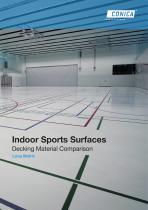
Indoor Sports Surfaces Decking Material Comparison Long Matrix
Open the catalog to page 1
Polyurethane (CONICA) Synthetically manufactured from petrochemicals. Contains natural alcohols and mineral fillers. Synthetically manufactured by the vegetable oil industry. Contains natural oils and mineral fillers. A mixture of linseed oil, cork dust and saw dust filled with chalk and other mineral fillers is applied to a backing fabric made of jute. Synthetically manufactured from petrochemicals. In the manufacturing process, already problematic production residues from chlorine chemistry accumulate. Large amount of softening agents are used to elasticize the hard and brittle PVC material. Natural...
Open the catalog to page 2
CONICA LTD Jessop Way Newark, Nottinghamshire NG24 2ER, United Kingdom Fon +44 (0)1636 642 460, Fax +44 (0)1636 642 477 [email protected], www.conica.com
Open the catalog to page 3All CONICA catalogs and technical brochures
 High performance flooring
16 Pages
 CONICA FUNCTIONAL FLOORING
42 Pages
 CONIPUR MX+
4 Pages
 CONIPUR PRO CLAY
6 Pages


- Industrial flooring
- Indoor flooring
- Tertiary flooring
- Industrial plaster
- Vinyl floor covering
- Tile flooring
- Non-slip flooring
- Gray flooring
- Commercial flooring
- Building coating
- Smooth flooring
- Indoor coating
- Textured flooring
- Acoustic floor covering
- Roll flooring
- Concrete look flooring
- Decorative flooring
- Exterior flooring
- Waterproof floor covering
- Smooth coating