- Company
- Products
- Catalogs
- News & Trends
- Exhibitions
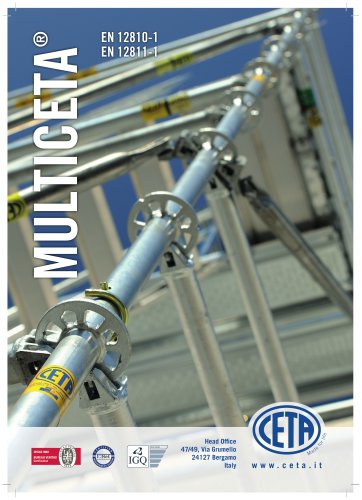
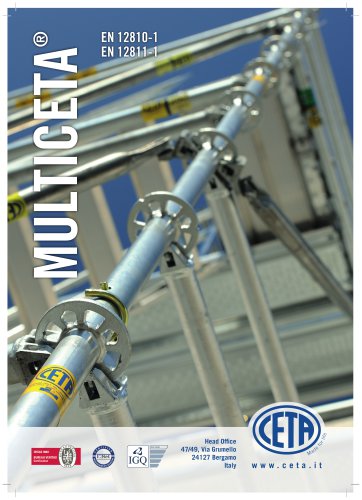
MULTICETA ALLROUND SYSTEM - UNI EN 12810-1 EN 12811-1 2013
MULTICETA ALLROUND SYSTEM - UNI EN 12810-1 EN 12811-1 2013
CETA, founded in 1947 in Bergamo, Italy, specializes in scaffolding systems for construction, sports, and entertainment. The company is known for quality and safety, certified by Italian authorities, and holds a UNI EN ISO 9001-2000 certification. CETA provides sales, rental, technical support, and training services.
Automated Production
CETA's production is largely automated, ensuring efficient delivery to construction sites or distributors.
Multiceta System
Advantages: Combines traditional scaffolding with modern modularity, offering safety and flexibility. Features an 8-connection rosette for complex structures.
Features: Made from high-quality steel S355JR, robust and easy to assemble without bolts.
Applications: Suitable for façade scaffolds, supporting structures, staircases, etc.
Loading Platforms
Designed for efficient loading adjacent to façade scaffolds, with a load capacity of up to 450 kg/m².
Decks for Multiceta System
CK series decks are safe and resistant, bearing loads up to 600 kg/m², featuring a special clinching process.
TMC Lattice Girders
Used for wide-span structures like catwalks and protection roofs, offering easy assembly and high load capacity.
MC Supporting Scaffold
Offers a competitive alternative to traditional scaffolding, with heights up to 20 m and load capacities between 30 kN and 50 kN per standard.
Staircases
Multiceta staircase towers can exceed 60 m in height without standard doubling, offering easy assembly.
Software and Services
CetaCAD software and comprehensive services support customers in design, assembly, and technical assistance.
Staircases
- Monodirectional and Bidirectional Staircases: Floors set every 2 meters, with exits on the sides for monodirectional and at the front for bidirectional staircases. Standard size is 150x250 with a flight load capacity of 2 kN/m² and 30 flights.
- Modular and Sectional Staircases: Designed for loads up to 600 Kg/m² with widths ranging from 77 cm to 300 cm, all with a load capacity of 6 kN/m² except for the 300 cm width which has 3 kN/m².
- Designed for building maintenance and renovation in old town centers, avoiding public area occupation. Scaffold life is 2 years with specific loading conditions and a maximum wind speed of 57.6 Km/h.
- Versatile structures for shows and sports events, including stages, tribunes, and barriers. Adaptable for various site requirements and can include access for handicapped individuals.
- Composed of standards and ledgers with plywood surfaces supported by lattice girders. Structures can be made in multiple sizes with adjustable base plates for even surfaces. Plywood surfaces are coated for wear resistance and comply with British regulations.
- Includes adjustable base plates, crosshead spindles, and various braces and ledgers for scaffolding systems.
- Components include base collars, standards with and without spigots, ledgers, diagonal braces, and console brackets for scaffold width adjustment.
- Includes various girders and accessories for constructing lattice structures, with specific weights and item numbers provided.
- Galvanized tubes and couplers for scaffolding, with detailed specifications on weight and dimensions.
- Wooden beams with specific moment and cut values, available in various lengths and weights.
- Includes fixing elements for wooden beams and ledgers, with detailed specifications.
- Includes sale, rent, and rent with assembly services. Technical and static solutions are provided by the engineering department, with on-site assistance available.
- Headquarters and branch office contact details for CETA SPA in Italy.
Catalog excerpts

MULTICETA® SYSTEM
Open the catalog to page 1
>2 This is an informative catalogue about CETA products for the Italian and the European markets. For a proper use of CETA equipment, we recommend to observe the specifications quoted both in the Ministerial Authorization books and in the calculation reports signed by a qualified engineer. The use of either supporting scaffolds or staircase towers as well as all improper use not mentioned in the Ministerial Authorization books is prescriptive according to the regulations in force. For the use of both supporting scaffolds and staircase towers, calculation reports duly signed by a qualified engineer...
Open the catalog to page 2
- COMPANY PROFILE - CETA was established in 1947 in Bergamo, that is that region of northern Italy which is considered as the cradle of the Italian building tradition. It has been producing scaffolding systems and accessories for the construction field since then and thanks to the long experience acquired over the years, together with the new technologies and patents developed, it has achieved a top-quality level both in the construction and in the sport and entertainment sectors. As a matter of fact, the wide range of products offered by CETA includes different types of scaffolds and components...
Open the catalog to page 4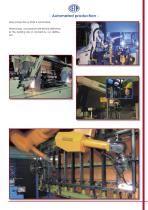
- Automated production Most production in CETA is automated. When ready, our products are directly delivered to the building site or stocked by our distributors.
Open the catalog to page 5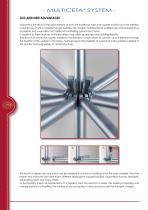
- MULTICETA® SYSTEM OLD AND NEW ADVANTAGES Multiceta is the result of the improvement of both the traditional tube and coupler scaffold and the prefabricated frame, of which it keeps the best qualities. Yet, modern multidirectional scaffolds are characterized by a modularity and a versatility that traditional scaffolding systems don’t have. In addition to these features, Multiceta offers more safety guarantees and building flexibility. Thanks to its 8-connection rosette welded to the standard - which allows to connect up to 8 elements through the insertion of the wedges in the holes – Multiceta...
Open the catalog to page 6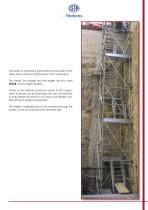
The solidity of Multiceta is guaranteed by the quality of the steel used as well as by the thickness of its components. The rosette, the wedges and the ledgers are all in steel S355JR, which is highly resistant. Thanks to the rational connection system of the components, Multiceta can be assembled very fast. The absence of bolts permits the erection of a robust and flexible scaffold with just a simple hammer blow. The weight is well-balanced on the standards through the rosette, so the structure becomes extremely rigid
Open the catalog to page 7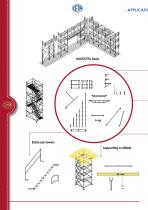
MULTICETA Basic Staircase towers Supporting scaffolds
Open the catalog to page 8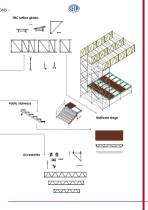
Public stairways Multiceta stage
Open the catalog to page 9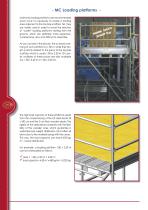
- MC Loading platforms Multiceta loading platforms are recommended every once it is necessary to create a loading area adjacent to the façade scaffold. Yet, they are mainly used in order to avoid the erection of “castle” loading platforms starting from the ground, which are definitely more expensive, cumbersome, slow and difficult to assemble. As you can see in the picture, the outward overhang of such platforms is 1.80 m, while their length is strictly related to the pace of the façade scaffold, which is usually 1.80 or 2.50 m. Of course, multiples of these paces are also available (i.e. 1.80...
Open the catalog to page 10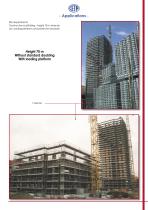
- Applications Site requirements: Construction scaffolding – height 70 m; inner decks, loading platforms and protection brackets Height 70 m Without standard doubling With loading platform
Open the catalog to page 11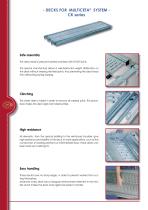
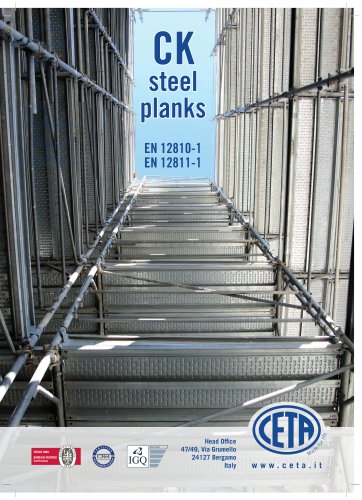
- DECKS FOR MULTICETA® SYSTEM -CK series Safe assembly The deck head is pressure-inserted and fixed with 8 TOX® joints. This special manufacture allows a well-balanced weight distribution on the deck without stressing the fixed joints, thus preventing the deck head from detaching during loading. Clinching The sheet steel is folded in order to remove all welded joints. This procedure makes the deck rigid and indestructible. High resistance All elements, from the special profiling to the reinforced shoulder, give high resistance and stability to the deck. In some applications, such as the construction...
Open the catalog to page 12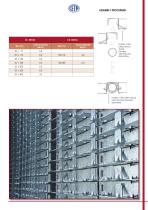
ASSEMBLY PROCEDURE CK DECKS Position of the safety device O during the deck assembly and dismantling
Open the catalog to page 13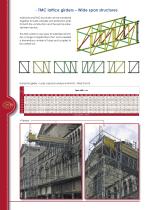
- TMC lattice girders - Wide span structures Multiceta and TMC structures can be combined together to build catwalks and protection roofs for both the construction and the sport & entertainment sectors. The TMC system is very easy to assemble and offers a range of applications that once needed a tremendous number of tubes and couplers to be carried out. Horizontal girder - Load capacity analysis in kN/m2 - Wind 0 km/h
Open the catalog to page 14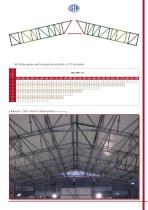
> Bologna – CETA’s stand at SAIE exposition
Open the catalog to page 15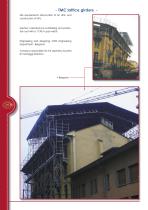
- TMC lattice girders Site requirements: Renovation of an attic and construction of lofts. Solution: maintenance scaffolding and protection roof with a 17.90 m span width. Engineering and designing: CETA Engineering Department - Bergamo Company responsible for the assembly: Società di montaggi Tarantino
Open the catalog to page 16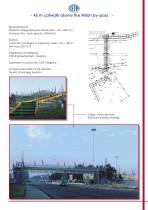
- 45 m catwalk above the Milan by-pass Site requirements: Pedestrian bridge joining two festival areas - min. width 4 m, total span 45 m, load capacity 6.00 kN/m2 . Solution: A structure composed of supporting towers 1.50 x 1.80 m with warp 2.30 x 2.70 Engineering and designing: CETA Engineering Dept. - Bergamo Supervision of construction: CETA - Bergamo Company responsible for the assembly: Società di montaggi Tarantino > Milan – Festa dell’Unità (PDS-party national meeti
Open the catalog to page 17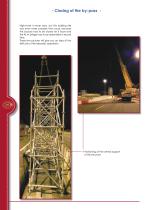
Night-work is never easy, but this building site was even more complex than usual, because the by-pass had to be closed for 5 hours and the 45 m-bridge had to be assembled in record time. These few pictures will give you an idea of the difficulty of the assembly operations < Positioning of the central support of the structure
Open the catalog to page 18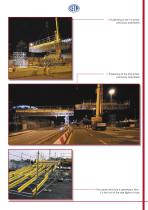
< Positioning of the 1st ashlar, previously assembled < Positioning of the 2nd ashlar, previously assembled < The central structure is assembled. Now, it is the turn of the side flights of stairs
Open the catalog to page 19All CETA SPA catalogs and technical brochures
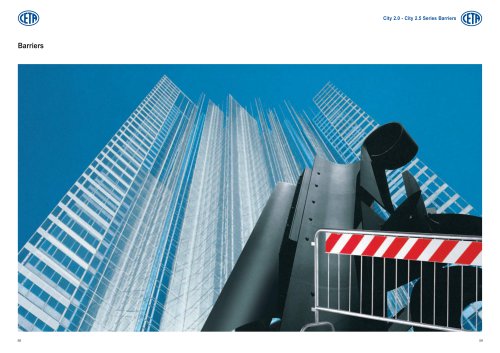 Barriers
3 Pages
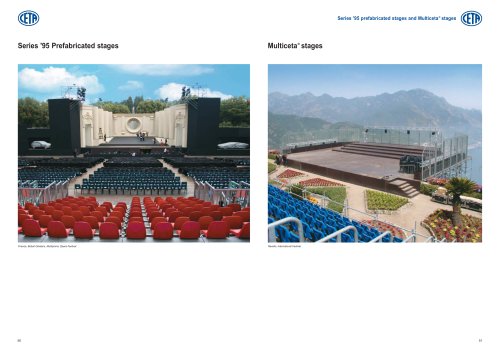 Prefabricated stages
4 Pages
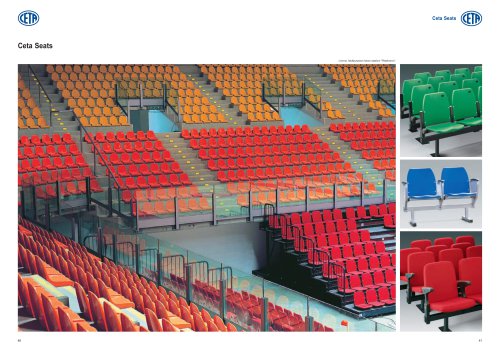 Ceta Seats
5 Pages
 Telescopic Stands
8 Pages
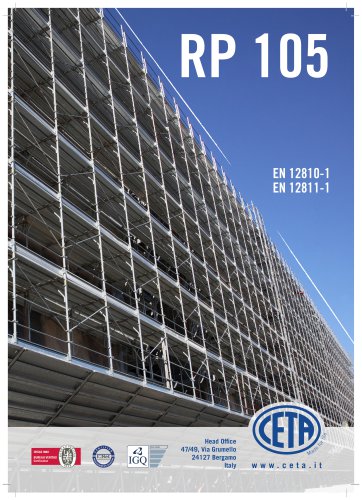 RP-105
2 Pages
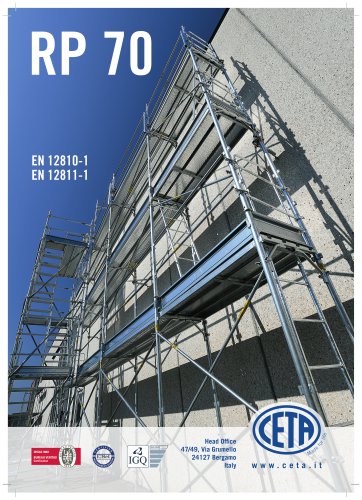
 RP-70
RP-702 Pages
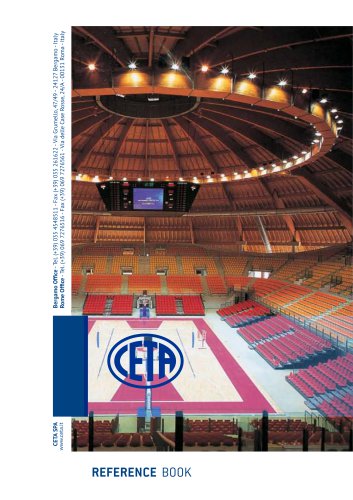 Reference-Book-Metalwork
5 Pages
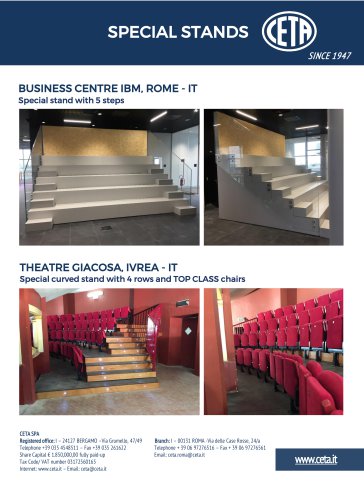 Special stands
4 Pages
 COMPANY PROFILE
28 Pages
 SPORT - ENTERTAINMENT
35 Pages
 SERIES “G2M”
39 Pages