
- Catalogs
- CBG Composites
- SeaPan WP 30/60

SeaPan WP 30/60

SeaPan WP 30/60
- 100% natural and incombustible
- No smouldering or smoke emission in case of fire
- Heat and sound insulating
- Mechanically loadable and moisture-resistant
- Vibration dampening and corrosion-resistant
- Chemically neutral and recyclable
- Surface density: 12.4 ± 10% kg/m2 with max 4% moisture content
- Gross thickness: 30 ± 1 mm
- Material composition: Ceramic basalt fiber, glass fiber laminate, specific mineral wool, inorganic fire protection adhesive
- Density: 400 ± 15% kg/m3
- Compressive strength: 100 ± 10 kPa
- Tensile strength: 30 ± 5 kPa
- Non-combustibility: Complies with IMO 2010 FTPC Part 1
- Fire class: A-60 (IMO 2010 FTPC Part 3)
- Inorganic content: Approx. 99%
- Thermal stability: Up to 1,300°C
- Available in various sizes and surfaces upon request
- Delivered on pallets wrapped with stretch film
- Connecting strips and adhesives available upon request
- Can be processed with standard cutting tools
- Protective measures recommended during processing
- Store horizontally on a level surface, secured against slipping
Catalog excerpts
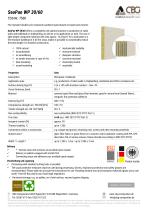
Carbon Basalt Glas Fire-resistant double-core composite sandwich panel based on basalt and ceramic. SeaPan WP 30/60 offers a completely new optimal solution to production of cabin walls and bulkheads in shipbuilding, as well as to its application on land. The use of light-weight composite materials with only approx. 12,4 kg/m2 for a wall panel or a fire-resistant bulkhead of A-60 fire class, makes it possible to considerably reduce the total weight of a finished construction. ✓ 100% natural ✓ incombustible ✓ no smouldering ✓ no smoke emission in case of fire ✓ heat-insulating ✓ sound-insulating ✓ mechanically loadable ✓ moisture-resistant ✓ dampens vibration ✓ corrosion-resistant ✓ chemically neutral ✓ recyclable Delivery S *- Various sizes and surfaces are possible upon request ^,clc„„cr, S Delivery on pallets wrapped with stretch film ■/ Connecting strips and adhesives are available upon request Verarbeitung und Lagerung S Processing with standard cutting tools is possible ✓ The usual protective measures must be used during processing. Gloves, respiratory protection and safety glasses are recommended. Please take into account the instructions for use "Handling mineral wool and insulation materials (glass wool, rock wool)" from BG Bau and/or your local legal regulations ✓ Horizontal storage, e.g. on pallets, on a level surface, secured against slipping CBG Composites GmbH Egerpohl 2 D-51688 Wipperfurth / Germany Tel: 02267-67-0 Fax: 02267-67-222 www.cbg-composites.de [email protected] The technical specifications of our products reflect the state of our knowledge at the time of printing. Therefore, the latest edition of the data sheet should always be used, as our experience and knowledge is constantly evolving. In case of doubt please contact us. The application shown is only exemplary and may vary in individual cases. It is therefore not liable. Our general terms and conditions apply, the latest version of which can be downloaded on our homepage
Open the catalog to page 1All CBG Composites catalogs and technical brochures
 CBG SeaPan WP 25/G
2 Pages
 SeaPan WP 50
1 Page
 CBG SilencePan 25/G
1 Page
 SeaPan FF 30/60
1 Page
 CBG BCR Rebar
1 Page
 CBG BCR Grid
1 Page
 CBG-Basalt-Fiber chops
1 Page
 CBG Basalt Roving
1 Page
 TDS CBG FirePan 50-90_EN
1 Page
 TDS CBG FirePan 25-30_EN
1 Page
 TDB CBG EasyPan-100_EN
1 Page
 TDB CBG EasyPan-75_EN
1 Page
 TDB CBG EasyPan-50_EN
1 Page


Archived catalogs
 CBG Glass fiber laminate
1 Page
 CBG Grid laminate Style
1 Page
 CBG Basaltfiber laminate
1 Page
 CBG PgBE
1 Page
 CBG PgGE
1 Page
 CBG-Basalt fabric
1 Page


- Thermal insulation
- Wall insulation
- High-performance insulation
- Mineral insulation
- Industrial acoustic insulation
- Metal facing sandwich panel
- Non-flammable insulation
- Facade acoustic sandwich panel
- Exterior insulation
- Glue
- Wall sandwich panel
- High-resistance sandwich panel
- Waterproof insulation
- Partition wall acoustic sandwich panel
- Wood glue
- Fire protection sandwich panel
- Foam insulation
- Fire-resistant sandwich panel
- Industrial concrete