
- Catalogs
- Black Mountain
- Hemp Insulation Product Brochure

Hemp Insulation Product Brochure

Hemp Insulation Product Brochure
Hemp insulation is presented as a sustainable, efficient, and environmentally friendly alternative for building insulation. It offers benefits such as carbon sequestration, moisture regulation, and thermal performance.
Environmental Impact
Hemp insulation locks up to two tonnes of CO₂ per tonne of fibre, making it a carbon-negative product. It requires minimal water and no artificial irrigation, and it acts as a natural weed suppressor, reducing the need for herbicides.
Moisture and Thermal Performance
Hemp insulation can absorb up to 20% of its weight in moisture without affecting its thermal performance. It acts as a moisture buffer, ideal for timber frame structures. The thermal conductivity is 0.039 W/m°K, providing excellent insulation properties.
Durability and Structure
The high natural fibre content ensures a semi-rigid structure, resistant to slumping and compaction, maintaining energy efficiency over time.
Manufacturing and Sustainability
Black Mountain's manufacturing process uses up to 90% less energy compared to alternatives. The product is biodegradable and can be incinerated for energy at the end of its life.
Technical Specifications
Hemp insulation meets various UK standards for thermal requirements. It has a fire performance rating of Euro Class E and is treated with a non-toxic compound for fire safety. Available in semi-rigid batts, it comes in various sizes and thicknesses.
Installation
Easy to install without protective clothing, hemp insulation is suitable for lofts, rafters, walls, and inter-floor applications.
Conclusion
Black Mountain hemp insulation is a technically superior, environmentally sensitive product, offering a greener alternative in the insulation market.
Catalog excerpts
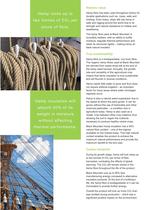
Historic value H emp locks up to t wo tonnes of C O ₂ per tonne of f ibre. Hemp fibre has been used throughout history for durable applications such as, ropes, sails and clothing. Even today, ships still use hemp in sails and rigging around the world due to its strength and natural resistance to mildew and weathering. The hemp fibre used at Black Mountain is incredibly resilient, with an ability to buffer moisture, regulate thermal performance and retain its structural rigidity - making hemp an ideal natural insulator. True sustainability Hemp fibre is a biodegradable, non-toxic fibre. The organic...
Open the catalog to page 2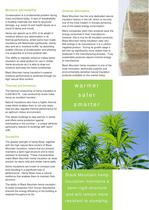
Moisture permeability Greener alternative Condensation is a fundamental problem facing many architects today. A lack of ‘breathability’ in building materials can lead to structural damage, e.g. wood rot and health issues as a result of damp and mould. Black Mountain has the only dedicated natural insulation factory in the UK, which is not only one of the most modern in Europe achieving one of the lowest energy consumption. Hemp can absorb up to 20% of its weight in moisture without any deterioration in its thermal performance, whilst some man-made insulations will deteriorate significantly. Hemp...
Open the catalog to page 3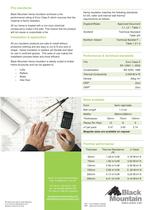
Fire standards Black Mountain hemp insulation achieves a fire performance rating of Euro Class E which ensures that the material is flame retardant. All our hemp is treated with a non-toxic chemical compound to make it fire safe. This means that the product will not cause or exacerbate a fire. Hemp insulation matches the following standards for loft, rafter and internal wall thermal requirements as follows: England/Wales Approved Document L1, L2 – Table 1 Technical Standard Table J23 Installation & application Technical Booklet F – Table 1.2/1.4 Northern Ireland All our insulation products are...
Open the catalog to page 4All Black Mountain catalogs and technical brochures
 Natuhemp technical sheet
1 Page
 Natuwool technical sheet
1 Page
 Natuflex
4 Pages
 Natuhemp
4 Pages
 Natuwool
4 Pages
 ThermalFlex Technical Sheet
2 Pages
 ThermalFlex Product Brochure
4 Pages
 Sheep Wool Technical Sheet
2 Pages
 Sheep Wool Product Brochure
4 Pages

- Panel insulation
- Thermal insulation
- Wall insulation
- High-performance insulation
- Roof insulation
- Roll insulation
- Non-flammable insulation
- Flooring insulation
- Interior insulation
- Euroclass E insulation
- Recyclable insulation
- Plant-based insulation
- Attic insulation
- Fire-retardant insulation
- Animal-based insulation
- Passive house insulation