

HDPE Base 125

HDPE Base 125
- Constructed from UV-resistant high-density polyethylene and aluminum, with stainless steel fastening elements.
- Allows installation at a 12.5° angle, optimizing thermodynamic efficiency for better cooling of photovoltaic modules.
- Lightweight and unobtrusive design with a natural white color.
- Quick and easy installation with a high power-to-surface ratio.
- Application: Flat roofs with up to 5° incline.
- Module Orientation: Landscape.
- Module Frame Tolerances: Width 991 mm ± 5 mm, Length 1,649 mm ± 15 mm.
- Temperature Range: -20 to 70°C.
- Snow Load: 0 – 1.65 kN/m².
- Wind Load: Up to 110 km/h (68 mph) in wind zones 1, 2, and 3.
- No roof penetration required; additional stabilization with ballast and L-profiles.
- Ballast requirements vary by wind zone and building height, with specific weights detailed in the ballast table.
- HDPE bases are horizontally connected and overlapped, with vertical connections via L-profiles.
- 10-year durability guarantee.
- Wind loads calculated according to Eurocode 1 (EN 1991-1-4).
- For surfaces covered by PVC foil, an additional layer of the same material is recommended.
- Information for additional wind zones is available upon request.
Catalog excerpts
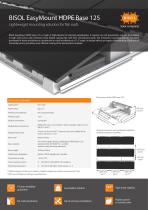
BISOL EasyMount HDPE Base 125 Lightweight mounting solution for flat roofs BISOL EasyMount HDPE base 125 is made of high-density UV-resistant polyethylene. It requires no roof penetration and can be installed in high wind zones with minimum extra ballast, sparing the roof from unnecessary loads. The innovative mounting solution has been developed in-house and allows an unobtrusive on-roof installation at a 12.5° angle. Its design reflects an expert understanding of the laws of thermodynamics, providing more efficient cooling of the photovoltaic modules. Dimensions of the HDPE base 125: Flat roofs Roof incline Module angle Module orientation Module frame tolerances Module frame holes 4 holes / Φ 6 mm (0.24’’) / Distance from the middle of the frame: 450 mm (17.72’’) Base color Natural white Base material UV-resistant high-density polyethylene (HDPE base 125) / Aluminum EN-AW 6060 T5 (L- profile) / Stainless steel (fastening elements) Base weight Additional stabilization Ballast / BISOL EasyMount L-profiles Temperature range Snow load per system 0 – 1.65 kN/m2 (with BISOL PV modules) Distances between rows and lateral installation of BISOL EasyMount L-profiles: Additional layer of the same material should be added on surfaces covered by PVC foil. With use of ballast according to specifications. Low-ballast solution High wind stability Quick and easy installation Higher powerto-surface ratio
Open the catalog to page 1
Additional stabilization requirements for different wind zones WIND ZONE 1: v=20 m/s (Average wind speed up to 70 km/h / 45 mph) Ballast Ballast with use of L-profiles H building height WIND ZONE 2: v=25 m/s (Average wind speed up to 90 km/h / 56 mph) Ballast WIND ZONE 3: v=30 m/s (Average wind speed up to 110 km/h / 68 mph) Ballast Ballast with use of L-profiles Ballast with use of L-profiles building height building height Wind loads calculated in accordance with Eurocode 1 (EN 1991-1-4). Information for additional wind zones available upon request. (X) The use of HDPE 125 bases is not recommended....
Open the catalog to page 2All BISOL catalogs and technical brochures
 Slim & Twin Slim BASE_EN
2 Pages
 BISOL_Supreme_M10_EN
2 Pages
 Alpine TRIANGLE_EN
2 Pages
 BISOL Lumina Series
2 Pages
 BISOL XL Series
2 Pages
 BISOL Premium Series
2 Pages
 BISOL Duplex Series
2 Pages
 Roof hook 6-35
2 Pages
 ALU Base 125/200/300
2 Pages
 BISOL BIPV
2 Pages
 Corporate Brochure
7 Pages
 BISOL EasyMount ALU Base
2 Pages
 BISOL EasyMount ALU Rail 80
2 Pages
 Lumina POLY
2 Pages
 PeakPerformance MONO
2 Pages
 Laminates POLY
2 Pages
 BIPV POLY
2 Pages
 Premium MONO
2 Pages
 Premium POLY
2 Pages
 Off-grid system
5 Pages
 Corporate brochure
7 Pages


Archived catalogs
 BISOL Spectrum Series
8 Pages
 2019 BISOL Spectrum Series
10 Pages
 BLO239-251
2 Pages
 BLU227-245
2 Pages
 BSU227-245
2 Pages
 BSO239
2 Pages
 BMO239-251
2 Pages
 250-260
2 Pages
 BMU227-245
2 Pages
 PeakPerformance
2 Pages


- Industrial solar panel
- Metal fastening system
- Industrial photovoltaic module
- Monocrystalline solar panel
- Monocrystalline PV panel
- Exterior mounting clip
- Exterior fitting fastening system
- Mounting system
- Steel fastening system
- Photovoltaic panel mounting system
- Solar mounting system
- Colored PV panel
- Black PV panel
- Railing fastening system
- PV panel with aluminum frame
- Roof PV panel
- Architectural integration PV panel
- Heating PV panel
- Joinery fastening system
- Tiled roof mounting system