
BASF 3-Liter House

BASF 3-Liter House
The 3-liter house project by LUWOGE, BASF's real estate company, is a pioneering initiative in the Brunck Quarter of Ludwigshafen. It aims to modernize old buildings to achieve significant energy efficiency, reducing heating oil consumption to just 2.6 liters per square meter annually, surpassing the initial 3-liter target.
Modernization Plan
The project began in the 1990s to address outdated apartment designs. A comprehensive modernization program was developed, reducing heating fuel needs by 80%. The strategy involved innovative construction materials and energy-efficient designs, making the building a model for energy efficiency across Europe.
Energy Strategy
Key elements include special thermal insulation using Neopor® panels, controlled ventilation systems with heat recovery, and triple-glazed windows. These innovations significantly reduce energy consumption and CO2 emissions, maintaining a comfortable indoor climate.
Innovations
Neopor® and Styropor® are advanced insulating materials developed by BASF. Neopor® offers superior insulation with less material, enhancing environmental efficiency. Phase Change Materials (PCM) are used in construction to manage indoor temperatures effectively, reducing the need for air conditioning.
Scientific Measurement Study
A study by Kaiserslautern Technical University monitored the building's thermal properties and fuel consumption. Results showed that the 3-liter house's ventilation system effectively maintains air quality and temperature with minimal energy use.
Fuel Cell Technology
The building incorporates a fuel cell system that generates electricity and heat from natural gas, covering 30% of its heating needs. This technology is efficient and environmentally friendly, with potential for further development.
Outlook
The 3-liter house serves as a prototype for energy-efficient construction, inspiring similar projects worldwide. With rising energy costs, such sustainable construction methods offer significant long-term savings and environmental benefits.
Catalog excerpts
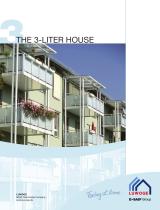
LUWOGE BASF Real Estate Company www.luwoge.de
Open the catalog to page 1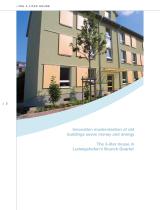
Innovation modernization of old buildings saves money and energy The 3-liter house in Ludwigshafen's Brunck Quarter
Open the catalog to page 2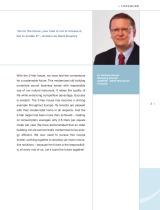
"As for the future, your task is not to foresee it, but to enable it" – Antoine de Saint-Exupéry With the 3-liter house, we have laid the cornerstone for a sustainable future. This modernized old building combines sound business sense with responsible Dr. Matthias Hensel Managing Director LUWOGE – BASF Real Estate Company use of our natural resources. It raises the quality of life while enhancing competitive advantage. Success is evident: The 3-liter house has become a shining example throughout Europe. Its tenants are pleased with their modernized home in all respects. And the 3-liter target...
Open the catalog to page 3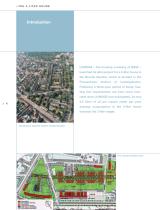
LUWOGE – the housing company of BASF – launched its pilot project for a 3-liter house in the Brunck Quarter, which is located in the Friesenheim Following a three-year period of study, heating fuel requirements are even more favorable than LUWOGE had anticipated. At only 2.6 liters of oil per square meter per year, average consumption in the 3-liter house exceeds the 3-liter target. The Brunck Quarter before modernization
Open the catalog to page 4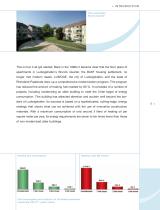
> INTRODUCTION The modernized Brunck Quarter This is how it all got started. Back in the 1990s it became clear that the floor plans of apartments in Ludwigshafen's Brunck Quarter, the BASF housing settlement, no longer met modern needs. LUWOGE, the city of Ludwigshafen, and the state of Rhineland-Palatinate drew up a comprehensive modernization program. This program has reduced the amount of heating fuel needed by 80 %. It consisted of a number of projects, including modernizing an older building to meet the 3-liter target of energy consumption. This building has attracted attention and acclaim...
Open the catalog to page 5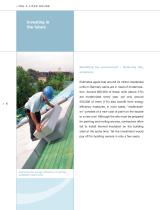
Benefiting the environment – Reducing CO2 emissions Estimates agree that around 24 million residential units in Germany alone are in need of modernization. Around 600,000 of these units (about 3 %) are modernized every year, yet only around 200,000 of them (1 %) also benefit from energy efficiency measures. In most cases, "modernization" consists of a new coat of paint on the facade or a new roof. Although the site must be prepared for painting and roofing anyway, contractors often fail to install thermal insulation on the building shell at the same time. Yet the investment would pay off for...
Open the catalog to page 6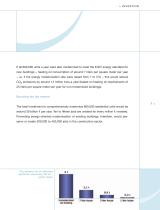
If all 600,000 units a year were also modernized to meet the EnEV energy standard for new buildings – heating oil consumption of around 7 liters per square meter per year – i.e. if the energy modernization rate were raised from 1 to 3 % – this would reduce CO2 emissions by around 14 million tons a year (based on heating oil requirements of 25 liters per square meter per year for non-modernized buildings). Boosting the job market 7 < The total investment to comprehensively modernize 600,000 residential units would be around 30 billion D per year. Ten to fifteen jobs are created for every million...
Open the catalog to page 7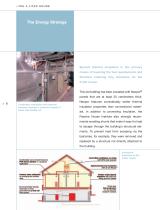
-LITER HOUSE Controlled ventilation with thermal recovery ensures a constant supply of Special thermal insulation is the primary means of lowering the fuel requirements and therefore reducing C02 emissions for the This old building has been insulated with Neopor® panels that are at least 20 centimeters thick. Neopor features considerably better thermal insulation properties than conventional materi- als. In addition to promoting insulation, the Passive House Institute also strongly recom- mends avoiding shunts that make it easy for heat to escape through the building's structural ele- ments....
Open the catalog to page 8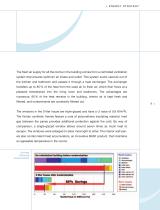
The fresh air supply for all the rooms in the building comes from a controlled ventilation system that ensures optimum air intake and outlet. This system sucks used air out of the kitchen and bathroom and passes it through a heat exchanger. The exchanger transfers up to 85 % of the heat from the used air to fresh air, which then flows at a pleasant temperature into the living room and bedrooms. The advantages are numerous: 85 % of the heat remains in the building, interior air is kept fresh and filtered, and contaminants are constantly filtered out. The windows in the 3-liter house are triple-glazed...
Open the catalog to page 9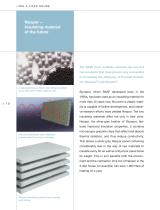
Neopor – Insulating material of the future The BASF foam portfolio contains not one but two products that have proven very successful in increasing the efficiency of thermal insulation: Styropor® and Neopor®. A special process foams the Neopor pellets up to fifty times their original size Styropor, which BASF developed back in the 1950s, has been used as an insulating material for more than 45 years now. But even a classic mate- rial is capable of further development, and intensive research efforts have yielded Neopor. The two insulating materials differ not only in their color. Neopor, the silver-grey...
Open the catalog to page 10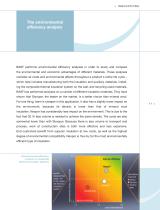
The environmental efficiency analysis BASF performs environmental efficiency analyses in order to study and compare the environmental and economic advantages of different materials. These analyses consider all costs and environmental effects throughout a product's entire life cycle – which here includes manufacturing both the insulation and auxiliary materials, installing the composite thermal insulation system on the wall, and recycling used materials. BASF has performed analyses on a number of different insulation materials. They have shown that Styropor, the leader on the market, is a better...
Open the catalog to page 11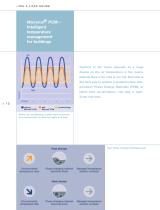
Active air conditioning: Latent I leat accumula- tors compensate for thermal highs and lows Comfort in the home depends to a large degree on the air temperature in the rooms. Nobody likes it too cold or too hot. But what is the best way to achieve a pleasant mean tem- perature? Phase Change Materials (PCM), or latent heat accumulators, can play a signi- ficant role here. How Phase Change Materials work temperature uses Phase charging material Mian aged temperature becomes liquid remans constant Heal rerease temperature falls Phase charuniy material Manager temperature bMomt-s soh a remains cormlanl...
Open the catalog to page 12All BASF USA catalogs and technical brochures
 Construction Chemicals Brochure
24 Pages
 Basotect® Melamine resin foam
20 Pages
 The Chemistry of Construction
16 Pages

- Industrial plaster
- Wall paint
- Decorative paint
- Industrial paver
- Building coating
- Panel insulation
- Indoor coating
- Wall coating
- Outdoor coating
- Synthetic insulation
- High-performance insulation
- Mineral insulation
- Rigid insulation panel
- Roof insulation
- Waterproofing
- Concrete paver
- Industrial acoustic insulation
- Protective coating