
- Catalogs
- BANKER WIRE
- Banker-Wire-Digital-Catalog-of-Wire-Mesh.


- Company
- Products
- Catalogs
- News & Trends
- Exhibitions
Banker-Wire-Digital-Catalog-of-Wire-Mesh.
Banker-Wire-Digital-Catalog-of-Wire-Mesh.
Banker Wire, founded in 1896, is a prominent manufacturer of woven and welded metal mesh in North America, recognized for its innovative processes and high-quality products.
Banker Wire provides a variety of pre-crimped woven wire mesh styles, including Plain Crimp, Intercrimp, Flat Top, Lock Crimp, Triple Shute, and Hybrid, each tailored for specific applications like filtration and heat treating.
The company utilizes advanced equipment such as CNC-controlled press brakes and robotic welding cells to offer custom mesh solutions, ensuring precise and efficient production across various materials and configurations.
Banker Wire also produces welded wire mesh using automated CNC grid welding machines, ensuring high strength and flatness with various wire diameters and spacing configurations.
Banker Wire is dedicated to delivering products that meet high industry standards, using state-of-the-art equipment and innovative processes to exceed customer expectations in quality and performance.
The company offers a range of materials for wire mesh production, including Carbon Steel, Stainless Steel, Aluminum, Bronze, Copper, Brass, and Galfan®, each with specific properties for different applications.
Banker Wire's fabrication department employs processes like cutting, forming, and welding, using CNC grid welding machines and other advanced equipment to meet diverse industry needs.
Advanced techniques, including manual and robotic welding, ensure precision and quality in producing welded wire mesh with specific configurations.
Banker Wire ensures high industry standards through the use of state-of-the-art equipment and high-quality raw materials, with wire certifications available upon request.
Specifications consider aspect ratio, spacing, opening size, and diameter, crucial for correct application and performance, with guidance provided to avoid common errors.
Conversion factors for typical alloys like aluminum and copper are provided, with specific values for each.
POA is the ratio of hole area to total screen area, useful for material comparison, while MD helps determine crimp styles and POA.
Emphasizes using decimals of an inch for standard wire diameters to avoid confusion.
Banker Wire has developed optical testing procedures for applications involving light transmittance, referred to as APO.
Manufactures welded wire mesh to specifications, with options for trimmed and untrimmed edges, providing tolerances for squareness and dimensions.
Discusses challenges in visualizing material characteristics from small samples, suggesting simple math and beam theory for assistance.
Explains deflection is proportional to the length cubed and weight, and inversely proportional to the Modulus of Elasticity and Rectangular moment of Inertia.
Provides algebraic relationships between wire spacing, diameter, and opening size, highlighting common errors in mesh spacing specifications.
Catalog excerpts
Established by Charles Banker in 1896 as C.I. Banker Wire & Iron Works, the company flourished in Milwaukee as one of many early metal fabricators making use of the new engineering marvel - inexpensive steel. Banker Wire specialized in fabricating wrought iron and wire products such as fire escapes, tool room partitions and bank teller cages. Changing times and changing owners gradually took its toll, and by the mid 1960’s, the company had withered to a local buyer and seller of industrial wire cloth. New ownership in 1965 gradually began revitalizing Banker. By the mid 1970’s, the business was...
Open the catalog to page 2
Established by Charles Banker in 1896 as C.I. Banker Wire & Iron Works, the company flourished in Milwaukee as one of many early metal fabricators making use of the new engineering marvel - inexpensive steel. Banker Wire specialized in fabricating wrought iron and wire products such as fire escapes, tool room partitions and bank teller cages. Changing times and changing owners gradually took its toll, and by the mid 1960’s, the company had withered to a local buyer and seller of industrial wire cloth. New ownership in 1965 gradually began revitalizing Banker. By the mid 1970’s, the business was...
Open the catalog to page 3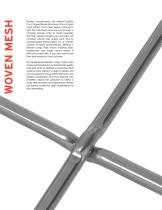
Banker manufactures the highest quality Pre-Crimped Woven Wire mesh. Pre-crimped mesh differs from Plain weave material in that the individual wires are run through a crimping process prior to mesh assembly. Our high speed crimpers use precision cut crimping wheels that shape each wire to accommodate intersections on an infinite number of mesh specifications. Without a defined crimp, Plain woven material lacks consistency and shape which makes it difficult to work with. It can also lead to lost time and money for the customer. The fundamental Banker Crimp styles listed across are the basis for...
Open the catalog to page 4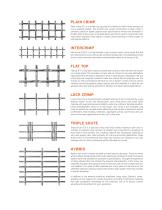
Banker manufactures the highest quality Pre-Crimped Woven Wire mesh. Pre-crimped mesh differs from Plain weave material in that the individual wires are run through a crimping process prior to mesh assembly. Our high speed crimpers use precision cut crimping wheels that shape each wire to accommodate intersections on an infinite number of mesh specifications. Without a defined crimp, Plain woven material lacks consistency and shape which makes it difficult to work with. It can also lead to lost time and money for the customer. The fundamental Banker Crimp styles listed across are the basis for...
Open the catalog to page 5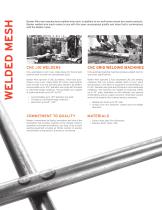
CNC GRID WELDING MACHINES Fully automated 2 and 3 axis single phase DC fixture weld systems excel at small runs and specialty grids. Fully automated welding machines produce welded mesh to your exact specifications. Banker Wire operates 2 CNC jig welders. These fully automated 2 and 3 axis, single phase DC fixture weld systems excel at small runs and specialty grids. Banker’s jig welders accommodate up to .375” diameter wire grids with trimmed or untrimmed edge conditions. The jig welders are capable of producing sheets up to 60” by 120”. Banker Wire operates 2 fully automated CNC grid welding...
Open the catalog to page 6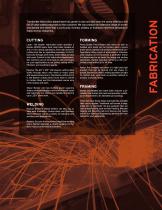
CNC GRID WELDING MACHINES Fully automated 2 and 3 axis single phase DC fixture weld systems excel at small runs and specialty grids. Fully automated welding machines produce welded mesh to your exact specifications. Banker Wire operates 2 CNC jig welders. These fully automated 2 and 3 axis, single phase DC fixture weld systems excel at small runs and specialty grids. Banker’s jig welders accommodate up to .375” diameter wire grids with trimmed or untrimmed edge conditions. The jig welders are capable of producing sheets up to 60” by 120”. Banker Wire operates 2 fully automated CNC grid welding...
Open the catalog to page 7
STAINLESS STEEL WIRE BRASS WIRE Banker can produce any of the numerous types of stainless steels commonly used in Wire cloth. There are many stainless steel compositions available to suit any number of corrosive or high temperature specialized applications. The most common types of stainless steels are listed below. Please call for more information about other available options. Brass wire is commonly used in woven wire cloth as filtration material as well as particle analysis test sieves. Brass wire combines proportions of Copper and Zinc. The most common Brass used in wire cloth contains 70%...
Open the catalog to page 8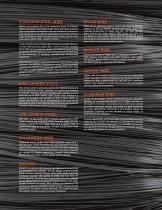
STAINLESS STEEL WIRE BRASS WIRE Banker can produce any of the numerous types of stainless steels commonly used in Wire cloth. There are many stainless steel compositions available to suit any number of corrosive or high temperature specialized applications. The most common types of stainless steels are listed below. Please call for more information about other available options. Brass wire is commonly used in woven wire cloth as filtration material as well as particle analysis test sieves. Brass wire combines proportions of Copper and Zinc. The most common Brass used in wire cloth contains 70%...
Open the catalog to page 9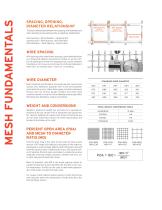
SPACING, OPENING, DIAMETER RELATIONSHIP The basic relationship between wire spacing, wire diameter, and clear opening can be expressed by an algebraic relationship: Wire Spacing = Wire Diameter + Opening Size Opening Size = Wire Spacing - Wire Diameter Wire Diameter = Wire Spacing - Opening Size ASPECT RATIO (AR) Wire Spacing (edge to edge of wire) Aspect Ratio is a useful way to characterize materials that have non-square or slotted openings or repeat patterns. It is the ratio of the larger pattern repeat distance to the smaller pattern repeat distance. Wire Spacing (center to center of wire)...
Open the catalog to page 10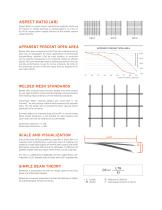
SPACING, OPENING, DIAMETER RELATIONSHIP The basic relationship between wire spacing, wire diameter, and clear opening can be expressed by an algebraic relationship: Wire Spacing = Wire Diameter + Opening Size Opening Size = Wire Spacing - Wire Diameter Wire Diameter = Wire Spacing - Opening Size ASPECT RATIO (AR) Wire Spacing (edge to edge of wire) Aspect Ratio is a useful way to characterize materials that have non-square or slotted openings or repeat patterns. It is the ratio of the larger pattern repeat distance to the smaller pattern repeat distance. Wire Spacing (center to center of wire)...
Open the catalog to page 11All BANKER WIRE catalogs and technical brochures
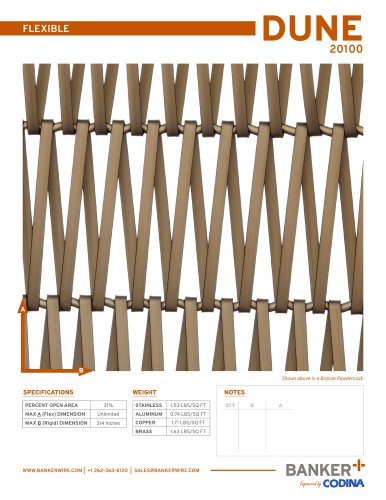 Dune_20100
1 Page
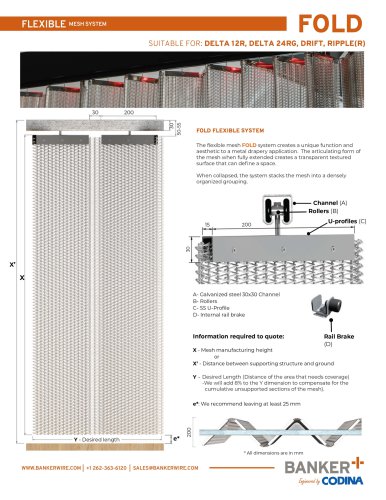 FOLD
1 Page
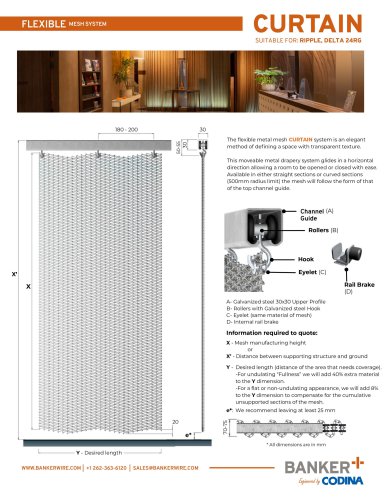 CURTAIN
1 Page
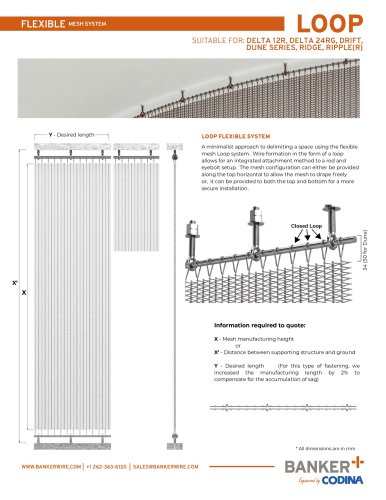 Banker-Wire-Loop_61726
1 Page
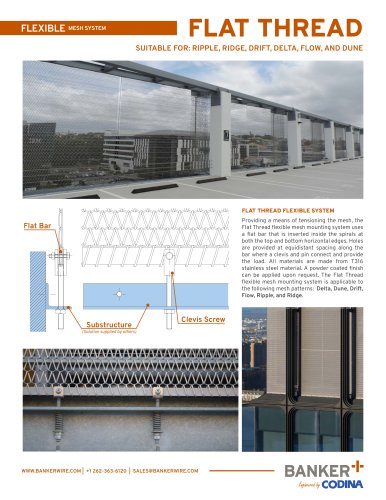 FLAT THREAD
1 Page
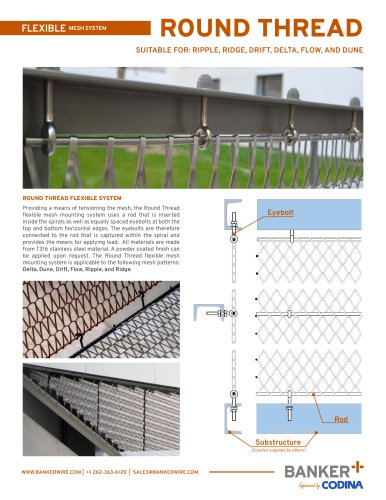 ROUND THREAD
1 Page
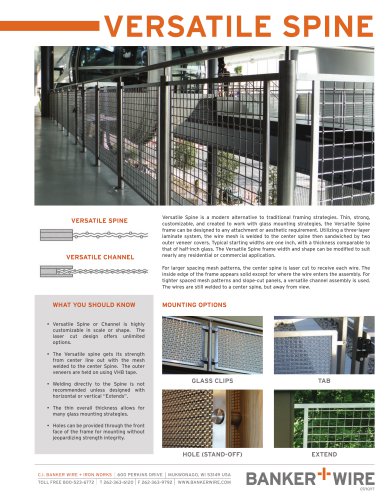 VERSATILE SPINE
1 Page
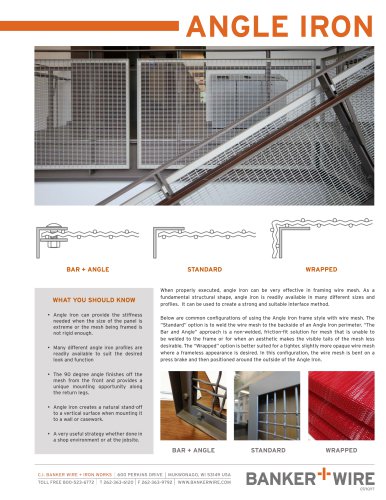 ANGLE IRON
1 Page
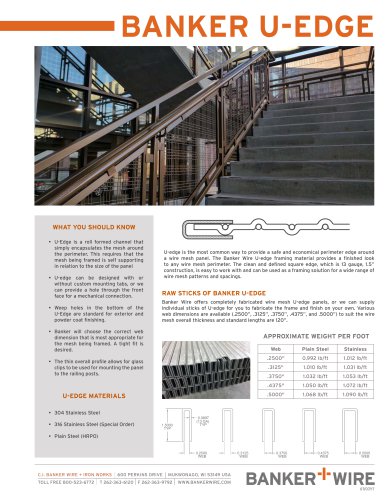 BANKER U-EDGE
1 Page
 Banker Wire BIM Files
1 Page
 DUNE 40100
1 Page

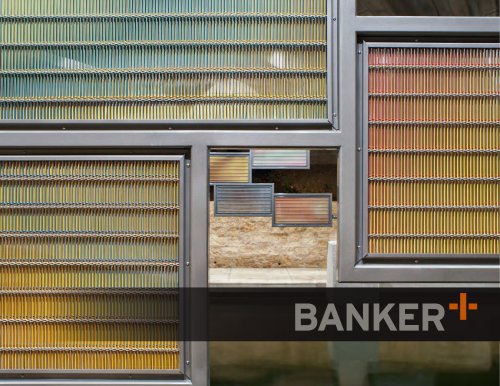



Archived catalogs
 Dune 20100
1 Page

- Industrial rail
- Banker Wire stainless steel wire mesh
- Outdoor railing
- Metal railing
- Banker Wire decorative wire mesh
- Banker Wire building wire mesh
- Banker Wire wire interior fitting mesh
- Stair railing
- Balcony railing
- Indoor railing
- Banker Wire silver-colored wire mesh
- Patio railing
- Banker Wire golden wire mesh
- Banker Wire architectural wire mesh
- Banker Wire elongated wire mesh
- Banker Wire brass wire mesh
- Banker Wire wire landscaping mesh
- Banker Wire close-knit wire mesh