

- Company
- Products
- Catalogs
- News & Trends
- Exhibitions
Layers

Layers
Noise is defined as an unwanted and disturbing sound, such as the buzzing from a moving car or a drill. Acoustic comfort refers to the psychophysical condition of well-being experienced in an environment where noise is limited. The measurement of Reverberation Time (RT60) is crucial for assessing acoustic comfort, as it indicates the time required for sound to become imperceptible. High reverberation times are associated with noisy environments, often due to reflective materials or irregular geometric shapes.
The efficiency of an object's sound absorbency can be measured by comparing the RT60 of an environment with and without sound-absorbing objects. The formula used is RT60 = 0.161 x (V/A), where V is the volume of the space and A is the cumulative Equivalent Sound Absorbing Area of all surfaces and objects. The Sound Absorption Coefficient (α) is used to determine the sound-absorbing properties of a material, with values ranging from 0 (all sound reflected) to 1 (all sound absorbed).
The Axolight lamps were tested in a room measuring 7m x 7m x 6.1m (300 m³). The initial RT60 was measured across various frequencies, and reductions were observed with the addition of 1, 2, or 3 lamps. The results showed significant reductions in RT60, indicating improved acoustic performance. For example, with three lamps, the reduction in RT60 ranged from 29.3% to 47.1% across different frequencies.
Several Axolight products were tested, including SPLAYA, SPLAYB, SPLAYC, SPLAYD, SPLAYE, and SPLAYF. Each product demonstrated varying levels of acoustic performance, with reductions in RT60 and corresponding increases in the Equivalent Sound Absorption Area (A) per lamp. The performance varied across different frequencies, with higher reductions observed at higher frequencies.
Introducing sound-absorbing objects, such as Axolight lamps, into an environment can significantly enhance acoustic comfort by reducing reverberation time without requiring structural changes. The effectiveness of these objects is determined by their material properties, size, and shape, as well as the specific acoustic characteristics of the environment.
Catalog excerpts

Acoustic performance Layers
Open the catalog to page 1
From noise to acoustic comfort, how to do it? Noise is commonly identified as an unwanted and disturbing sound, for example buzzing (an incomprehensible and continuous hum) from a moving car, a drill, etc. Acoustic comfort is the psychophysical condition of wellbeing a person finds themselves in when they are in an environment where noise is limited. The measurement of Reverberation Time (RT60), or the time required for sound to become imperceptible, allows the acoustic comfort to be measured in any given environment: the higher the reverberation time, the greater the perception of sound. A setting...
Open the catalog to page 2
Where we tested our products? Vanessa Vivian from 2,30 to 5,78 Equivalent Sound Absorbing Area (A) The environment used to measure the sound-absorbing properties the Axolight lamps is shown below: 300 m3 The Reverberation Times of the room, with sounds of varying frequencies emitted from an audio source, were acoustic lamps, then with 1, 2 or 3 lamps added at a time. This is how the reduction of sound in the room was calculated. Acoustic performance
Open the catalog to page 3
Lighting performance per lamp Acoustic performance Before Initial Reverberation Time (RT60) in s After Reduction of Reverberation Time (RT60) in % Equivalent Sound Absorption Area (A) in m2 per lamp FREQUENCY
Open the catalog to page 4
Acoustic performance Lighting performance per lamp Lighting performance per lamp Before Initial Reverberation Time (RT60) in s Before Initial Reverberation Time (RT60) in s Reduction of Reverberation Time (RT60) in % Reduction of Reverberation Time (RT60) in % Equivalent Sound Absorption Area (A) in m2 per lamp Equivalent Sound Absorption Area (A) in m2 per lamp Acoustic performance
Open the catalog to page 5
Lighting performance per lamp Lighting performance per lamp Acoustic performance Acoustic performance Initial Reverberation Time (RT60) in s Initial Reverberation Time (RT60) in s Reduction of Reverberation Time (RT60) in % Reduction of Reverberation Time (RT60) in % Equivalent Sound Absorption Area (A) in m2 per lamp Equivalent Sound Absorption Area (A) in m2 per lamp Acoustic performance
Open the catalog to page 6
Lighting performance per lamp Ø 47 cm Acoustic performance Before Initial Reverberation Time (RT60) in s After Reduction of Reverberation Time (RT60) in % Equivalent Sound Absorption Area (A) in m2 per lamp FREQUENCY Acoustic performance
Open the catalog to page 7All AXO Light catalogs and technical brochures
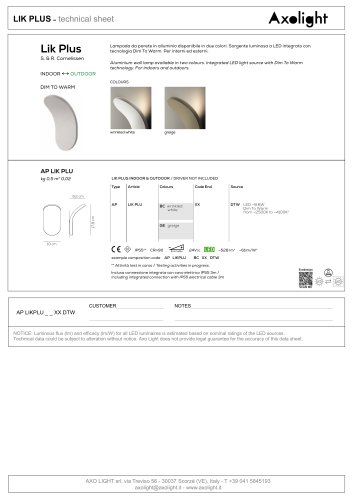 Lik Plus
1 Page
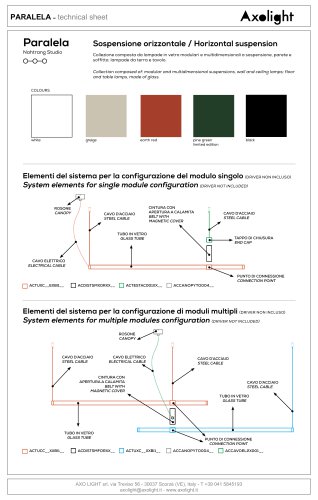 PARALELA
9 Pages
 Ukio
Ukio5 Pages
 Skirt
Skirt16 Pages
 Plumage
6 Pages
 Bell
Bell9 Pages
 Axolight Spring 2019
48 Pages
 Axolight Autumn 2018
16 Pages
 cut
cut1 Page
 liaison
1 Page
 kwic
kwic1 Page
 JEWEL
JEWEL1 Page
 ORCHID
1 Page
 NEWS 2016-2
30 Pages
 AP AX20 GR
2 Pages
 AP AURA
2 Pages
 3 X SP SUBZ
2 Pages
 3 X SP BLU DEC
2 Pages
 SP BLU DEC
2 Pages
 2 X SP BLU DEC
2 Pages
 NEWS 2016 - 1
74 Pages
 Axo Light Overview
16 Pages
 MOUNTAIN VIEW
12 Pages
 Axo Light VOLUME I
292 Pages
 Lightecture 2014-16
132 Pages
Archived catalogs
 catalogue 2015
60 Pages
 AX20
AX2014 Pages
 NAFIR
NAFIR32 Pages
 CRYSTAL SPOTLIGHT
10 Pages
 SKIRT
SKIRT25 Pages
 Mind-led 2014-15
194 Pages
 Clavius X 2014
28 Pages
 LIGHTECTURE
140 Pages
 Axo Light News 2012-1
84 Pages
