
- Catalogs
- Arpa Industriale
- Technical Information Part 1: Thin HPL

Technical Information Part 1: Thin HPL

Technical Information Part 1: Thin HPL
- Definition: HPL are high-density panels known for their mechanical strength, chemical resistance, and ease of maintenance, made from cellulose fibers and thermosetting resins.
- Composition: Composed of 60-70% cellulose-based materials and 30-40% thermosetting resins, including overlay, decorative paper, and kraft paper layers.
- History: Evolved from Bakelite in 1896, with advancements in melamine-formaldehyde resins.
- Applications: Used in interior design, kitchens, hospitals due to durability and hygienic properties.
- Process: Involves impregnation of papers with resins, thermo-lamination, and finishing, following EN 438 and ISO 4586 standards.
- Formats and Finishes: Available in various sizes and finishes, with gloss finishes being less scratch-resistant.
- Grades: Classified by EN 438 based on application suitability, including standard, postformable, and fire-resistant laminates.
- Hygiene and Safety: Suitable for food contact, resistant to bacteria, and acts as a barrier against formaldehyde emissions.
- Fire Resistance: Specific grades offer enhanced fire resistance.
- Recommendations: Guidelines for maintaining and cleaning HPL to ensure longevity and performance.
- Handling and Processing: Instructions for transporting, storing, cutting, milling, and drilling HPL, with precautions for each process.
- Postforming: Techniques for hot-forming laminates, including temperature and machinery requirements.
- Preconditioning: Preparing laminates and substrates, with methods for balancing sheets and controlling humidity.
- Substrates and Bonding: Information on suitable substrates, bonding techniques, adhesives, and hardeners for composite panels.
- Regular Cleaning: Requires only a damp cloth with warm water or mild detergents.
- General Precautions: Avoid abrasive substances and ensure clean cloths when using solvents.
- Drilling: Ensure holes for screws are 0.5mm larger than the screw diameter to prevent cracking.
- Drilling Tools: Use special steel twist drills for plastics with specific angles.
- Internal Cuts: Round and polish corners to prevent cracking.
This document provides guidelines on the manufacture of composite panels using HPL and various substrates, emphasizing humidity considerations.
- Selection: Depends on application characteristics, intended use, and environmental conditions.
- Not Recommended: Plaster, concrete, and solid wood due to uneven surfaces.
- Process: Surfaces must be cleaned before bonding, with adhesive choice based on substrate type.
- Types of Adhesive: Includes thermoplastic and thermosetting types, each with specific properties.
Catalog excerpts

Technical Information Part 1: Thin HPL
Open the catalog to page 1
What is HPL Composition History Fields of application How to hot-form postforming laminates Postforming temperature Machinery Postforming technique Manufacturing process Formats Finishes Summary of Arpa sizes, thicknesses and finishes (table) EN438 grades Most common grades - Definitions and classification Arpa typologies 7.1 How to prepare HPL laminates and substrates 7.2 Pre-conditioning 7.2.1 Cold pre-conditioning 7.2.2 Hot pre-conditioning 7.3 Balancing the sheets 7.4 Ventilation and humidity control Properties of Arpa laminates Hygiene Suitable for contact with food Resistance to bacteria...
Open the catalog to page 2
This document is intended to provide a general understanding of HPL, its manufacture, properties, types and relevant international standards. It provides information on working methods with Thin HPL, as well as some good practice recommendations for its use. The advice and recommendations have an advisory nature only. If you need more information or have a specific question, please contact Arpa customer service.
Open the catalog to page 3
1.1 What is hpl Decorative High Pressure Laminates (HPL), as defined by the European and international standards for HPL, EN 438 and ISO 4586, are high-density panels (≥1.35g/cm3), finished and ready for use, which have exceptional mechanical, physical strength and chemical resistance, are easy to work and simple to maintain. Arpa HPL panels are made of several layers of cellulose fibre material impregnated with thermosetting resins and then simultaneously subjected to both pressure (>7MPa)) and heat (140 / 150°C) in special presses, for a fixed time, which varies depending on the type of laminate....
Open the catalog to page 4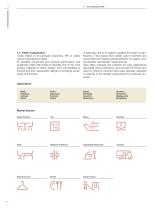
1.4 Fields of application Today, thanks to its particular properties, HPL is widely used in miscellaneous fields. Its excellent mechanical and physical performance and toughness make high-pressure laminate one of the most popular materials in interior design, from wall cladding to flooring and from suspended ceilings to furnishing accessories and furniture. In particular, due to its hygienic qualities and ease of maintenance, it has always been widely used in kitchens and everywhere that requires special attention to hygiene, such as hospitals, laboratories, restaurants etc. Arpa offers materials...
Open the catalog to page 5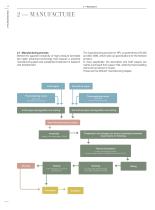
2.1 Manufacturing process Behind the apparent simplicity of high pressure laminates lies highly advanced technology that requires a powerful manufacturing plant and substantial investment in research and development. Kraft paper The manufacturing process for HPL is governed by EN 438 and ISO 4586, which sets out specifications for the finished product. In Arpa specifically, the decorative and kraft papers are mainly purchased from paper mills, while the thermosetting resins are produced in-house. These are the different manufacturing stages: Decorative paper Thermosetting resins Thermosetting...
Open the catalog to page 6
2.2 Panel formats Arpa panels are available in different sizes and thicknesses. The great variety of sizes (2440x1220, 3050x1300, 4200x1300, 4200x1600, 4300x1850) also allows for different applications, with self-supporting properties in the case of high thickness versions. The minimum density of the laminate is 1.35g / cm3. 2.3 Finishes The Arpa catalogue covers a wide range of patterns and finishes that can satisfy multiple design and manufacturing requirements. In some cases there is a close relationship between the pattern and its finish, while, in others, the finish can be used on most of...
Open the catalog to page 7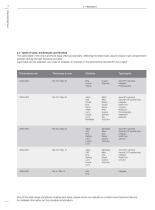
2.4 Table of sizes, thicknesses and finishes The sizes listed in the chart are those Arpa offers as standard, reflecting the sheet sizes used in Arpa's multi-compartment presses during the high-pressure process. Laminates can be supplied cut to size or shaped, on request, in the dimensions required for the project. Dimensions mm Thickness in mm Finishes Typologies Flooring grade Aleve Mesh Arpa HPL standard Cliff Mika Arpa HPL PF postforming Corallo Naked Integrale Erre Opaca Solid Core Farah Pesca Unicolor Ghibli Pixel Multicolor Larix Quarzo Flooring grade Lucida Satinata Magnetico Solid Core...
Open the catalog to page 8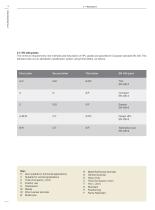
2.5 EN 438 grades The minimum requirements, test methods and description of HPL grades are specified in European standard EN 438. This standard sets out an alphabetic classification system using three letters, as follows. First Letter Second letter Third letter Key: H Also suitable for horizontal applications V Suitable for vertical applications C Thick (Compact) ≥ 2mm E Exterior use A Pearlescent M Metals W Wood veneer laminate B Multicolour R Metal Reinforced laminate G General purpose D Heavy Duty C Thick (Compact) ≥ 2mm T Thin < 2mm S Standard P Postforming F Flame Retard
Open the catalog to page 9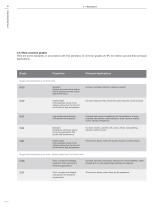
2.6 Most common grades Here are some examples, in accordance with this standard, of common grades of HPL for interior use and their principal Grade Properties Principal Applications Single sided laminates up to 2mm thick HGS Standard furniture, worktops, kitchens, catering, retail etc. Suitable for horizontal as well as vertical applications that require high performance. HGP Postformable the same areas as HGS, where the project requires curved surfaces. with properties similar to the category above but can be bent and formed at high temperature. HGF High-performance laminate, Premises that require...
Open the catalog to page 10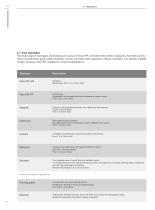
2.7 Arpa typologies The wide range of typologies, thicknesses and colours of Arpa HPL laminates offers interior designers, Architects and furniture manufacturers great creative freedom, so they can follow their inspirations without constraint. The specific qualities of each typology make HPL suitable for numerous applications. Standard. Single sided, from 0.7 to 1.8mm thick Postforming. Single sided, hot formable into both concave and convex curves. From 0.6 to 1.2mm thick Compact, self-supporting laminate, very stable and hard-wearing. Single or double sided. From 2 to 30mm thick Solid Core...
Open the catalog to page 11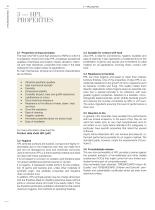
3.1 Properties of Arpa laminates The heat (140/150°C) and high pressure (>7MPa) to which it is subjected, ensure that Arpa HPL possesses exceptional qualities of hardness and scratch, impact, abrasion, chemical and heat resistance, properties that make it the ideal material for the widest variety of applications. Its main mechanical, physical and chemical characteristics are as follows. • • • • • • • • • • • • • Attractive aesthetic qualities High mechanical strength Flexibility Dimensional stability Durability (impact, wear and graffiti resistance) Lightfastness of colour Good chemical resistance...
Open the catalog to page 12All Arpa Industriale catalogs and technical brochures
 FOR AMERICAS
37 Pages
 OPEN INNOVATION FOR INTERIOR DESIGN
139 Pages
 ARPA HANDWORK
8 Pages
 ARPA XXL
8 Pages

- Industrial counter-top
- Industrial decorative laminate
- HPL decorative laminate
- Stain-proof countertop
- Decorative panel
- Composite countertop
- Heat-resistant countertop
- Antibacterial kitchen worktop
- High-resistance decorative laminate
- Plain decorative laminate
- Smooth decorative laminate
- Home decorative panel
- Imitation wood decorative laminate
- Textured decorative laminate
- Interior decorative panel
- Fire-retardant decorative laminate
- Wear-resistant countertop
- Commercial countertop
- Commercial decorative panel
- Custom-made countertop