
- Catalogs
- ARCELORMITTAL Long
- Sections and Merchant Bars

Sections and Merchant Bars

Sections and Merchant Bars
ArcelorMittal's updated sales program for hot rolled sections and merchant bars offers a wide range of structural shapes and steel grades. The document details the properties, advantages, and applications of these products, emphasizing continuous product development and online updates.
ArcelorMittal is the leading global steel company, operating in over 60 countries with 262,000 employees. It leads in markets such as automotive, construction, and packaging, focusing on sustainability, quality, and innovative steelmaking technologies.
This unit produces long products across 22 plants in Europe and North Africa, including sections, merchant bars, rails, and special sections. It prioritizes customer satisfaction, performance, and innovation, offering technical assistance and design software.
Standard rolling tolerances are provided, with specific tolerances available upon agreement. Maximum lengths vary by shape, and minimum order tonnage is 5 tonnes per section. Surface quality adheres to EN10163-3: 2004 standards.
Long Carbon Europe offers derived profiles, allowing consumers to design and roll profiles to their specifications with a minimum order of 500 tons per custom profile.
Technical advice is provided globally, covering structural design, metallurgy, welding, construction details, surface protection, and fire safety.
Services include drilling, flame cutting, T cut-outs, notching, cambering, curving, straightening, cold sawing, welding, shot blasting, and surface treatment.
Focuses on fire safety, sustainable development, coatings, composite construction, and Eurocodes, collaborating with sales and marketing to produce guides and software.
Steel is highly recyclable, with 99% of hot-rolled sections reusable or recyclable. ArcelorMittal's solutions meet sustainability criteria, offering environmental, economic, socio-cultural, and technical benefits.
Advantages of hot-rolled profiles in steel and composite constructions include transparency, slenderness, and high load-bearing capacity. Adaptability to changes in use is emphasized.
Reducing material weight correlates with reduced environmental impacts. HISTAR grades significantly reduce weight, material costs, and CO2 emissions.
ArcelorMittal offers software and technical documentation for project design, including cost estimation tools and pre-design software.
Details the design and fabrication processes for ACB® and Angelina™ beams, offering improved inertia-to-weight ratios.
Applications include floors, car parks, offshore structures, roofing, gangways, and wide-span purlins, using steel grades like S355, S460, and HISTAR® 460.
Emphasizes the holistic competitiveness of steel solutions in terms of lifecycle costs and sustainability, supported by technical resources and innovative design approaches.
Outlines design types for optimizing height/weight and load/weight ratios, specifying common steel grades for various applications.
Integrates steel beams into concrete slabs, reducing floor thickness and allowing for increased ceiling height or reduced building height.
Offers built-in fire resistance, light structures, easy assembly, competitive pricing, and sustainability.
Describes SFB, IFB Type A, and IFB Type B beams, suitable for different project scales and requirements.
Combines slim-floor and composite construction advantages, supporting spans up to 14 meters with reduced steel consumption and carbon footprint.
Defines the designation system for steel according to EN 10027-1:2005.
Details structural steel grades according to various international standards, summarizing mechanical characteristics and chemical composition.
Steels produced by thermo-mechanical rolling have improved toughness and good cold forming properties.
Offer high strength, good toughness, and superior weldability, with enhanced yield strength through the QST process.
HISTAR® and FRITENAR® steels offer excellent weldability for manual and automatic processes.
HISTAR® Offshore and FRITENAR® Offshore grades offer improved deformation characteristics and guaranteed transverse resilience properties.
Details yield strength, tensile strength, elongation, and impact test requirements for various steel grades.
Specifies maximum carbon content and limits for other elements, with CEV calculations for weldability.
References European and American standards for structural steels, specifying requirements for chemical composition and mechanical properties.
Specific agreements are required for certain chemical compositions and mechanical properties.
Tables provide detailed data on chemical composition and mechanical properties of different steel grades.
Outlines specifications for European I-beams (IPE) and standard beams (IPN), including dimensions, tolerances, and surface conditions.
Minimum order quantities and special conditions for delivery are specified.
Provides detailed section properties for each beam type, including weight per meter, moment of inertia, and section modulus.
Tables provide comprehensive data on dimensions, weights, and mechanical properties for each beam type and size.
Details specifications for European wide flange beams, including dimensions, tolerances, and surface conditions.
Outlines minimum order requirements and specific conditions for different grades.
Surface conditions comply with EN 10163-3: 2004, class C, subclass 1.
For plastic design, sections must belong to class 1 or 2 based on rotation capacity.
Includes extensive tabular data on section properties such as weight, moments of inertia, and section moduli.
Specifies minimum order quantities for different steel grades.
Details dimensions and standards for European wide flange beams, conforming to various standards.
Provides detailed section properties for various beam types, including classification according to EN standards.
Specifications for European extra wide flange beams are provided, adhering to ASTM standards.
Tables list detailed dimensions and properties for various beam types.
Specifies minimum order quantities for different profiles and grades.
Outlines specifications for wide flange columns and piles, including dimensions, tolerances, and surface conditions.
Provides detailed section properties for various profiles, including HD and HP series.
For plastic design, sections must belong to class 1 or 2 based on rotation capacity.
Channels with parallel flanges are specified according to DIN standards.
Includes extensive tables listing dimensions, weights, and structural properties for various profiles.
Provides detailed specifications and standards for European U-channels and equal leg angles.
Lists various UPE and UPN profiles with dimensions, weights, and section properties.
Provides section properties for each profile, including moment of inertia and section modulus.
References several standards for classification and compliance with European norms.
Advises that minimum tonnage and delivery conditions require prior agreement.
Tables provide detailed measurements for each profile, including height, width, thickness, and radius.
Provides detailed specifications and properties for equal leg angles, including dimensions, tolerances, and sectional properties.
Lists angle sections with dimensions, weights, and sectional properties.
Conforms to various standards, including EN and DIN standards.
Specifies minimum order quantities and conditions, with some sections available upon agreement.
Tables provide critical data such as weight per meter, dimensions, and sectional properties.
Additional notes indicate that other dimensions are available on request.
Outlines specifications for equal and unequal leg angles, flat bars, and wide flat bars.
Minimum order requirements and delivery conditions are subject to prior agreement.
Adheres to European norms for dimensions and tolerances.
Other dimensions can be requested, and radii may vary depending on the rolling process.
Includes detailed tables listing various profiles with dimensions, weights, and technical specifications.
Provides detailed specifications and properties of British Universal Beams according to various standards.
Lists various UB profiles with dimensions, weights, and section properties.
Includes values such as moment of inertia and section modulus.
References several standards for classification and compliance.
Minimum order of 40 tonnes per section and grade is required.
Specified according to EN standards.
Includes notes on plastic design requirements and the use of HISTAR© steel.
Provides detailed specifications and properties of American wide flange beams, adhering to ASTM standards.
Categorized by dimensions and weight, with specific measurements provided.
For plastic design, beams must belong to class 1 or 2 based on rotation capacity.
Conforms to ASTM standards for dimensions, tolerances, and surface conditions.
Emphasizes the importance of adhering to specified classes for plastic design.
Tables provide extensive data on section properties, including moment of inertia and section modulus.
Stresses the need for compliance with specified standards and classifications.
Provides detailed specifications and classifications for various types of American steel beams, channels, and piles.
Conforms to ASTM standards for dimensions, tolerances, and surface conditions.
Outlines classification of sections for plastic design.
Detailed tables provide section properties for various beam and pile sizes.
Tables list various beam and pile designations with corresponding properties.
For plastic design, sections should belong to class 1 or 2.
Minimum tonnage and delivery conditions require prior agreement.
Provides detailed specifications and classifications for various types of steel angles and beams, focusing on American and Russian standards.
- American Unequal Leg Angles: Specifications include dimensions, tolerances, and surface conditions.
- American Equal Leg Angles: Details dimensions and mechanical properties of equal leg angles.
- Russian Hot Rolled Beams: Dimensions and tolerances specified according to Russian standards.
- Construction Dimensions: Provides detailed construction dimensions for angles.
- Dimensions: Provided in both metric and imperial units.
- Tolerances: Defined according to ASTM and GOST standards.
- Surface Conditions: Compliance with ASTM and EN standards.
Includes extensive tables listing mechanical properties and dimensions of various steel profiles.
Other dimensions are available upon request, and minimum tonnage and delivery conditions require prior agreement.
Outlines various specifications and standards for structural sections.
Provides detailed section properties for various profiles.
For plastic design, sections must belong to class 1 or 2.
Includes extensive tables listing properties of different profiles.
Parameters such as kg/m, mm4, mm3, and mm describe physical and mechanical properties.
Specifies that minimum tonnage and delivery conditions require prior agreement.
Provides section factors used in fire design according to EN standards.
Includes notations and formulae relevant to structural engineering.
Cross-sections are classified according to their ability to form plastic hinges.
Outlines rolling tolerances for beams, ensuring structural integrity.
Catalog excerpts

Long Carbon Europe Profilés et Aciers Marchands Sections and Merchant Bars Profil- und Stabstahl Programme de Vente / Sales Programme / Verkaufsprogramm
Open the catalog to page 1
© FMGB. Guggenheim Bilbao Museoa, Bilbao. 2007
Open the catalog to page 2
Cher partenaire, Dear Partner, Sehr geehrte Partner, Nous sommes heureux de vous présenter la nouvelle édition papier du programme de vente ArcelorMittal pour les profiles et aciers marchands. We are delighted to present you the new paper edition of the ArcelorMittal sales programme for hot rolled sections and merchant bars. Nous vous offrons la plus vaste gamme en termes de dimensions géométriques et de nuances d'acier. Vous trouverez ici, toute l'information relative a leurs propriétés, avantages et applications . We offer you the widest range of structural shape sizes and steel grades and...
Open the catalog to page 3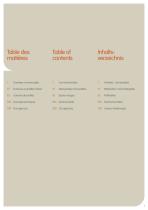
Données commerciales Commercial data Nuances et qualités d’acier Steel grades and qualities Vertriebs-, Servicedaten Section ranges
Open the catalog to page 5
le numéro un mondial de la sidérurgie avec plus de 262 000 employés répartis dans 60 pays. Une présence industrielle dans 20 pays nous permet d'être positionnés sur tous les marchés clés de l’acier qu’ils soient émergents ou matures. Notre groupe est aujourd’hui leader sur les tous les principaux marchés de l’acier, de la construction automobile au secteur du bâtiment et des appareils électroménagers à l’emballage. Nos efforts en matière de R&D ainsi que notre réseau de distribution sont parmi les facteurs clés de notre succès An industrial presence in 20 countries exposes our company to all...
Open the catalog to page 7
© asbl Atomium vzw - Marie-Françoise Plissart
Open the catalog to page 8
Données commerciales Commercial data Delivery conditions Support technique Technical support Technische Beratung Développement durable Structural Software for Pre-design ACB - Poutrelle alvéolaire à ouver- 18 tures circulaires ACB - Castellated beam with circular openings ACB - Lochstegträger mit runden Öffnungen "AngelinaTM " - Pouterelle alvéolaire 20 à ouvertures sinusoidales "AngelinaTM " - Castellated beam with sinusoidal openings "AngelinaTM " - Lochstegträger mit sinusförmigen Öffungen Construction Slim-Floor Slim-Floor Construction CoSFB - Nouvelle génération de poutrelles Slim-Floor...
Open the catalog to page 9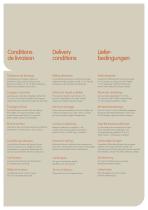
Delivery conditions Rolling tolerances Les tolérances de laminage usuelles sur dimensions, forme, poids et longueur sont données au tableau 15-19. Certaines tolérances réduites sont possibles après accord. The usual rolling tolerances on dimensions, shape, weight and length are given in table 15-19. Specific tolerances can be reduced after agreement. Die üblichen Walztoleranzen auf Abmessungen, Form, Gewicht und Länge sind in der Tabelle 15-19 aufgezeigt. Spezifische Toleranzen können nach Absprache reduziert werden. Longueur maximale Maximum length available Maximale Lieferlänge Les longueurs...
Open the catalog to page 10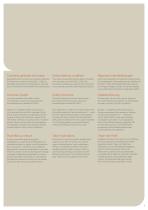
Conditions générales de livraison General delivery conditions Allgemeine Lieferbedingungen Sauf spécifications contraires, les conditions générales de livraison sont conformes à EN10021: 2006. Un exemplaire du document est disponible sur demande ou sur le site Internet www.arcelormittal.com/sections. If not otherwise specified, general delivery conditions are in accordance with EN10021: 2006. The document is available upon request and can be found on the Internet site www.arcelormittal.com/sections. Sofern keine gesonderte Vereinbarung vorliegt, gelten für die allgemeinen Lieferbedingungen die...
Open the catalog to page 11
Support technique Technical support Technische Beratung A Long Carbon Europe, nous voulons faire plus que simplement vous offrir des aciers de construction. Nous souhaitons vous soutenir dans la conception et le développement de solutions innovantes pour tirer le meilleur parti de nos aciers. At Long Carbon Europe, we want to do more than simply provide structural products. We would like to help you in designing and developing innovative solutions to take the best advantage of our steel. Long Carbon Europe versteht sich als mehr als nur ein Profilstahlhersteller. Wir wollen Sie bei der Konzeption...
Open the catalog to page 12
Pour compléter les possibilités techniques de nos partenaires, nous nous sommes dotés d’outils de parachèvement performants et offrons un large éventail de services, tels que : As a complement to the technical capacities of our partners, we are equipped with highperformance finishing tools and offer a wide range of services, such as: Wir halten verschiedene technische Einrichtungen für die Anarbeitung vor, um das Angebot zu optimieren. Unsere Möglichkeiten zur Anarbeitung umfassen folgende Bereiche: forage oxycoupage découpes en Tés crantage contrefléchage cintrage dressage mise à longueur exacte...
Open the catalog to page 13
ArcelorMittal développe constamment des produits et solutions innovantes pour répondre aux besoins spécifiques du marché de la construction. ArcelorMittal is constantly developing innovative products and solutions designed to satisfy the specific needs of the construction market. ArcelorMittal entwickelt fortwährend innovative Produkte und Lösungen, um die besonderen Anforderungen des Bausektors erfüllen zu können. La sécurité incendie, le développement durable, les revêtements, la construction mixte et l’utilisation des Eurocodes font partie intégrante de notre stratégie. Fire safety, sustainable...
Open the catalog to page 14
Développement durable Sustainability Nachhaltigkeit L’Acier : un matériau écologique Steel: an eco-friendly material. Stahl: ein umweltfreundlicher Baustoff Grâce à sa capacité à recouvrer ses propriétés originales même après plusieurs boucles de recyclage, l’acier est le matériau le plus recyclé au monde. Lorsqu’une construction en poutrelles laminées arrive en fin de vie, 99% des profilés peuvent être ensuite réutilisés ou recyclés. Ainsi pour le réemploi, la vie des poutres en acier peut être étendue à de nouvelles constructions ou rénovations. Pour le recyclage, 100% de la ferraille devient...
Open the catalog to page 15All ARCELORMITTAL Long catalogs and technical brochures
 Slim-Floor
40 Pages
 ACB® and Angelina® beams
64 Pages
 Bridges With rolled sections
52 Pages
 Bars and Rods
36 Pages
 Stainless steel in construction
68 Pages
 Arval Sunstyl
16 Pages
 Pflaum & Söhne Bausysteme GmbH
72 Pages
 Arval Colorissime
10 Pages
 Steel Sheet Piling
56 Pages
 Beam Finishing
8 Pages
 ACB - Cellular Beams
48 Pages
 RESIDENTIAL BUILDINGS
68 Pages
 Angelina TM beams
38 Pages
 Safety Barriers
12 Pages
 Pfl aum & Söhne Bausysteme GmbH
72 Pages


Archived catalogs
 Aluzinc® in Building
8 Pages
 Colorissime
10 Pages
 Long Products
180 Pages
 Form Tie Bars
2 Pages
 ExpandedMetal
24 Pages
 CARRIL / RAIL
28 Pages
 AMCRPS
52 Pages
 arival system by arcelormittal
80 Pages
 ArcelorMittal Piling Handbook
368 Pages
 Sunstyl
16 Pages
 Floor systems guide
96 Pages
 Material Selection Guide
23 Pages


- Industrial flooring
- Tertiary flooring
- ARCELORMITTAL building coating
- Indoor coating
- Profiled sheet
- Acoustic floor covering
- ARCELORMITTAL outdoor coating
- Strip flooring
- Interior panel
- Steel sheet metal
- Facade profiled sheet
- Metal profile
- Commercial panel
- Home panel
- Smooth coating
- ARCELORMITTAL protective coating
- Smooth panel
- Building panel