
- Catalogs
- ARCELORMITTAL Long
- HISTAR - Innovative high strength steels for economical steel structures

HISTAR - Innovative high strength steels for economical steel structures

HISTAR - Innovative high strength steels for economical steel structures
The document discusses the role of hot rolled steel sections in sustainable construction, emphasizing ecological, economic, and socio-cultural benefits. Steel's recyclability and efficiency are highlighted, with production using 100% scrap in electric arc furnaces. Economically, steel structures reduce costs and offer flexibility, while socio-culturally, they provide safe and aesthetically pleasing environments.
Introduction
HISTAR steels, developed by ArcelorMittal, are noted for high yield strength, toughness, and weldability, achieved through the Quenching and Self-Tempering (QST) process. These steels comply with European and national standards, making them suitable for high-rise buildings, long-span trusses, and offshore structures.
Characteristics of HISTAR Steels
HISTAR steels are low alloy structural grades with high strength and weldability, available in grades with minimum yield strengths of 355 or 460 MPa. They meet standards like EN 10025-4:2004 and EN 10225:2001, with detailed chemical compositions and mechanical properties for various applications.
Weight Reduction of Steel Structures
HISTAR steels enable significant weight and cost reductions in steel structures compared to conventional steels. The document provides examples and figures illustrating economic benefits in columns, beams, and trusses.
Fabrication Guidelines
The guidelines cover fabrication, welding, and heat treatment of HISTAR steels. It advises consulting ArcelorMittal for aspects not covered, ensuring optimal use of HISTAR 355 and 460 steels.
1. Introduction
This section provides technical guidelines for using HISTAR steel grades, focusing on properties, fabrication, and application in construction.
2. Specifications
HISTAR grades, such as 355 and 460, are designed for high tensile strength applications and can be processed similarly to conventional structural steels.
3. Fabrication Procedures
- Flame Cutting: HISTAR beams can be cut with a torch without preheating above 0°C.
- Welding: HISTAR steels are weldable using various methods, with preheating generally unnecessary.
- Stress Relieving: Post-weld heat treatment may be required at 530°C to 580°C.
- Flame Straightening: Can be performed up to 700°C for full thickness and 900°C for surface heating.
- Hot and Cold Forming: Hot forming is not suitable; cold forming follows conventional rules.
- Galvanizing: HISTAR grades can be galvanized with specific silicon content.
4. Technical Delivery Conditions
- Rolling Tolerances: Identical to those of structural steels.
- Mechanical Testing: Includes tensile and Charpy V-notch impact tests as per EN standards.
- Ultrasonic Testing: Available upon agreement.
- Certification: Specified at the time of order.
- Surface Conditioning: Delivered in standard ex-mill condition, with options for shot-blasting and coating.
5. Finishing and Support
ArcelorMittal offers finishing services such as drilling, flame cutting, and welding, along with technical advisory services to optimize product use.
6. Conclusion
HISTAR steel grades offer versatile applications in construction, with specific guidelines for processing and fabrication to ensure optimal performance.
Catalog excerpts
Long Carbon Europe Sections and Merchant Bars Innovative high strength steels for economical steel structures
Open the catalog to page 1
Shanghai World Finance Center, P.R. China Innovative high strength steels for economical steel structures
Open the catalog to page 2
Hot rolled sections in sustainable construction 2. Characteristics of the HISTAR® steels 3. Weight reduction of steel structures through the use of HISTAR® steels 5. Technical delivery conditions Technical Advisory & Finishing Your partners
Open the catalog to page 3
Hot rolled sections in sustainable construction The preservation of natural resources in our industrialized societies has become a priority in the creation of the built environment. Consequently, the industrialized building concepts have to comply on one hand with changing economical parameters like the incorporation of life cycle analyses in the design of buildings, on the other hand with technological changes for considering at an equal level sustainability goals with respect to the environment, economy and society. building material in the world. In the modern safety. The inhabitants and their...
Open the catalog to page 5
© Chuck Choi - Architect: Foster & Partners - Hearst Tower, NYC
Open the catalog to page 6
1. Introduction © Skidmore, Owings & Merrill LLP / dbox Studio With the development of the HISTAR steels, ArcelorMittal has succeeded to create structural steels combining high yield strength with excellent toughness at low temperatures and outstanding weldability. These material properties were considered incompatible until now. This development was made possible by the innovative “in line” Quenching and SelfTempering (QST) process, developed by the Commercial Sections division of ArcelorMittal in cooperation with the Centre de Recherches Métallurgiques in Liège. The QST process enables the...
Open the catalog to page 7
2. Characteristics of the HISTAR® steels 1. Product Description Different HISTAR grades are available in the market: HISTAR steels are structural grades with a low alloy content, combining high strength, good toughness and superior weldability. HISTAR grades are available with minimum yield strengths of 355 or 460 MPa. HISTAR steels are delivered in the thermomechanically rolled condition and comply with the requirements of the European standards EN 10025-4:2004 for weldable fine grain structural steels and EN 10225:2001 for weldable structural steels for fixed offshore structures. They also...
Open the catalog to page 8
Table 1: Comparison table for HISTAR grades Standards HISTAR Yield strength (MPa) European and national standards Previous standards 2. Chemical composition and mechanical properties The chemical composition and the mechanical properties of the HISTAR grades are given in Table 2 and 3 for general construction and in Table 4 and 5 for offshore applications. (pages 8-9) 3. Types of sections HISTAR grades are available for HE-beams ≥ 260 mm and IPE beams ≥ 500 mm. The corresponding ASTM A6 and the BS 4 shapes are also available. The maximum flange thickness is: 125 mm for HISTAR 355 / 460 63 mm...
Open the catalog to page 9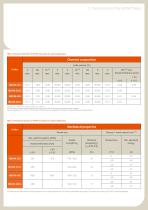
2. Characteristics of the HISTAR® Steels Table 2: Chemical composition of HISTAR steel grades for general applications Chemical composition Ladle analysis [%] Grades (1) CEV = C + Mn/6 + (Cr + Mo + V)/5 + (Cu + Ni)/15 (2) If sufficient nitrogen binding elements are present, the minimum aluminium requirement does not apply. (3) Upon agreement: Si = 0.14 - 0.25 % and P ≤ 0.035% max. for capability of forming a zinc layer during hot-dip galvanisation. Table 3: Mechanical properties of HISTAR steel grades for general applications Mechanical properties Charpy V-notch impact test (1) Tensile test Min....
Open the catalog to page 10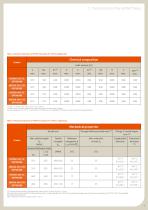
2. Characteristics of the HISTAR® Steels Table 4: Chemical composition of HISTAR steel grades for offshore applications Chemical composition 1) CEV = C + Mn/6 + (Cr + Mo + V)/5 + (Cu + Ni)/15 (2) When other N-binding elements are used, the minimum Al value does not apply. (3) Upon agreement: Si = 0.14 - 0.25 % and P ≤ 0.035% max. for capability of forming a zinc layer during hot-dip galvanisation. Table 5: Mechanical properties of HISTAR steel grades for offshore applications Mechanical properties Through thickness tensile test (1) Tensile test Charpy V-notch impact test (2) Longitudinal direction...
Open the catalog to page 11
3. Weight reduction of steel structures through the use of HISTAR® steels
Open the catalog to page 12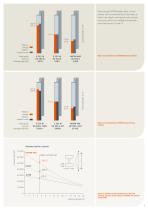
High strength HISTAR grades allow, in comparison with conventional structural steels, to reduce the weight and material costs of steel structures, and to cut welding and assembly time (see Figures 2,3 and 4). Relative weight Relative material costs S 235 JR HE 280 M 4578 Steel grade Section Ultimate load (kN) Figure 2: Economical use of HISTAR steel in columns 100 % 70 % 68 % Relative weight Relative material costs S 235 JR HD 400 x 1086 25254 Steel grade Section Ultimate load (kN) Figure 3: Economical use of HISTAR steel in heavy columns HISTAR 460 Relative ultimate load Ultimate load for columns...
Open the catalog to page 13
ArcelorMittal Photo Library - Architect: Dominique Perrault - Velodrome, Berlin
Open the catalog to page 14
Fabrication costs Weight per meter 120 % 102 % Steel grade Section Ultimate load (kN) Weight (kg/m) Due to the high yield strength of HISTAR beams, it is possible to substitute complicated and expensive built-up sections by economical hot rolled beams (see Figure 5). Figure 5: Economical use of a HISTAR column compared to built-up sections In case of bending, the required cross section and fabrication cost can be reduced by using beams in HISTAR grades (see Figure 6). Weight relative to grade S 355 Material costs Weld volume 125 % 112 % 110 % 7m Steel grade Section Ultimate load (kN) HISTAR grades...
Open the catalog to page 15
4. Fabrication guidelines 1. General The general recommendations given in this chapter shall be observed to ensure the successful fabrication, welding, and heat treatment of the fine-grained high-strength HISTAR 355 and HISTAR 460 steels for structural and offshore applications. HISTAR steels offer a good weldability for manual and automatic processes, provided the general rules for welding are respected. Shielded Metal Arc Welding (SMAW), Gas Metal Arc Welding (GMAW), Flux-Cored Arc Welding (FCAW), and Submerged Arc Welding (SAW) are processes successfully used to weld HISTAR 355 and 460 grades....
Open the catalog to page 16All ARCELORMITTAL Long catalogs and technical brochures
 Slim-Floor
40 Pages
 ACB® and Angelina® beams
64 Pages
 Bridges With rolled sections
52 Pages
 Bars and Rods
36 Pages
 Stainless steel in construction
68 Pages
 Arval Sunstyl
16 Pages
 Pflaum & Söhne Bausysteme GmbH
72 Pages
 Arval Colorissime
10 Pages
 Steel Sheet Piling
56 Pages
 Beam Finishing
8 Pages
 ACB - Cellular Beams
48 Pages
 RESIDENTIAL BUILDINGS
68 Pages
 Angelina TM beams
38 Pages
 Safety Barriers
12 Pages
 Pfl aum & Söhne Bausysteme GmbH
72 Pages


Archived catalogs
 Aluzinc® in Building
8 Pages
 Colorissime
10 Pages
 Long Products
180 Pages
 Form Tie Bars
2 Pages
 ExpandedMetal
24 Pages
 CARRIL / RAIL
28 Pages
 AMCRPS
52 Pages
 Sections and Merchant Bars
244 Pages
 arival system by arcelormittal
80 Pages
 ArcelorMittal Piling Handbook
368 Pages
 Sunstyl
16 Pages
 Floor systems guide
96 Pages
 Material Selection Guide
23 Pages


- Industrial flooring
- Tertiary flooring
- ARCELORMITTAL building coating
- Indoor coating
- Profiled sheet
- Profile
- Acoustic floor covering
- ARCELORMITTAL outdoor coating
- Strip flooring
- Interior panel
- Steel sheet metal
- Facade profiled sheet
- Metal profile
- Commercial panel
- Home panel
- Smooth coating
- ARCELORMITTAL protective coating
- Smooth panel
- Industrial formwork