
- Catalogs
- ARCELORMITTAL Long
- ACB® and Angelina® beams

ACB® and Angelina® beams

ACB® and Angelina® beams
ACB® and Angelina® beams are innovative structural elements with large web openings, offering flexibility and functionality. They serve as alternatives to traditional trusses and open-web joist systems, providing lightweight, long-span solutions for creating vast column-free spaces. These beams accommodate mechanical, electrical, and plumbing (MEP) systems within their depth, allowing for compact ceiling systems and maximizing floor-to-ceiling heights. They are manufactured using optimized methods for cost-effectiveness and quick dispatch.
These beams are used in roof and floor support systems, building renovations, parking structures, and offshore structures. They efficiently accommodate building services and structural support within minimal ceiling spaces, enabling large, column-free areas.
The design and fabrication involve flame cutting and welding of hot-rolled structural sections. Beams can be customized in size, spacing of openings, and profiles to meet specific project needs. They can be curved, cambered, tapered, or have elongated openings to suit architectural or serviceability requirements.
Beams are designed to meet specific tolerances and stability requirements, including fire conditions. They ensure structural integrity and efficiency, with options for reinforced or filled openings to support high shear forces or for fire safety reasons.
ACB® and Angelina® beams contribute to sustainable construction by reducing material usage and facilitating efficient building designs. ArcelorMittal provides predesign software and support to assist engineers and architects in selecting efficient and economical beam solutions.
- Supporting Concentrated Loads: Use of stiffeners or infills is recommended to prevent plastic deformation under concentrated loads.
- Welding Standards: Welders are qualified under EN 287-1 for MAG 135 and 136 processes. Butt welding is typically used, and full penetration welds are generally not required.
- Web Reinforcement: Cellular beams require sufficient stiffness to minimize deflection and vibrations, with options including heavier sections, higher steel grades, infilling openings, or stiffening openings.
- Fabrication Options: Beams can be delivered "as fabricated," overlength, cut to length, and with filled openings.
- Optimisation of Openings: Careful positioning of openings is crucial to avoid unnecessary filling, optimizing the beam structurally and adjusting the spacing between openings.
- Splicing and Curving: Splicing may be necessary, and partial filling of openings can maintain load paths. Curving of beams is often required for architectural or load compensation reasons.
- Overall Height of Cellular Beams: Determined by beam span, spacing, strength, and serviceability requirements. Span/depth ratios vary based on application.
- Layout of Web Openings: Governed by architectural and functional requirements, with geometric limits to ensure mechanical stability.
- Design Checks: Must meet Ultimate and Serviceability Limit States, considering local instabilities, shear buckling resistance, and lateral torsional buckling.
- Design Recommendations: Considerations include beam span, spacing, and serviceability requirements. Beam spacing varies with floor type and propping conditions.
- Design Checks: Include section capacity during construction, shear stud capacity, bending moment capacity, and vertical deflection limits.
ACB® and Angelina® beams typically withstand ISO fire for 15 to 20 minutes. To meet the R30 requirement, a moderate overdesign using higher-grade steel like S460 is suggested. Fire resistance can be enhanced with spray or intumescent coatings. MACS+ software and the Natural Fire Safety Concept are used for specific calculations and reducing or eliminating passive protection based on real fire conditions.
These beams contribute positively to both operational and embodied impacts in buildings, offering clear spans, service integration, and efficient asymmetric sections, aligning with circular economy principles. They are made from low-impact materials like HISTAR® steel, produced using the electric arc furnace process.
ACB+ and ANGELINA software are used for designing beam solutions, including single span, tapered, and curved beams. These tools perform capacity checks according to Eurocode standards and are available in multiple languages. Predesign charts help engineers quickly determine section sizes and web opening layouts based on project loading conditions.
The design load, qdim, is calculated using specific formulas and compared with ultimate load, qu, from the charts. Three procedures are outlined for using the predesign charts based on known design load, span length, or section size. An example is provided for designing an Angelina® beam for a composite floor with specific parameters and loading criteria.
Detailed specifications and ultimate load capacities for various composite Angelina® sections are provided, based on HD, HISTAR® 460, and S355 with COFRAPLUS 60 and Cofradal 200. Tables list dimensions and ultimate load capacities (qu) in kN/m for different spans (m), highlighting performance under varying conditions.
ArcelorMittal offers comprehensive technical support for designing and developing steel solutions, including free technical advice on structural design, construction details, surface protection, fire safety, metallurgy, and welding. High-performance finishing services such as drilling, flame cutting, and welding are also provided.
The Steligence® approach considers buildings as part of their environment throughout their lifecycle, demonstrating the economic, flexible, sustainable, and creative benefits of using best-in-class products.
Contact details for technical support and inquiries are provided for European and other markets. ArcelorMittal operates globally, with local agencies available for assistance.
Catalog excerpts
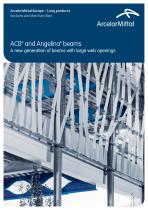
ArcelorMittal Europe - Long products Sections and Merchant Bars ACB® and Angelina® beams A new generation of beams with large web openings
Open the catalog to page 1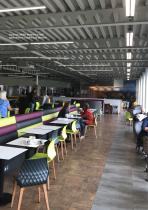
Exposed cellular beams in a roof application at a motorway services
Open the catalog to page 2
ACB® and Angelina® beams, with their circular and sinusoidal large web openings, elegantly combine function with flexibility. Alternatives to trusses and open-web joist systems, cellular beams are lightweight, long-spanning, structural elements that enable the design of vast column-free spaces. They can be used in composite and non-composite systems. Information includes analysis recommendations for use of these elements in traditional applications, such as floors and roofs; assumptions when considering how the sections will behave in response to fire; and information about using cellular beams...
Open the catalog to page 5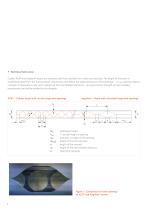
Technical fabrication Cellular ACB® and Angelina® beams are manufactured from standard hot-rolled steel sections. The length of the beam is established based from the framing layout. Dimensions that define the shape and layout of the openings – i.e. a0 (opening, depth), s (length of sinusoidal curve), and w (length of the intermediate web post) – are governed by strength and serviceability requirements and will be verified by the designer. ACB® - Cellular beam with circular large web openings Angelina® - Beam with sinusoidal large web openings total beam height T-section height at opening diameter...
Open the catalog to page 6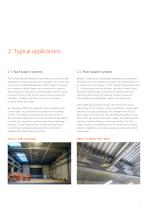
2.1. Roof support systems 2.2. Floor support systems ACB® and Angelina® beams are an attractive solution in roof applications as they provide the functionality of trusses with one simple, prefabricated element. When used as long span roof members cellular beams are economical for spans of 20m and above, and have successfully been used for spans in excess of 40m. They can be used as simply supported members, cantilever elements or as part of moment or portal frame structures. Modern construction increasingly demands accommodation of building services (heating, ventilation, air conditioning, etc.)...
Open the catalog to page 7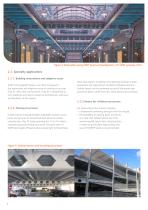
Studios d'Architecture ORY & Associés Figure 4: Renovation using ACB® beams at headquarters of Crédit Lyonnais, Paris 2.3. Specialty applications 2.3.1. Building renovations and adaptive reuse ACB® and Angelina® beams are often employed in the renovation and adaptive reuse of existing structures (Fig. 4). With their perforations, they fit in beautifully to such buildings and help to preserve architecture, openness and flexibility of the spaces. often dark spaces. In addition, the openings facilitate smoke evacuation and improved air circulation between sections. Cellular beams can be cambered...
Open the catalog to page 8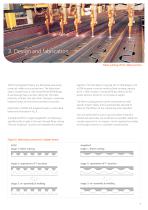
3. Design and fabrication Flame cutting of hot rolled sections ACB® and Angelina® beams are fabricated exclusively using hot-rolled structural sections. The fabrication shop is located close to the ArcelorMittal Differdange (Luxembourg) heavy section rolling mill. The close proximity of these two sites limits transport, maximises responsiveness and minimises manufacturing costs. Fabrication of ACB® and Angelina® beams, is described below and illustrated in Fig. 6: A double (ACB®) or single (Angelina®) cut following a specified path is made in the web through flame cutting. The two resulting T-sections...
Open the catalog to page 9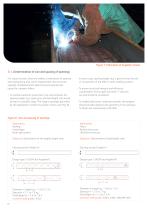
Figure 7: Fabrication of Angelina® beams 3.1. Determination of size and spacing of openings For a given section, there are endless combinations of opening sizes and spacing that can be implemented. Items that are typically considered when determining the appropriate layout for a project follow: • To maintain aesthetic proportions, the ratio between the opening height (a0), spacing (e) and final height (Ht) should be kept in a specific range. The range is generally governed by the application in which the system will be used (Fig. 8). In some cases, opening height (a0) is governed by the size...
Open the catalog to page 10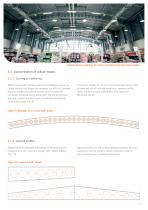
Cellular beams spanning 25 meters and featuring important camber 3.2. Customisation of cellular beams 3.2.1. Curving or cambering Where required for architectural or serviceability reasons (i.e. create positive roof slopes for rainwater run off or to manage dead load deflection, cellular beams can be curved and cambered. Achieved during fabrication, the top and bottom tee’s are curved/cambered prior to assembly and welding into the final state (Fig. 9). A minimum camber of 15 mm is recommended, and in order to avoid any risk of inverted installation, cambers will be clearly marked on each beam...
Open the catalog to page 11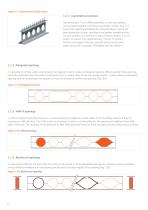
Figure 11: Asymmetrical ACB® beam 3.2.3. Asymmetrical sections Top and bottom T from differing profiles, or even steel grades, can be welded together to produce asymmetric profiles (Fig. 11). Asymmetric beams are adapted to composite design, having the ideal distribution of mass resulting in the lightest possible section. For such systems, it is common to have a heavier bottom T as it is subject to tension from global bending. The top T's primary function is to support the wet concrete at the construction stage, and so this is typically 30% lighter than the bottom T. 3.2.4. Elongated openings...
Open the catalog to page 12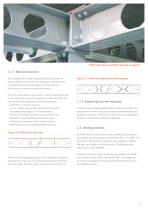
ACB® beam featuring filled openings at support 3.2.7. Web reinforcement Serviceability limit states require sufficient stiffness to reduce deflection and minimise vibrations. Cellular beams can efficiently meet these needs by optimising the distribution of steel throughout the profile. At times, optimisation may result in a risk of buckling at one or two web posts near the supports. In order to fortify the section, the following options can be considered: • selection of a heavier section • use of a higher steel grade, which would increase the load bearing capacity of the web posts • infilling...
Open the catalog to page 13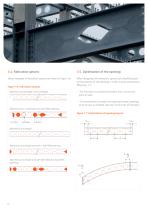
Select examples of fabrication options are shown in Figure 16. When designing the framework, special care should be given to the positions of the openings in order to avoid unnecessary filling (Fig. 17). Figure 16: Fabrication options delivered “as fabricated” and overlength • The first step is to optimise the beam from a structural point of view. • The second step is to adjust the spacing between openings so as to have a complete web post at the ends of the beam. delivered “as is”, overlength and with filled openings Figure 17: Optimisation of openings layout 1/2 disc Full disc delivered cut...
Open the catalog to page 14All ARCELORMITTAL Long catalogs and technical brochures
 Slim-Floor
40 Pages
 Bridges With rolled sections
52 Pages
 Bars and Rods
36 Pages
 Stainless steel in construction
68 Pages
 Arval Sunstyl
16 Pages
 Pflaum & Söhne Bausysteme GmbH
72 Pages
 Arval Colorissime
10 Pages
 Steel Sheet Piling
56 Pages
 Beam Finishing
8 Pages
 ACB - Cellular Beams
48 Pages
 RESIDENTIAL BUILDINGS
68 Pages
 Angelina TM beams
38 Pages
 Safety Barriers
12 Pages
 Pfl aum & Söhne Bausysteme GmbH
72 Pages


Archived catalogs
 Aluzinc® in Building
8 Pages
 Colorissime
10 Pages
 Long Products
180 Pages
 Form Tie Bars
2 Pages
 ExpandedMetal
24 Pages
 CARRIL / RAIL
28 Pages
 AMCRPS
52 Pages
 Sections and Merchant Bars
244 Pages
 arival system by arcelormittal
80 Pages
 ArcelorMittal Piling Handbook
368 Pages
 Sunstyl
16 Pages
 Floor systems guide
96 Pages
 Material Selection Guide
23 Pages


- Industrial flooring
- Tertiary flooring
- ARCELORMITTAL building coating
- Indoor coating
- Profiled sheet
- Acoustic floor covering
- ARCELORMITTAL outdoor coating
- Strip flooring
- Interior panel
- Steel sheet metal
- Facade profiled sheet
- Metal profile
- Commercial panel
- Home panel
- Smooth coating
- ARCELORMITTAL protective coating
- Smooth panel
- Building panel