
- Catalogs
- Ancon Building Products
- Ancon Thermal Breaks


Ancon Thermal Breaks
Ancon Thermal Breaks
Catalog excerpts

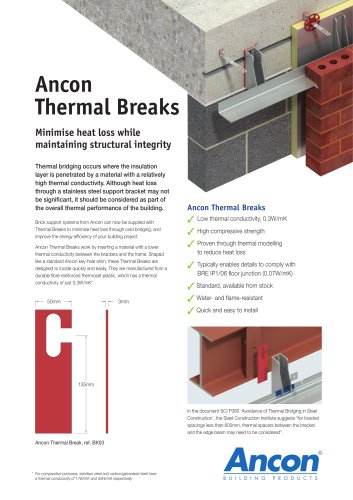
Ancon Thermal Breaks Minimise heat loss while maintaining structural integrity Thermal bridging occurs where the insulation layer is penetrated by a material with a relatively high thermal conductivity. Although heat loss through a stainless steel support bracket may not be significant, it should be considered as part of the overall thermal performance of the building. Brick support systems from Ancon can now be supplied with Thermal Breaks to minimise heat loss through cold bridging, and improve the energy efficiency of your building project. Ancon Thermal Breaks work by inserting a material with a lower thermal conductivity between the brackets and the frame. Shaped like a standard Ancon key-hole shim, these Thermal Breaks are designed to locate quickly and easily. They are manufactured from a durable fibre-reinforced thermoset plastic, which has a thermal conductivity of just 0.3W/mK*. Ancon Thermal Breaks Low thermal conductivity, 0.3W/mK High compressive strength Proven through thermal modelling to reduce heat loss Typically enables details to comply with BRE IP1/06 floor junction (0.07W/mK) Standard, available from stock Water- and flame-resistant Quick and easy to install In the document SCI P380 ‘Avoidance of Thermal Bridging in Steel Construction’, the Steel Construction Institute suggests “for bracket spacings less than 600mm, thermal spacers between the bracket and the edge beam may need to be considered”. Ancon Thermal Break, ref. BK03 * For comparative purposes, stainless steel and carbon/galvanised steel have a thermal conductivity of 17W/mK and 50W/mK respectively.
Open the catalog to page 1
Ancon Thermal Breaks Maximum Shimming Allowance The maximum thickness of shims should not exceed the outside diameter of the fixing or 16mm, whichever is less. The 3mm thickness of an Ancon Thermal Break should be taken into account when calculating the maximum shimming allowance for a system. Installation Guidance Ancon Thermal Breaks can be used singularly or as part of a shim pack. When used in conjunction with stainless steel shims, the Thermal Break should be located against the structure. Care should be taken not to exceed the maximum shimming allowance. Specifying and Ordering The standard...
Open the catalog to page 2All Ancon Building Products catalogs and technical brochures
 Eazistrip
16 Pages
 Tapered Thread Couplers
12 Pages
 MBT MechanicallyBolted Couplers
10 Pages
 Staifix HRT4 Wall Tie
1 Page
 EC2-Compliant Design Method
12 Pages
 Reinforcing Bar Couplers
28 Pages
 Tension and Compression Systems
16 Pages
 Restraint System
4 Pages
 Gauge Tape
2 Pages
 Non-Drill Wall Ties
6 Pages
 Refractory Fixings
8 Pages
 Staifix Wall Ties
2 Pages
 Special Fabrications
12 Pages
 Punching Shear Reinforcement
12 Pages
 Starter Bar Systems
8 Pages
 KSN Anchors
24 Pages
 Lockable Dowels
12 Pages
 DSD/ESD Shear Load Connectors
20 Pages
 Masonry Reinforcement
16 Pages
 Tension and Compression Systems
16 Pages
 Corner Guards
2 Pages
 Hidden Strength
7 Pages
 Stainless Steel in Construction
12 Pages
 12 Page Product Guide
12 Pages
 Wall Ties and Restraint Fixings
32 Pages


Archived catalogs
 Windposts and Parapet Posts
8 Pages
 Channel and Bolt Fixings
20 Pages


- Building fastening system
- Metal fastening system
- Building panel
- Stainless steel mounting clip
- Exterior mounting clip
- Construction panel
- Metal panel
- Steel fastening system
- Facade cladding fastening system
- Wall mounting clip
- Ventilated facade fastening system
- Industrial lintel
- Ground anchor
- Steel panel
- Load-bearing lintel
- Shear load connector
- Masonry fastening system
- Prefab lintel
- Reinforcing bar connector
- Wind post