
- Catalogs
- Amorim Cork Composites
- eBook Why is damping important for construction?


eBook Why is damping important for construction?
eBook Why is damping important for construction?
Damping is crucial for vibration control in construction, enhancing safety and comfort in buildings and infrastructures. Cork, with its high loss factor, is highlighted as an excellent damping material.
Understanding Damping
Damping refers to the dissipation of vibration energy in solid mediums over time and distance, similar to sound absorption in air. It occurs due to friction that diminishes movement and disperses energy. The damping capacity of a material is known as its loss factor, representing the ratio between dissipated energy and the energy remaining in the system.
Examples of Damping
Examples include the friction between a rolling ball and the ground, and the resistance faced by a car due to rolling friction and air resistance. In liquid environments, this is known as viscous damping.
Damping and Vibration Isolation
Damping limits vibrations and protects systems, such as spring hinges in doors or bridge deck damping systems. It prevents resonance effects, which can lead to structural collapse. Solutions include altering the structure's natural frequency and adding damping characteristics.
Vibration Control
Effective vibration control requires considering system characteristics like surrounding atmosphere, temperature, and material properties. Transmissibility, determined by mass, rigidity, and damping, is key to insulation system performance.
Measuring Damping
Damping can be measured by vibration range reduction, temporal variation in free vibrations, and spatial reduction of forced vibrations.
Cork as a Damping Material
Cork's closed, cellular structure gives it a higher loss factor than rubber, making it effective for energy dissipation. The Acousticork range from Amorim Cork Composites offers solutions balancing damping and insulation, with specific polymer formulations enhancing cork's properties.
Conclusion
Damping is a critical component in construction for ensuring structural integrity and comfort. Cork, with its unique properties, provides an effective solution for damping needs.
Catalog excerpts
eBook Why is damping important for construction?
Open the catalog to page 1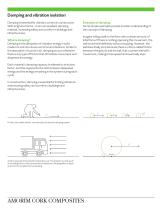
Damping and vibration isolation Damping is essential for vibration control in construction. With a high loss factor, cork is an excellent damping material, increasing safety and comfort in buildings and infrastructures. What is damping? Damping is the dissipation of vibration energy in solid mediums and structures over time and distance. Similar to the absorption of sound in air, damping occurs whenever there is any type of friction that diminishes movement and disperses the energy. Examples of damping Some simple examples provide a better understanding of the concept of damping: Imagine rolling...
Open the catalog to page 2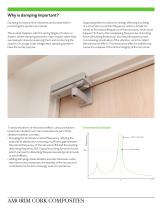
This is what happens with the spring hinges of a door or drawer, where damping prevents major impact when they are opened/closed, preserving them and protecting the system. On a large scale, bridge deck damping systems have the same purpose. To avoid situations of resonance effect, various solutions have been studied, two main measures are part of the vibration isolation concept: • changing the structure’s natural frequency, altering the load and its distribution, ensuring a sufficient gap between the natural frequency of the structure (f0) and the exciting disturbing frequency (fn). Typical...
Open the catalog to page 3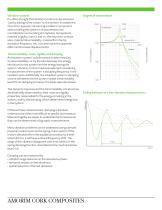
Many vibration problems can be addressed using a simple physical model, known as the spring-mass system. If the mass is disturbed from the equilibrium position by a brief external force, it will have a natural frequency of f0. The range of this vibration disappears over time, based on the spring damping function, described as the mechanical loss factor (ƞ). Damping can be measured by: • vibration range reduction in the resonance phase; • temporal variation in free vibrations; • spatial reduction of forced vibrations. Fading behavior of a free vibration displacement x Deflection x Of these three...
Open the catalog to page 4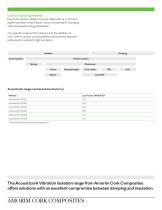
Cork as a damping material Due to its closed, cellular structure, filled with air, cork has a higher loss factor than rubber, which is essential for damping and consequent energy dissipation. Our specific polymer formulations and the addition of cork, with its unique compressibility and recovery features, enhance the material’s high loss factor. Isolation Active systems Damping Passive systems Elastomers Foams Recycled rubber Cork rubber Acousticork range mechanical loss factor (ƞ) Material * Temperature, frequency and load dependent The Acousticork Vibration Isolation range from Amorim Cork...
Open the catalog to page 5
Amorim Cork Composites Rua Comendador Américo Ferreira Amorim, 260 4536-902 Mozelos, Santa Maria da Feira, Portugal T. +351 22 747 5300 F. +351 22 747 5301 E. [email protected] Amorim Cork Composites USA 26112 110th Street Trevor, WI 53179, USA T. +1 262 862 2311 F. +1 262 862 2500 E. [email protected] www.amorimcorkcomposites.com
Open the catalog to page 6All Amorim Cork Composites catalogs and technical brochures
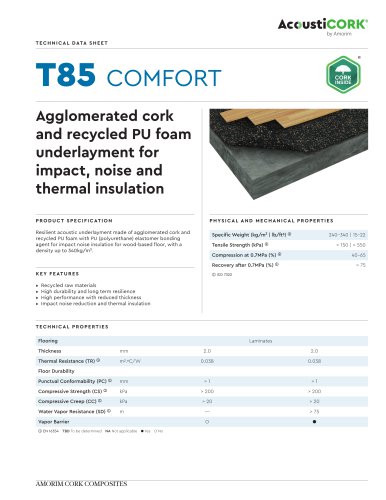 TDS_Acousticork_T85
4 Pages
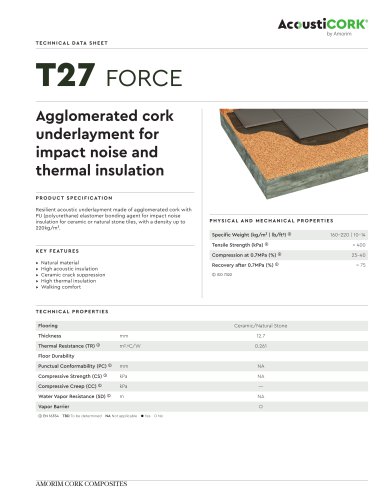 TDS_Acousticork_T27
4 Pages
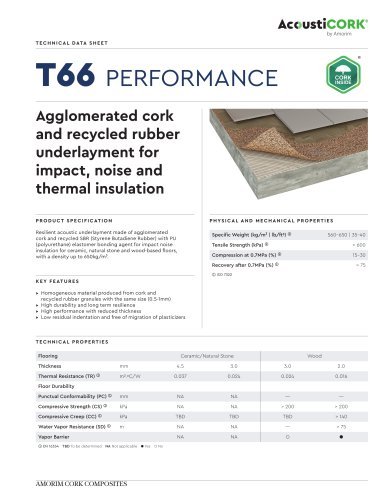 TDS_Acousticork_T66
4 Pages
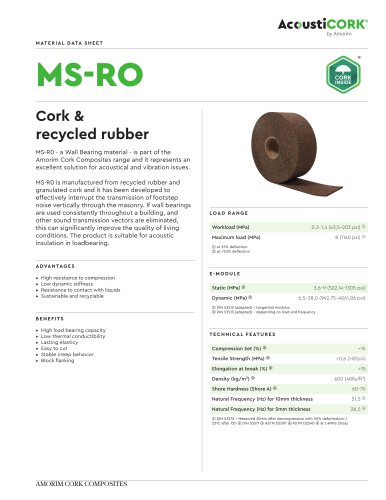 Acousticork_MS-R0_ACS
2 Pages
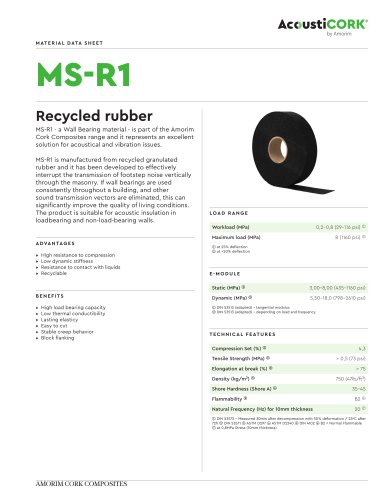 Acousticork_MS-R1_ACS
2 Pages
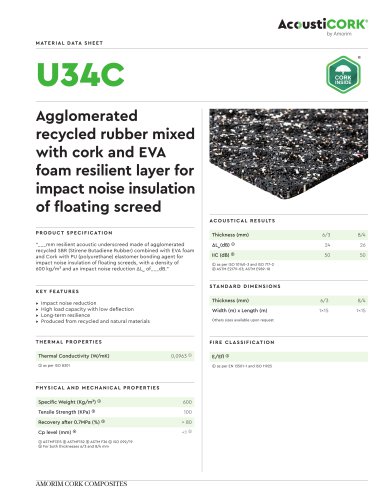 Acousticork_U34C
3 Pages
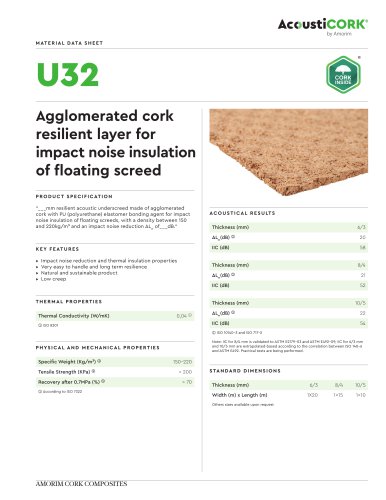 Acousticork_U32_ACS
4 Pages
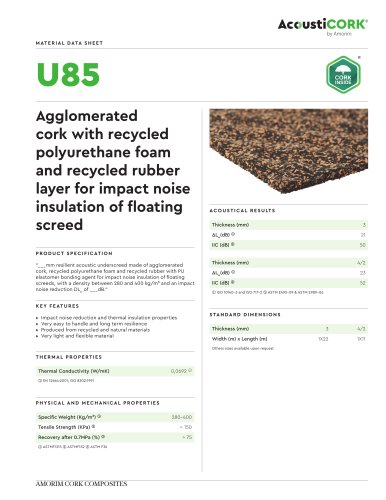 Acousticork_U85_ACS
3 Pages
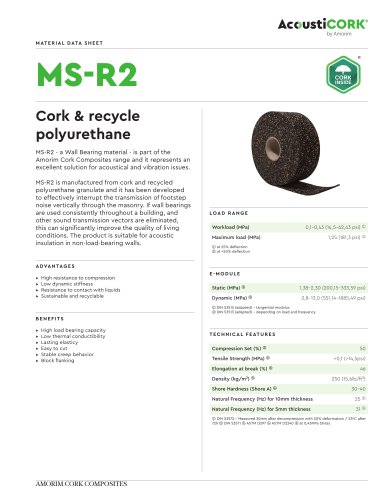 Acousticork_MS-R2_ACS
2 Pages
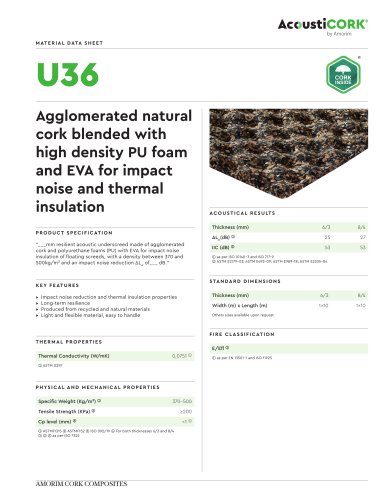 Acousticork_U36_ACS
3 Pages
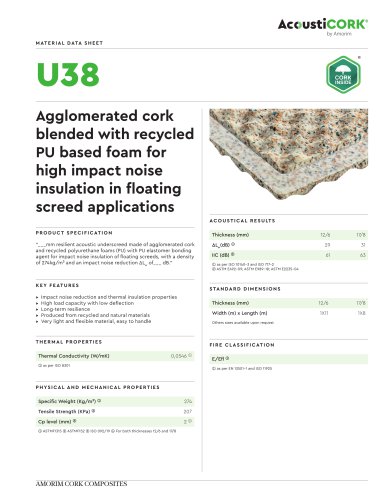 Acousticork_U38_ACS
3 Pages


Archived catalogs
 T61 balance
5 Pages
 T56 endurance
4 Pages
 T51 protection
3 Pages
 T47 versatile
4 Pages
 T04 maximum
5 Pages
 T92 selection
4 Pages
 ACM30
ACM301 Page
 UNDERL AYS
8 Pages
 Let’s cork together
36 Pages
 YOGA COLLECTION
8 Pages
 General brochure Acousticork EN
22 Pages



- Synthetic insulation
- Wall insulation
- Thermal-acoustic insulation
- Industrial acoustic insulation
- Flooring insulation
- Exterior insulation
- High-resistance insulation
- Plant-based insulation
- Sound-absorbing underlay
- Expanded polyurethane insulation
- Recycled insulation
- Fire-retardant insulation
- Rubber insulation
- Cork insulation
- Rubber sound-insulating underlay
- Floor panel resilient underlay
- Cork resilient underlay
- Sheet resilient underlay
- Strip type insulation