
- Catalogs
- AMICO - Alabama Metal Industries
- Stay Form Catalogue


Stay Form Catalogue

Stay Form Catalogue
Stay-Form® is a versatile product used in various construction applications such as pile caps, grade beams, dams, foundations, blindside walls, bulkheads, bridges, shotcrete, retaining walls, keyways, ductbanks, tunnels, and footings. It offers significant labor cost savings as it eliminates the need for stripping forms. The lightweight sheets are easy to handle and allow for visual inspection during concrete pouring. Made from hot-dipped galvanized sheet steel, Stay-Form® is available in different lengths and features V-ribs for added rigidity.
Stay-Form® is ideal for forming concrete walls close to existing structures. It works with rebar studs and hook ties to create a one-sided form. The product's V-ribs provide the necessary rigidity to withstand concrete pressures. It is compatible with self-consolidating concrete and allows for a recommended pour rate of 4 to 7 feet per hour.
Stay-Form® is effective for forming bulkheads as it does not require stripping after the concrete pour. It allows for easy rebar or conduit penetration and provides greater shear bond strengths due to its open mesh design.
Stay-Form® saves labor in forming below-grade structures like pile caps by eliminating the need for stripping forms. It allows water to run out during the concrete pour and is typically used with backfill or slab-on-grade designs.
Stay-Form® simplifies the formation of grade beams, reducing excavation needs and preventing soil from collapsing into the excavation site. It is often used with backfill to minimize bracing requirements.
Electrical contractors prefer Stay-Form® for forming ductbanks due to its ease of installation and significant labor savings. It allows for visual inspection to prevent honeycombing during concrete consolidation.
Stay-Form® is frequently used in bridge construction for forming footings, edge forms, and bulkheads. It provides greater shear bond strength compared to plywood and eliminates the need for scabbling.
Stay-Form® serves as an effective backstop for shotcrete applications, minimizing rebound and allowing for visual inspection of both sides of the formwork.
Stay-Form® exhibits high yield and ultimate strength, with a modulus of elasticity of 29,500 ksi. It outperforms traditional materials in shear bond strength tests, providing up to 21% greater strength.
Stay-Form® should be braced similarly to plywood, with specific guidelines for lap and tie wire usage. It can be cut with various tools and requires proper bracing at lap points.
Catalog excerpts

Stay-in-place Concrete Form Made in the HR 1 EH, Meets ARRA Section 1110 blindside walls pile caps QUALITY PRODUCTS – COAST TO COAST ®
Open the catalog to page 1
35% LABOR SAVINGS NO STRIPPING OF FORMS QUALITY PRODUCTS – COAST TO COAST Alabama Metal Industries Corporation 3245 Fayette Avenue • Birmingham, AL 35208 Phone (205) 787-2611 • (800) 366-2642 • Fax (205) 786-6527 www.amico-stayform.com
Open the catalog to page 2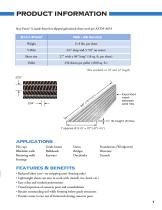
PRODUCT INFORMATION Stay-Form® is made from hot-dipped galvanized sheet steel per ASTM-A653 Sheet size 27” wide x 96” long* (18 sq. ft. per sheet) 250 sheets per pallet (4500 sq. ft.) *Also available in 10’ and 12’ lengths Expanded mesh between solid ribs applications Pile caps Grade beams Blindside walls Bulkheads Retaining walls Keyways Footings Dams Bridges Ductbanks Foundations (Windpower) Shotcrete Tunnels features & benefits • Reduced labor cost—no stripping costs (bracing only) • Lightweight sheets are easy to work with (install, cut, bend, etc.) • Easy rebar and conduit penetrations •...
Open the catalog to page 3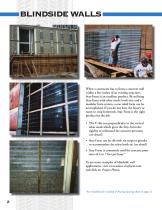
BLINDSIDE WALLS When a contractor has to form a concrete wall within a few inches of an existing structure, Stay-Form is an excellent product. By utilizing Stay-Form with rebar studs, hook ties, and a modular form system, a one sided form can be accomplished. If you do not have the luxury or room to strip formwork, Stay-Form is the right product for the job. • The V ribs run perpendicular to the vertical rebar studs which gives the Stay-Form the rigidity to withstand the concrete pressures (see detail). • Stay-Form can be slit with tin snips or grinder to accommodate the rebar hook tie (see detail)....
Open the catalog to page 4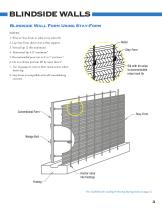
BLINDSIDE WALLS Blindside Wall Form Using Stay-Form NOTES: 1. Wire tie Stay-Form to rebar every other rib. 2. Lap Stay-Form sheets over a rebar support. 3. Vertical lap (2 ribs minimum) 4. Horizontal lap 4-8” minimum* 5. Recommended pour rate is 4’ to 7’ per hour.* 6. Do not vibrate previous lift by more than 6”. Slit with tin snips to accommodate rebar hook tie 7. Use 16-gauge tie wire or sheet metal screws where sheets lap. 8. Stay-Form is compatible with self-consolidating concrete. Conventional Form Wedge Bolt Anchor rebar into footings Footing *See Guidelines for Loading & Bracing Spacings...
Open the catalog to page 5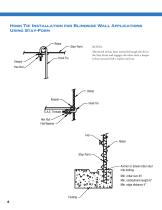
Hook Tie Installation for Blindside Wall Applications Using Stay-Form Rebar NOTES: After hook tie has been inserted through the slit in the Stay-Form and engages the rebar stud, a keeper is then secured with a washer and nut. Rebar Keeper Hook Tie S.A.E. Threads Hex Nut Flat Washer Lap Rebar Anchor or dowel rebar stud into footing Min. rebar size #5 Min. embedment length 6” Min. edge distance 4”
Open the catalog to page 6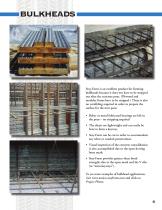
Stay-Form is an excellent product for forming bulkheads because it does not have to be stripped out after the concrete pour. (Plywood and modular forms have to be stripped.) There is also no scrabbling required in order to prepare the surface for the next pour. • Rebar or metal fabricated bracings are left in the pour – no stripping required • The sheets are lightweight and can easily be bent to form a keyway. • Stay-Form can be cut in order to accommodate any rebar or conduit penetrations. • Visual inspection of the concrete consolidation is also accomplished due to the open herring bone mesh....
Open the catalog to page 7
PILE CAPS When forming below grade structures like a pile cap, Stay-Form can save a considerable amount of labor. You have no labor for stripping forms. If rebar or metal is used for bracing, it stays in place. (Wood bracing has to be removed.) Some contractors backfill around the Stay-Form prior to the pour therefore they minimize bracing. • Contractors can cut the V ribs in order to bend the sheets to any geometry. • During the concrete pour any water in the form will run out of the Stay-Form as it is displaced by the concrete (no pumping it out). • Concrete finish is not a concern since backfill...
Open the catalog to page 8
GRADE BEAMS Grade beams are easily formed using Stay-Form and rebar or lumber as bracing. Some contractors prefer to backfill 75 to 90 percent up the grade beam prior to the concrete pour in order to minimize the required bracing. Backfilling acts as the bracing which will stop the formwork from spreading during the pour. • Using tie wire around the Stay-Form ribs and rebar or lumber is easy to do. • Since the Stay-Form is not stripped, the excavation required is less than what would be needed using conventional formwork. • Some contractors use Stay-Form to hold the surrounding soil from falling...
Open the catalog to page 9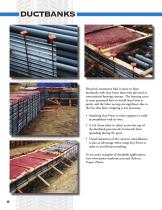
Electrical contractors find it easier to form ductbanks with Stay-Form than with plywood or conventional forming systems. The learning curve to train personnel how to install Stay-Form is quick, and the labor savings are significant due to the fact that form stripping is not necessary. • Attaching Stay-Form to rebar supports is easily accomplished with tie wire. • A 2x4 (from rebar to rebar) across the top of the ductbank prevents the formwork from spreading during the pour. • Visual inspection of the concrete consolidation is also an advantage when using Stay-Form in order to avoid honeycombing....
Open the catalog to page 10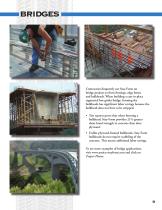
Contractors frequently use Stay-Form on bridge projects to form footings, edge forms and bulkheads. When building a cast-in-place segmental box girder bridge, forming the bulkheads has significant labor savings because the bulkhead does not have to be stripped. • Test reports prove that when forming a bulkhead, Stay-Form provides 21% greater shear bond strength to concrete than does plywood. • Unlike plywood-formed bulkheads, Stay-Form bulkheads do not require scabbling of the concrete. This means additional labor savings. To see more examples of bridge applications, visit www.amico-stayform.com...
Open the catalog to page 11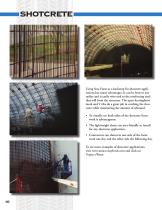
Using Stay-Form as a backstop for shotcrete applications has many advantages. It can be bent to any radius and is easily wire-tied to the reinforcing steel that will form the structure. The open herringbone mesh and V ribs do a great job in catching the shotcrete while minimizing the amount of rebound. • To visually see both sides of the shotcrete formwork is advantageous. • The lightweight sheets are user-friendly to install for any shotcrete application. • Contractors can shotcrete one side of the formwork one day and the other side the following day. To see more examples of shotcrete applications,...
Open the catalog to page 12All AMICO - Alabama Metal Industries catalogs and technical brochures
 Safety Grating
4 Pages
 Security Mesh
4 Pages
 Fabricated Products
108 Pages
 Perforated Metals
4 Pages
 Architectural Concepts Guide
72 Pages
 The easy-to-work-with company
20 Pages
 Secura Lath ®
12 Pages
 AMICO Vinyl Bead
36 Pages

- Industrial metal mesh
- Fencing
- Industrial suspended ceiling
- Stainless steel metal mesh
- Metal fence
- Residential fence
- Contemporary fence
- Building metal mesh
- Trim board
- Interior metal mesh
- Industrial solar shading
- Commercial fence
- Industrial garden fence
- Steel sheet metal
- Facade solar shading
- Facade profiled sheet
- Metal suspended ceiling
- Panel suspended ceiling
- Tile edge trim