
- Catalogs
- AGC Glass Europe
- Anti-Fog Technical Data Sheet


Anti-Fog Technical Data Sheet

Anti-Fog Technical Data Sheet
This technical datasheet provides detailed information on Planibel Anti-Fog, iplus 1.1-AF, Energy N-AF, ipasol neutral 70/37-AF, and Stopray Vision-72-AF glass products, focusing on their stock sizes.
Normative References
The products conform to EN 1096 standards for coated glass, ensuring compliance with definitions, classifications, requirements, and test methods. They are CE-marked and produced in ISO 9001 certified factories.
Composition and Properties of the Glass
Chemical Composition: The glass is primarily composed of SiO2 (69-74%), Na2O (10-16%), CaO (5-14%), MgO (0-6%), Al2O3 (0-3%), and other elements (0-5%).
Mechanical Properties: Includes a density of 2,500 kg/m³, Young's Modulus of 70,000 N/mm², and a characteristic bending strength of 45 N/mm².
Thermal Properties: The glass has a softening point of approximately 600°C and a fusion temperature of about 1500°C.
Optical Properties: The refractive index for visible radiation is 0.67 (air/glass) and 1.50 (glass/air).
Electrical Properties: Specific resistance is 5.107 Ω.m at 1,000 Hz and 25°C.
Durability of Coatings
Planibel Anti-fog is classified as class A, while other products have dual coatings (class A and C). Durability tests include resistance to condensation, acid, neutral salt spray, and abrasion.
Light, Solar, and Thermal Properties
Properties such as light transmission (LT), light reflection (LR), energy transmission (DET), and solar factor (SF) are measured with specific tolerances. The thermal transmittance Ug is calculated according to EN 673.
Acoustic Properties
The acoustic properties are listed with Rw values for different thicknesses, indicating sound insulation performance.
Tolerances on Dimensions
Thickness and dimensions have specific tolerances, with thickness measured to the nearest 0.01 mm and length/width tolerances of ±3 mm and ±2 mm, respectively.
Quality Requirements
Defines defects such as uniformity defects, stains, punctual defects (spots, pinholes, scratches), and clusters. Detection involves visual inspection under specific lighting conditions.
Acceptance Criteria of Coatings Glass Defects
Criteria for acceptance of defects are detailed, including limits on uniformity, stains, spots, pinholes, clusters, and scratches.
Color Difference in Façades
Describes methods for measuring and evaluating color differences in installed façades, with specific requirements for ΔL*, Δa*, and Δb* values.
Other Related Documents
Additional resources include processing guides, cleaning and maintenance guides, glazing instructions, and CE-Marking declarations, available at www.YourGlass.com.
Catalog excerpts
Technical Data Sheet Planibel Anti-Fog, iplus 1.1-AF, Energy N-AF, ipasol neutral 70/37-AF, Stopray Vision-72-AF 11/2018
Open the catalog to page 1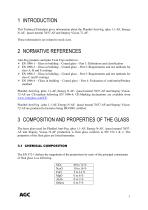
1 INTRODUCTION This Technical Datasheet gives information about the Planibel Anti-fog, iplus 1.1-AF, Energy N-AF, ipasol neutral 70/37-AF and Stopray Vision-72-AF. These information's are related to stock sizes. 2 NORMATIVE REFERENCES Anti-Fog products and iplus Twin Top conform to: EN 1096-1 – Glass in building – Coated glass – Part 1: Definitions and classification EN 1096-2 – Glass in building – Coated glass – Part 2: Requirements and test methods for class A, B and S coatings EN 1096-3 – Glass in building – Coated glass – Part 3: Requirements and test methods for class C and D coatings...
Open the catalog to page 3
Weight (at 18°C): = 2 500 kg/m³ Density: 2,5 Young's Modulus (modulus of Elasticity): E = 70 000 N/mm² Poisson Ratio: = 0,2 Shear Modulus: G = E/ 2 (1+) 29 166 N/mm² Knoop Hardnes: 6 GPa Mohs Hardness: 6 Characteristic bending strength: 45 N/mm² Softening point: 600 °C Fusion temperature: 1500 °C Linear expansion coefficient: = 9.10-6/K (between 20° and 300°) Specific heat capacity: C = 720 J/(kg.K) Refractive index N to visible radiation (380 to 780 nm): - air/glass: 0,67 - glass/air: 1,50 Specific resistance: 5.107 .m at 1 000 Hz and 25°C Dielectric constant: 7,6 at 1 000 Hz...
Open the catalog to page 4
5 LIGHT, SOLAR AND THERMAL PROPERTIES 5.1 CONVENTION FOR COATING POSITION The following conventions are used for the numbering of the glass faces and the position of the coating. For glasses with two coatings, only the coating of class C is indicated.
Open the catalog to page 5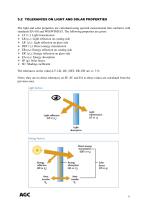
5.2 TOLERANCES ON LIGHT AND SOLAR PROPERTIES The light and solar properties are calculated using spectral measurement that conforms with standards EN 410 and WIS/WINDAT. The following properties are given: LT (v): Light transmission LR (v): Light reflection on coating side LR' ('v): Light reflection on glass side DET (e): Direct energy transmission ER (e): Energy reflection on coating side ER' ('e): Energy reflection on glass side EA (e): Energy absorption SF (g): Solar factor SC: Shading coefficient The tolerances on the values LT, LR, LR', DET, ER, ER' are +/- 3 %....
Open the catalog to page 6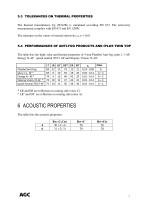
The thermal transmittance Ug (W/m2K) is calculated according EN 673. The emissivity measurement complies with EN 673 and EN 12898. The tolerance on the values of normal emissivity Sn is + 0,01. 5.4 PERFORMANCES OF ANTI-FOG PRODUCTS AND IPLUS TWIN TOP The table lists the light, solar and thermal properties of 4 mm Planibel Anti-fog, iplus 1.1-AF, Energy N-AF, ipasol neutral 70/37-AF and Stopray Vision-72-AF.
Open the catalog to page 7
The same tolerances than for the float used as support of the coating apply. These information's are related to stock sizes. The actual thickness shall be the average of for measurements, taken to the nearest 0,01 mm, one taken at the center of each side. The actual thickness rounded to the nearest 0,1 mm shall not vary from the nominal thickness by more than the tolerances shown in the table. The tolerances on nominal dimensions length H and width B are respectively ± 3 mm and ± 2 mm. The limit of squareness is described by the difference between diagonals. The difference is maximum 5 mm.
Open the catalog to page 8
8 QUALITY REQUIREMENTS 8.1 INTRODUCTION The defect affecting appearances are: Specific from the float glass: see the Technical Datasheet "Planibel" Specific to the coating: see hereunder. If a defect specific to the glass substrate is more visible because of the coating, it will be treated as a coating defect. 8.2 DEFINITIONS OF DEFECTS The following definitions apply: Uniformity defect: Slight visible variation in color, in transmission or reflection, within a coated glass pane or from pane to pane Stain: Defect in the coating larger than punctual defect, often irregularly shaped, partially...
Open the catalog to page 9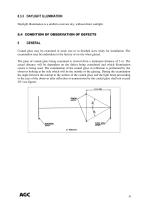
8.3.3 DAYLIGHT ILLUMINATION Daylight illumination is a uniform overcast sky, without direct sunlight. 8.4 CONDITION OF OBSERVATION OF DEFECTS 8.4.1 GENERAL Coated glass may be examined in stock size or in finished sizes ready for installation .The examination may be undertaken in the factory or on site when glazed. The pane of coated glass being examined is viewed from a minimum distance of 3 m. The actual distance will be dependent on the defect being considered and which illumination source is being used. The examination of the coated glass in reflection is performed by the observer looking...
Open the catalog to page 10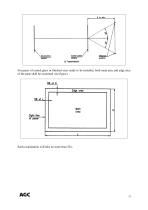
For panes of coated glass in finished sizes ready to be installed, both main area and edge area of the pane shall be examined (see figure). Each examination will take no more than 20 s.
Open the catalog to page 11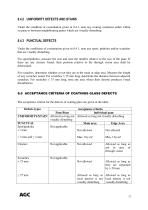
Under the condition of examination given in 8.4.1, note any coating variations either within on pane or between neightbouring panes which are visually disturbing. 8.4.3 PUNCTUAL DEFECTS Under the conditions of examination given in 8.4.1, note any spots, pinholes and/or scratches that are visually disturbing. For spots/pinholes, measure the size and note the number relative to the size of the pane. If there are any clusters found, their position relative to the through vision area shall be determined. For scratches, determine whether or not they are in the main or edge area. Measure the length...
Open the catalog to page 12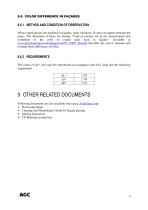
9 OTHER RELATED DOCUMENTS Following documents are also available from www.YourGlass.com: > Processing Guide > Cleaning and Maintenance Guide for Faqade glazing > Glazing Instruction > CE-Marking declarations
Open the catalog to page 13All AGC Glass Europe catalogs and technical brochures
 Leaflet Luxclear_Digital_EN
6 Pages
 Brochure_Deco-Solutions_0523_EN
21 Pages
 TDS_FIX-IN_AT_0523_EN
2 Pages
 BROCHURE Low-Carbon-Glass
4 Pages
 PLANIBEL LINEA AZZURA
4 Pages
 STRATOBEL COLOUR
6 Pages
 Stratobel Polycarbonate
1 Page
 Stratobel Security
12 Pages
 ENERGY 65/42S
4 Pages
 CLEARSIGHT
8 Pages
 ARTLITE SILKSCREEN
1 Page
 ARTLITE DIGITAL
1 Page
 STOPRAY-IPASOL | SUNERGY-STOPSOL
23 Pages
 LUXCLEAR PROTECT
6 Pages
 Planibel Easy
2 Pages
 Structura
2 Pages
 THERMOBEL
24 Pages
 OVERSIZED GLASS
20 Pages
 ImagIn & oltreluce Soft PAttERNS
16 Pages
 LACOBEL T & MATELAC T
12 Pages
 LACOBEL AND MATELAC
20 Pages
 MIROX 4GREEN & MNGE
12 Pages
 MATELUX
12 Pages
 COLORBEL
6 Pages
 ANTI-FOG
4 Pages
 Imagin & Oltreluce
43 Pages
 PLANIBEL CLEARSIGHT
2 Pages
 yourglass pocket
437 Pages
 lacomat
4 Pages
 Heat treated glass
5 Pages
 Blackpearl
3 Pages
 Antibacterial_glass
10 Pages
 Planibel Clear
4 Pages
 ipasol
9 Pages
 FIX-IN
6 Pages
 Colorbel Colour Matching
2 Pages
 Balustra
3 Pages
 Artlite
12 Pages
 Arvahcolor
5 Pages
 Home Glass Applications
16 Pages
 Interior Glass Applications
24 Pages
 Imagin
54 Pages
 Lacobel - Matelac
24 Pages
 Mirox 3G
7 Pages
 Oltreluce
19 Pages
 Planibel Low-e Anti-Fog
7 Pages
 Architectural Glass
24 Pages


Archived catalogs
 LUXCLEAR PROTECT 2019
2 Pages
 2016 IPLUS
20 Pages
 2019 GLASSILED
11 Pages
 Iplus
Iplus3 Pages
 Glassiled
15 Pages
 Architectural Glass
13 Pages
 2007 Lacobel - range 2007
14 Pages
 2006 Solar Control - Vision
22 Pages
 1998 Artilte
18 Pages
- Decorative panel
- Mirror
- Modern mirror
- Wall-mounted mirror
- Interior decorative panel
- Wall-mounted decorative panel
- Commercial decorative panel
- Vertical mirror
- Home decorative panel
- Cover decorative panel
- AGC glass panel
- Rectangular mirror
- Metal mirror
- Furniture decorative panel
- AGC interior glass panel
- AGC building glass panel
- High-resistance decorative panel
- Horizontal mirror
- Commercial mirror
- Living room mirror