
- Catalogs
- Serge Ferrari ARCHITECTURE
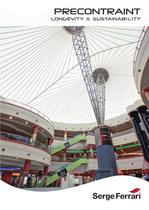
- Brochure Longevity

- Products
- Catalogs
- News & Trends
- Exhibitions
Brochure Longevity

Brochure Longevity
Introduction and Contact Information
The document introduces Serge Ferrari's Précontraint® composite materials, emphasizing their innovative technology, durability, sustainability, and global architectural applications. Contact details and references to official websites and local representatives are provided for further information.
Technology and Material Specifications
Précontraint® technology uniquely tensions composite materials biaxially (warp and weft) during coating, resulting in balanced elongation, minimal crimp, and a smoother surface compared to conventional fabrics tensioned only in the warp direction. The top coat thickness of 240 microns (versus 80 microns in standard fabrics) significantly enhances UV protection, weather resistance, abrasion resistance, mechanical strength, and overall lifespan.
Independent studies confirm that thicker coatings maintain higher residual tensile strength over extended periods (6 to 22 years) across diverse climates, with retention rates between 76% and 100%.
Mechanical and Aesthetic Longevity
Précontraint materials exhibit limited creep due to balanced biaxial tensioning, ensuring consistent mechanical performance and installation quality. Accelerated weathering tests (4000 hours per EN ISO 4892-3) demonstrate excellent resistance to UV, heat, and humidity. Fluotop surface treatments further enhance whiteness retention and microbial resistance (ISO 846 Method A).
Innovations include the “Low Wick” anti-capillarity thread treatment, which prevents moisture wicking, improving membrane appearance and translucency uniformity. The VISU SERVICES tool supports quality control by ensuring consistent color translucency within and between production batches.
Thermal Performance and Energy Efficiency
The Textherm software models air-conditioning power requirements based on membrane type and building parameters. Case studies, such as in Abu Dhabi, show that double membrane systems with LowE coatings can reduce cooling power needs by up to 55% compared to single translucent membranes, demonstrating significant energy savings and improved thermal performance.
Environmental Impact and Sustainability
Life Cycle Assessment (LCA) studies, compliant with ISO 14040 and peer-reviewed, quantify the environmental impacts of Précontraint materials from raw material extraction through end-of-life. The Texyloop® recycling process significantly reduces resource depletion, global warming potential, human toxicity, water consumption, energy use, and waste generation compared to landfill or incineration.
Texyloop® is an operational recycling chain that recovers high-value secondary raw materials compatible with various industrial processes. The process involves grinding, selective dissolution, fiber separation, precipitation, and solvent regeneration to produce second-generation raw materials, thereby supporting circular economy principles and reducing natural resource depletion.
Case Studies and Applications
- Lord’s Cricket Club, London, UK: Installation of Précontraint 1002 T2 over 1200 sqm.
- German Pavilion, Shanghai 2010: Use of Stamisol FT 371 over 21,000 sqm; membrane replaced after 19 years and recycled via Texyloop®.
Certifications and Standards
Précontraint membranes contribute to LEED credits by reducing heat island effect (Solar Reflectance Index >78 for flat roofs), minimizing light pollution, and enhancing daylighting. Environmental claims comply with ISO 14021 standards for accurate and verifiable self-declarations.
Summary of Key Advantages
- Biaxial tensioning ensures uniform mechanical properties and consistent installation.
- Thicker top coats provide superior durability and UV resistance.
- Proven long-term tensile strength retention across diverse climates.
- Advanced surface treatments resist microbial growth and maintain aesthetic quality.
- Thermal simulation tools demonstrate significant energy-saving potential.
- Comprehensive Texyloop® recycling process reduces environmental footprint and supports circular economy.
Additional Resources
Detailed LEED and LCA reports are available upon request. The Textherm software and VISU SERVICES tool assist in design optimization and quality control.
Comparative Life Cycle Assessment (LCA) of Stamisol FT 381
This section presents a comparative LCA focused on end-of-life scenarios for Stamisol FT 381, using 1 sqm as the functional unit.
End-of-Life Scenarios
- Landfill in China
- Incineration in China
- Recycling after shipment from China to Texyloop®
Impact Categories and Metrics
- Energy Consumption: Measured in megajoule equivalents (MJ eq.), reference value 100 MJ eq.
- Global Warming Potential: Kilograms of CO2 equivalent (kg CO2 eq.), reference 5 kg.
- Resource Depletion: Kilograms of antimony equivalent (kg Sb eq.), reference 0.100 kg.
- Human Toxicity: Kilograms of 1,4-dichlorobenzene equivalent (kg 1.4 DB eq.), reference 5 kg.
- Bulk Waste: Quantified as 1 kg of waste.
Summary of Findings
The LCA reveals that recycling reduces landfill waste but incurs additional transportation impacts from China to Texyloop®, affecting energy consumption and emissions. Incineration contributes notably to human toxicity and global warming potential, while landfilling impacts resource depletion and bulk waste accumulation.
Critical Considerations
- Recycling offers environmental benefits by reducing waste and resource depletion despite transport emissions.
- Incineration poses higher risks for toxicity and greenhouse gas emissions.
- Landfilling leads to increased resource depletion and waste accumulation.
This comparative LCA supports informed decision-making for sustainable end-of-life management of building materials.
Catalog excerpts
Sustainability case studies Lord’s Cricket Club – London – UK • Architect: Michael HOPKINS • Engineer: OVE ARUP • Serge Ferrari composite material: Précontraint 1002 T2 • Material area: 1200 sqm Membrane changed after 19 years in service > Dismantled in December 2005 in 1 Day > Re-installed in December 2005 in 7 Days The original membrane was recycled with Texyloop®. Building dismantled after exhibition > Recycling via Texyloop® offers a viable end of life solution for temporary buildings and reducing the impact on the environment. Comparative LCA depending on end-of-life scenarios Functional unit: 1 sqm Stamisol FT 381 Recycling after shipment from China to Texyloop® Landfill in China Energy consumption Incineration in China 100 Megajoul eq. 0 IMPACT 0 IMPACT 0 IMPACT 5 Kg eq. CO2 0 IMPACT 5 Kg 1.4 DB eq. 0 IMPACT GB • Architect: Schmidhuber + Kaindl (Munich) • Serge Ferrari composite material: Stamisol FT 371 • Material area: 21 000 sqm Précontraint is a Serge Ferrari registered trade mark. ref. 1773 • SEPT 2012/ V1.01 • Jean Vasseur Communication German Pavilion – Shanghai 2010 Universal Exhibition Resources depletion 0,100 Kg Sb eq. Human toxicity Bulk waste → Contact → • Headquarters: + 33 (0)4 74 97 41 33 • The Serge Ferrari operational recycling chain • Your local representative: www.sergeferrari.com • A quantified response to combat depletion of natural resources 1 Kg • Secondary raw materials of high intrinsic value compatible with multiple processes www.texyloop.com www.sergeferrari.com Cover photo: Delma Mall, Abu Dhabi (UAE) Inside photos: non contractual photos provided as examples. Photos : Serge Ferrari sas Global warming
Open the catalog to page 1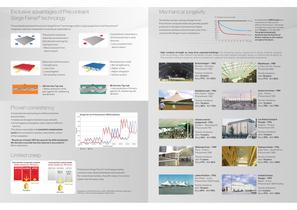
Exclusive advantages of Précontraint Serge Ferrari® technology Mechanical longevity % Residual tensile strength The worldwide patented Precontraint Serge Ferrari® technology confers unique properties to the Precontraint® composite materials compared to conventional coated fabrics. Précontraint composite materials are tensioned in both directions during the coating process. > More consistent from batch to batch. Conventional coated fabrics are tensioned only in warp direction. > Less consistent from batch to batch. Balanced in both directions: > Straight yarns > Low crimp > Low elongation > Far...
Open the catalog to page 2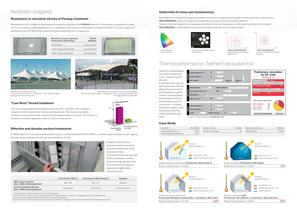
Aesthetic longevity Uniformity of colour per translucency Resistance to microbial attacks of Fluotop treatment Resistance to micro-organisms development is tested in compliance with ISO 846 Method A. The material is exposed for 4 weeks at 29°C in a solution containing various micro-organisms. The material is classified on a scale from 0 (inert: no micro-organisms develoment) up to 5 (100% of the material surface colonised by micro-organisms). Resistance to micro-organisms Précontraint 1202 Fluotop T ISO 846 Method A • Brand New Class 0 inert Classe 0 (inert) • After 13 years (Malaysia) Classe...
Open the catalog to page 3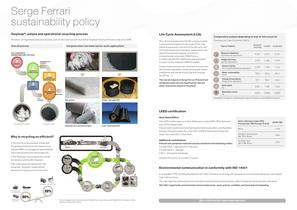
Serge Ferrari sustainability policy Texyloop®: unique and operational recycling process Life Cycle Assessment (LCA) Thanks to an organised collection network, end-of-life materials are recycled at Texyloop® facility at Ferrara, Italy since 2008. Overall process The Life Cycle Assessment (LCA) is measuring the environmental impacts of any product from raw material extraction to the end of the life cycle. Our Life Cycle Assessment has been conducted on the whole Précontraint range by an external environmental consultant, EVEA France, in conformity with ISO 14040 series and submitted to a peer review...
Open the catalog to page 4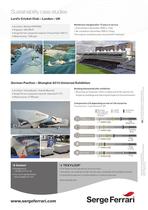
Sustainability case studies Lord’s Cricket Club – London – UK • Architect: Michael HOPKINS • Engineer: OVE ARUP • Serge Ferrari composite material: Précontraint 1002 T2 • Material area: 1200 sqm Membrane changed after 19 years in service > Dismantled in December 2005 in 1 Day > Re-installed in December 2005 in 7 Days The original membrane was recycled with Texyloop®. Building dismantled after exhibition > Recycling via Texyloop® offers a viable end of life solution for temporary buildings and reducing the impact on the environment. Comparative LCA depending on end-of-life scenarios Functional...
Open the catalog to page 5All Serge Ferrari ARCHITECTURE catalogs and technical brochures
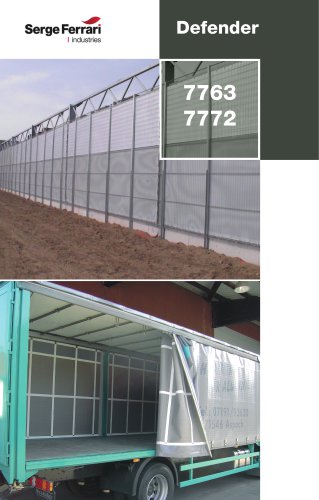 Defender 7763 7772
4 Pages
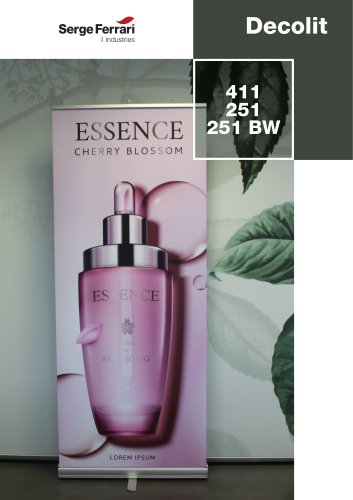 Decolit 411 251 251 BW
2 Pages
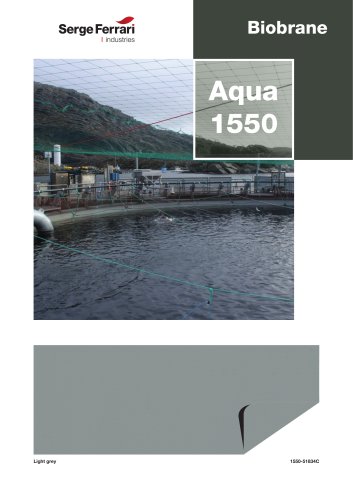 Biobrane Aqua 1550
2 Pages
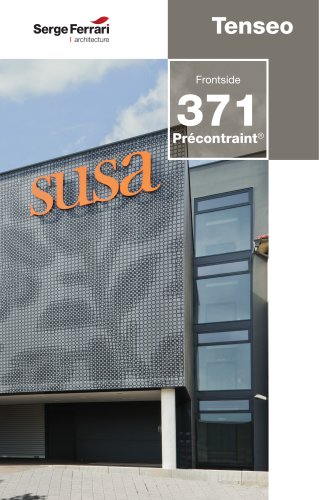 Frontside 371 Précontraint®
4 Pages
 Alphalia Silent Aw
6 Pages
Archived catalogs
 Batyline Iso
6 Pages
 news Monumenta
12 Pages
 FURNITURE & DESIGN
10 Pages
 SPECIAL ISSUE 6 Sports venues
34 Pages
 Sport venues - Latin America
25 Pages
 Grilles Meshes
4 Pages
 Soltis Horizon 86
6 Pages
 Soltis Opaque
6 Pages
 Soltis ProofW96
6 Pages
 STAMSKIN Zen
7 Pages
 Batyline
6 Pages
 Aquaculture
2 Pages
 STAM 3739-4739-5739-6739
2 Pages
 PRECONTRAINT 1002 ACTIV
2 Pages
 BRO-VISUAL-COMMUNICATION
20 Pages
 Flexlight perform 912 S2
1 Page
 Precontraint 1002 S2
2 Pages
 Precontraint TX30
6 Pages
 Frontside View 381
6 Pages
 protecc cover 505
2 Pages
 Frontside Safe P35
4 Pages
 Protect Cover 705
2 Pages
 Flexlight Lodge 6002
2 Pages
 STAMOID EASY
2 Pages
 Stamskin Top FR
4 Pages
 Frontside View 371
4 Pages
 Alphalia Silent Aw 2019
2 Pages
 ARCHITECTURE NEWS SHANGHAI
36 Pages
